Results: systematic weights
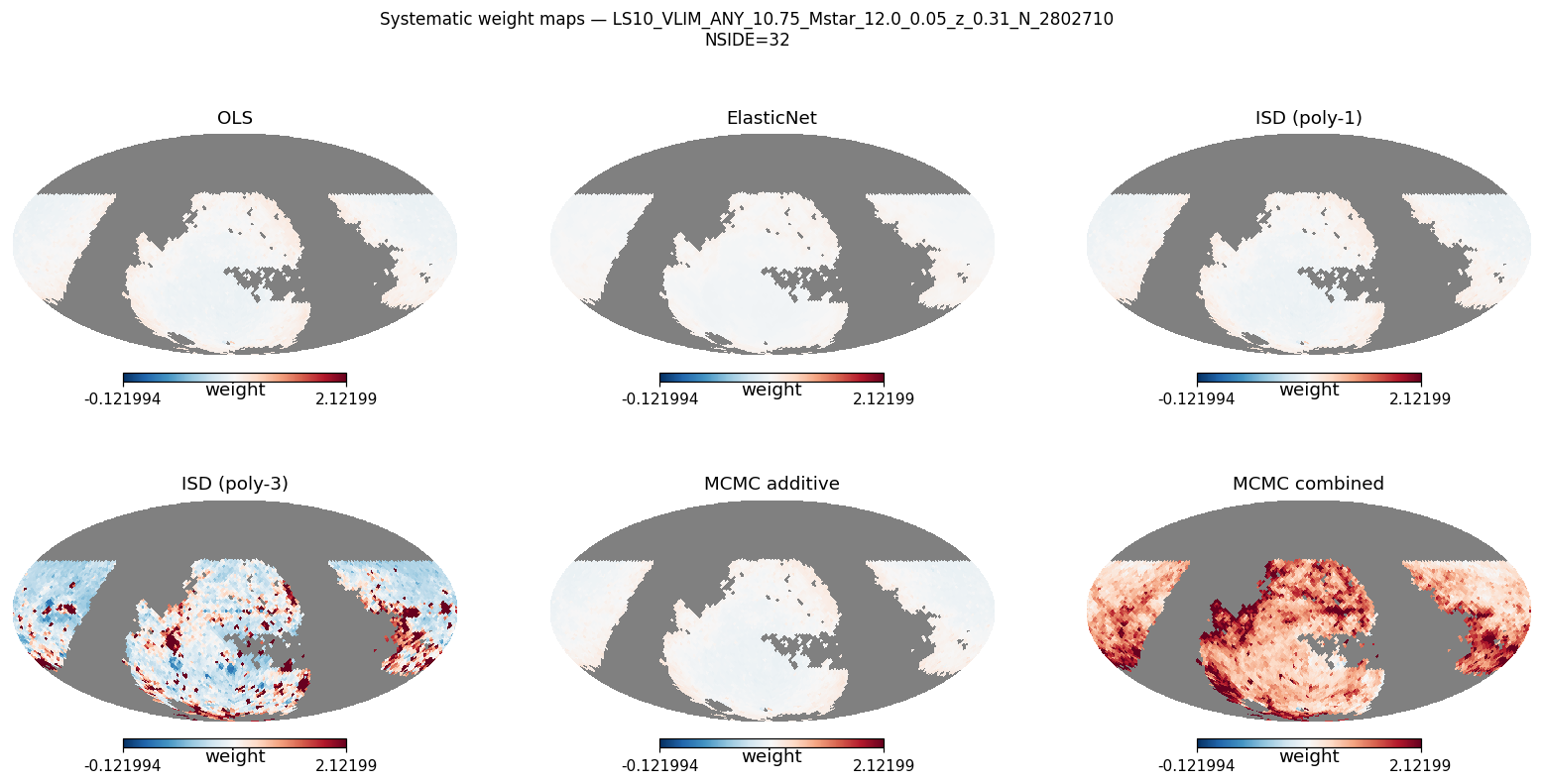
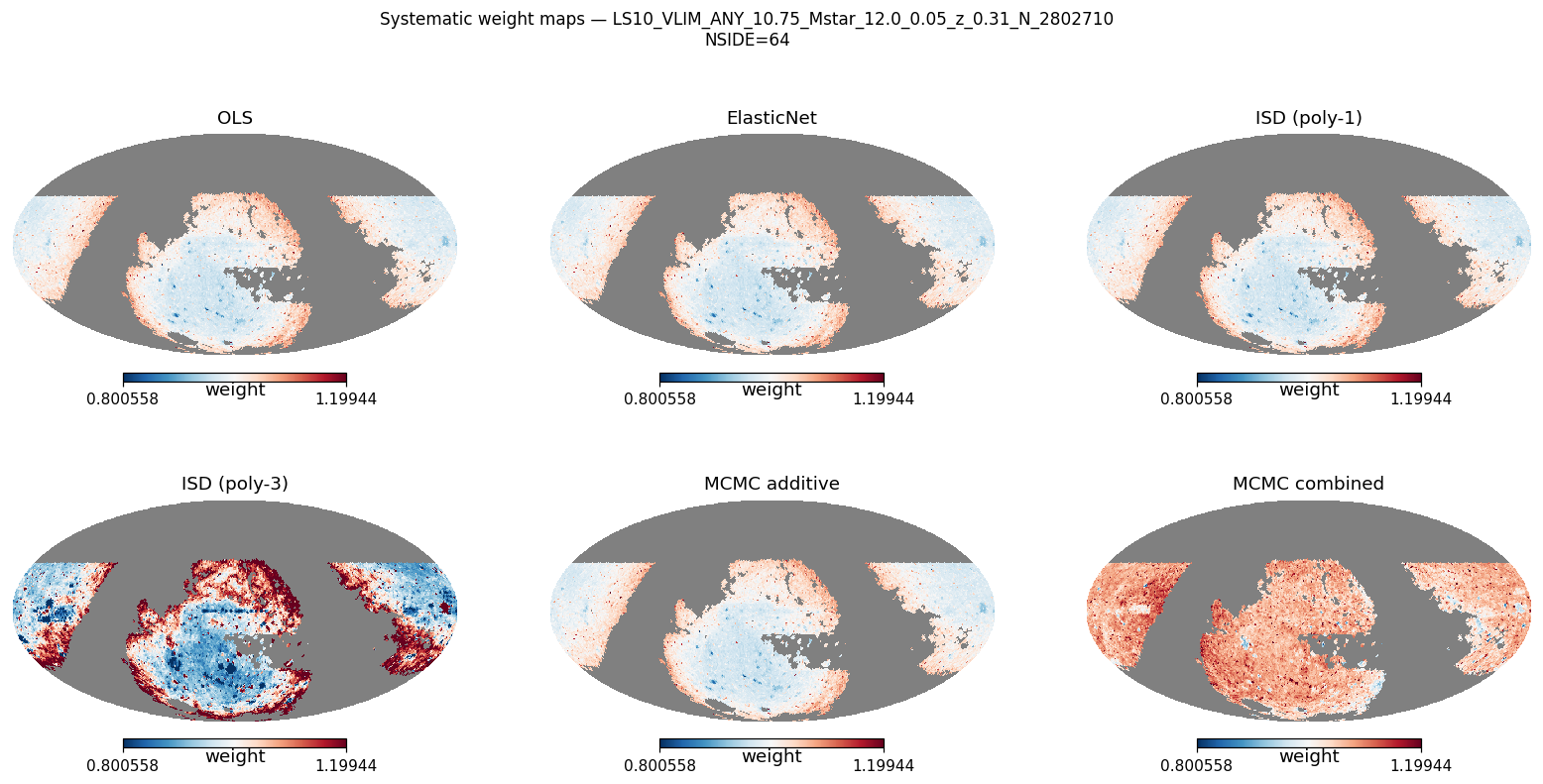
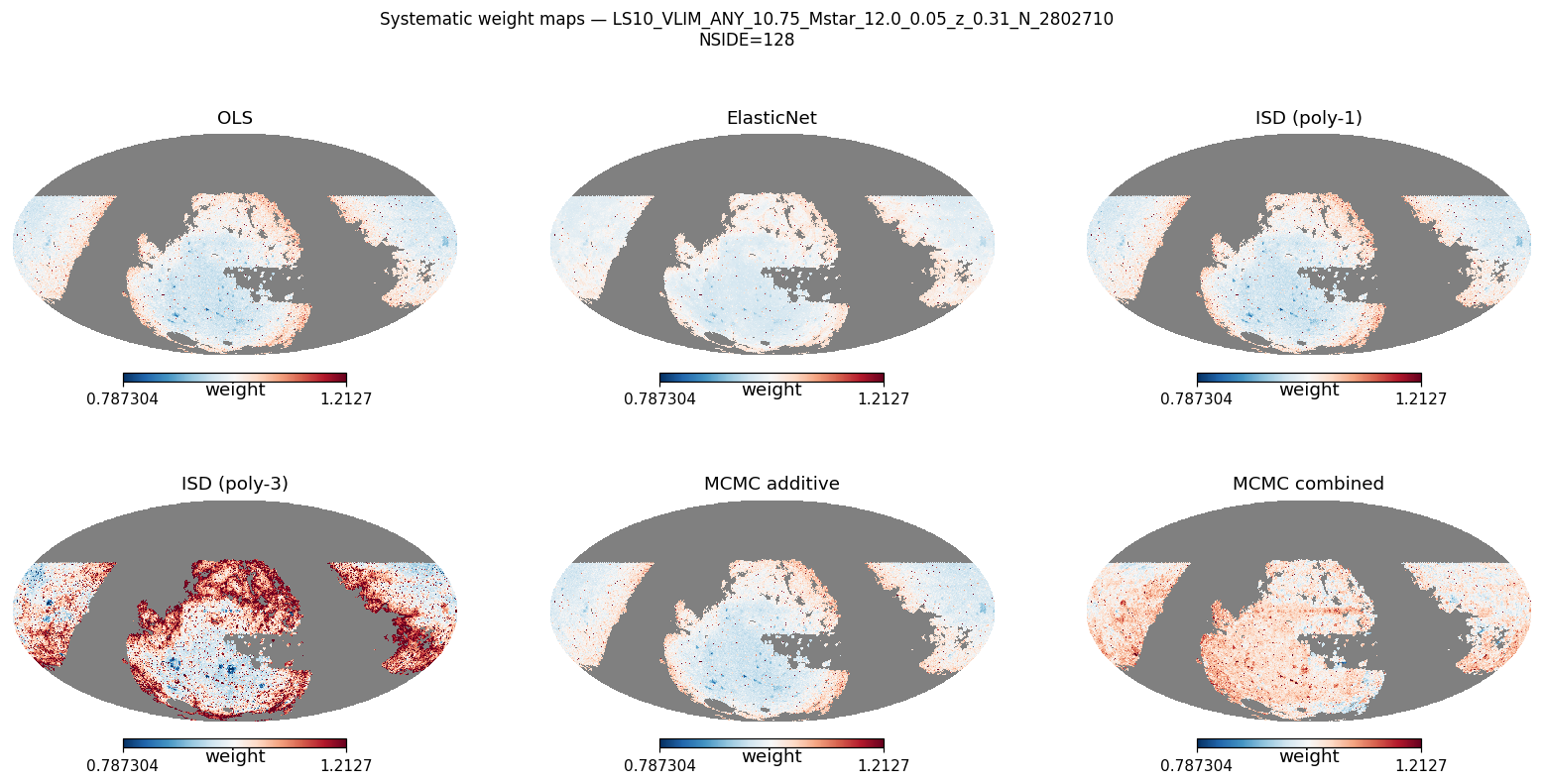
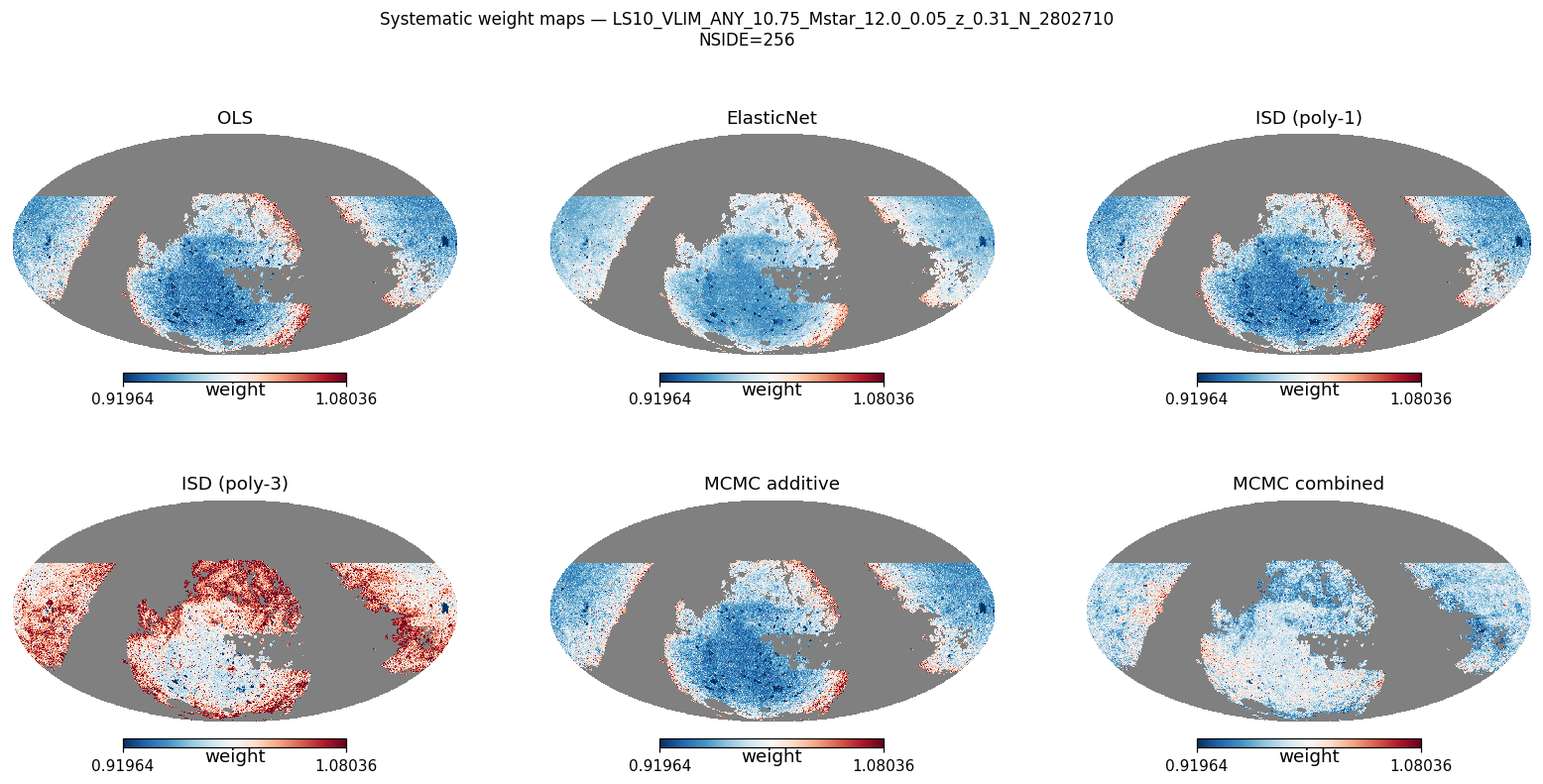
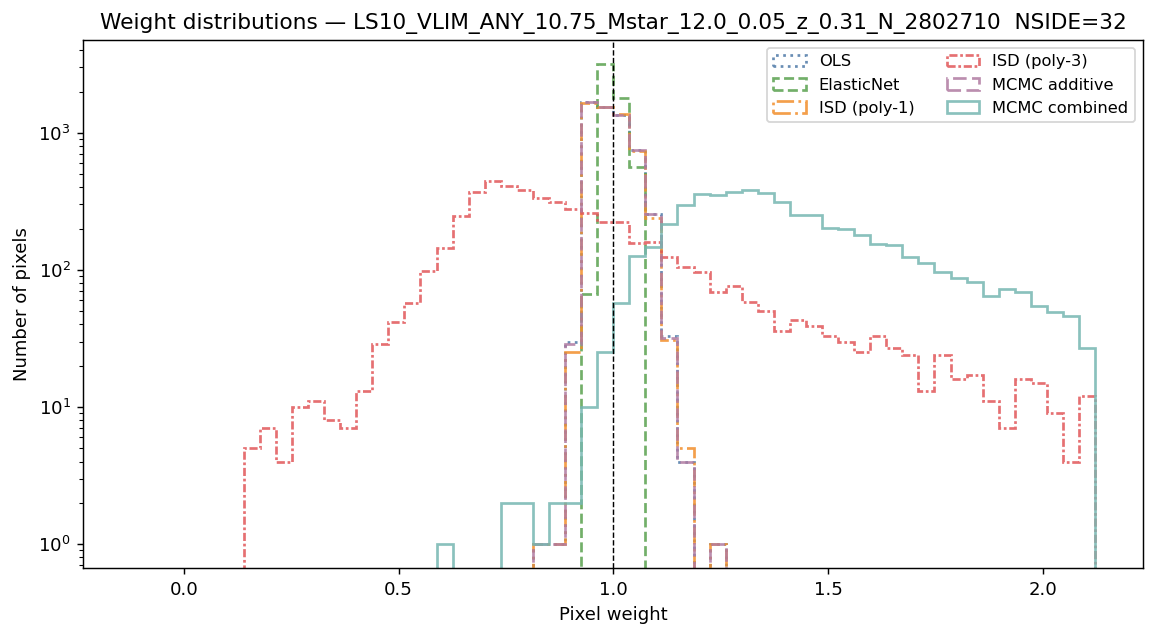
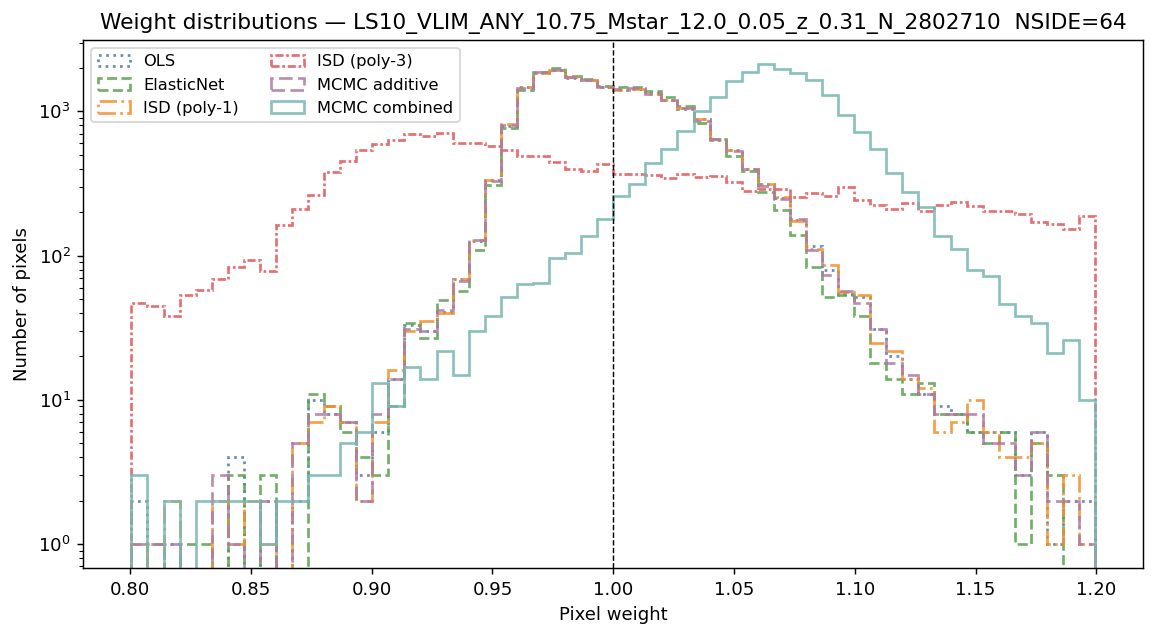
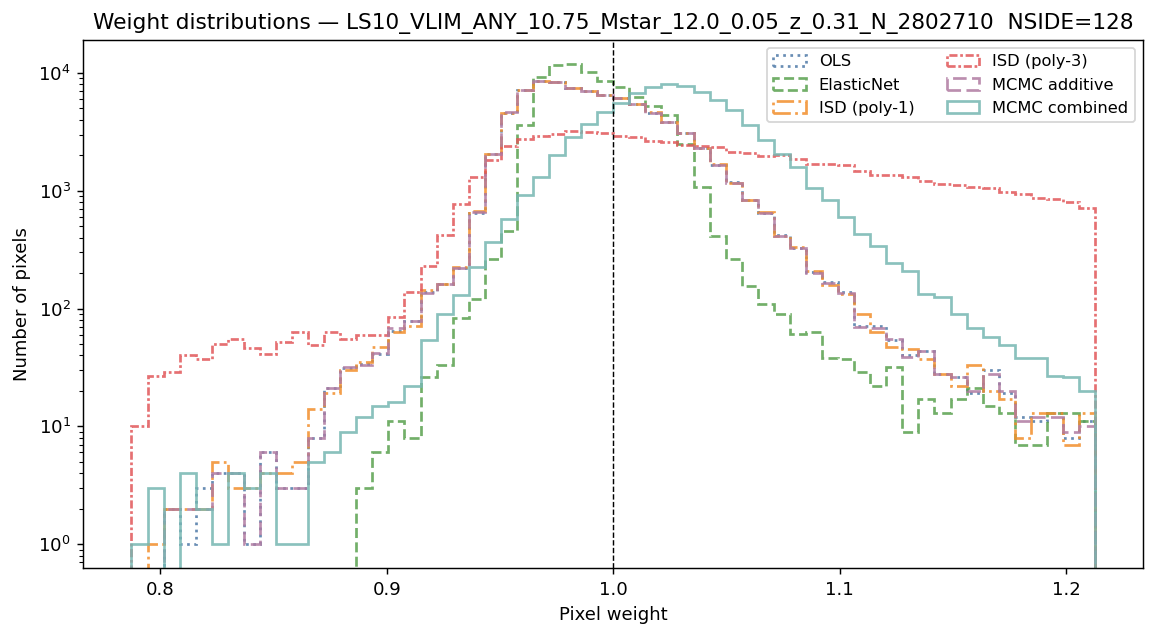
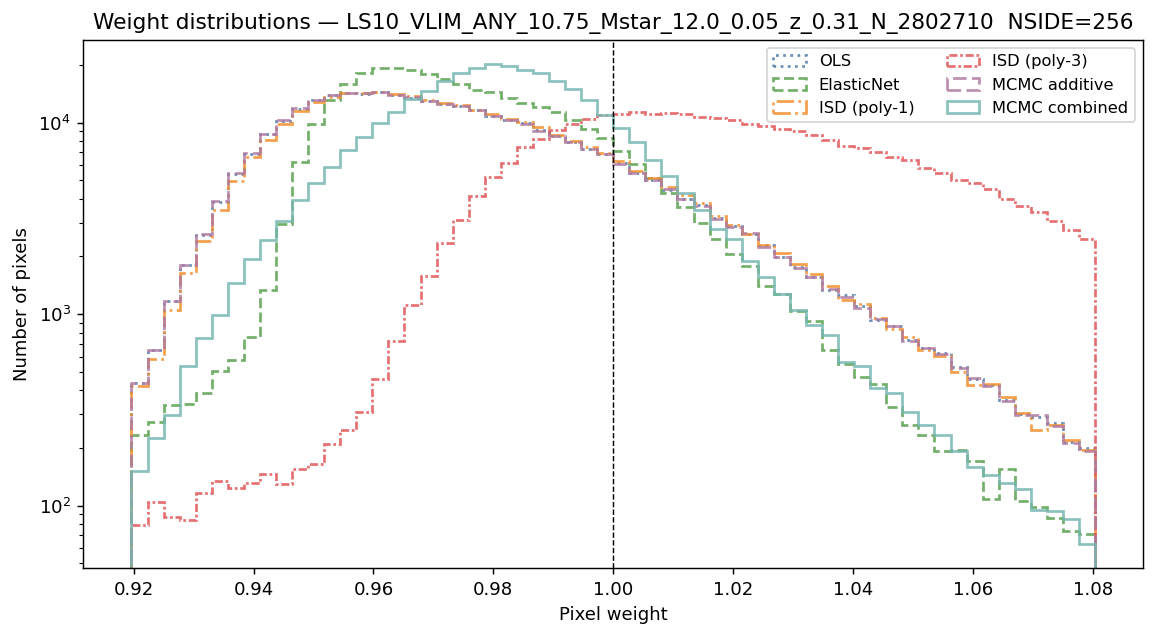
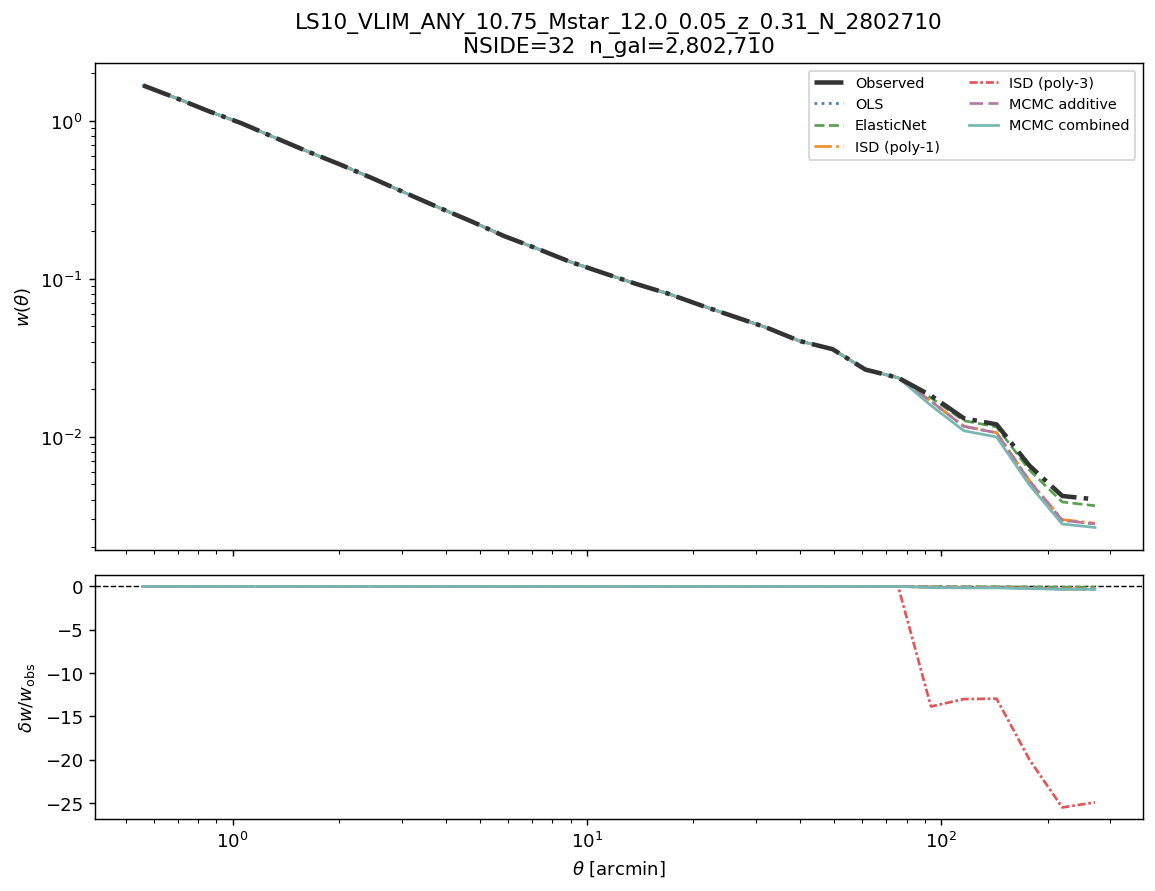
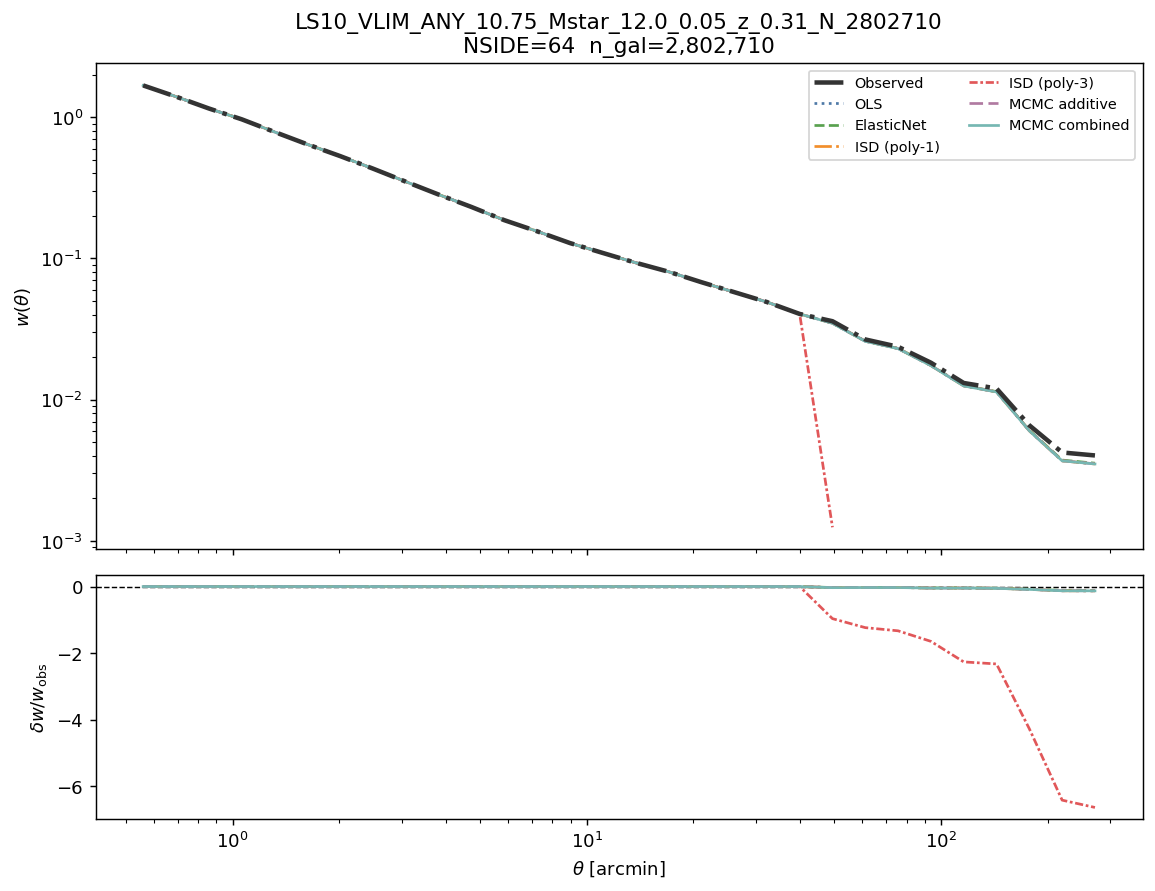
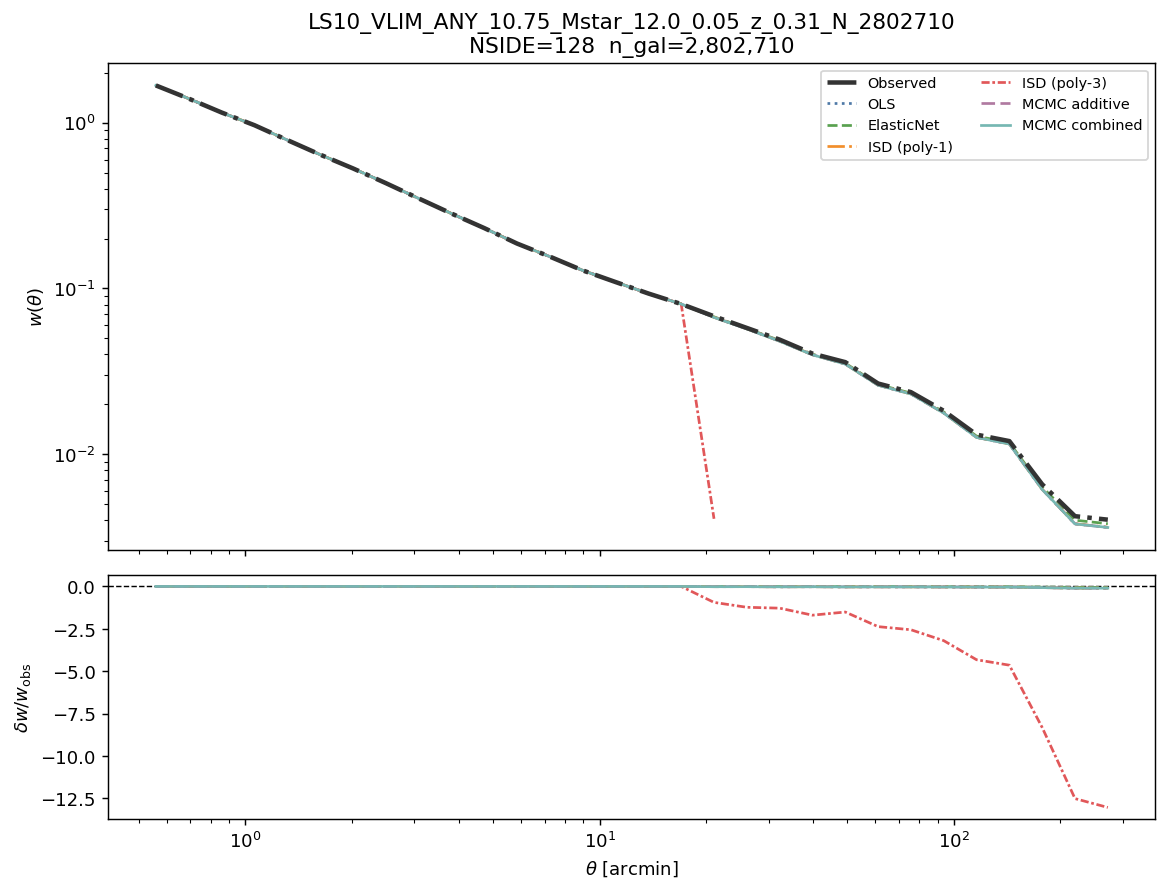
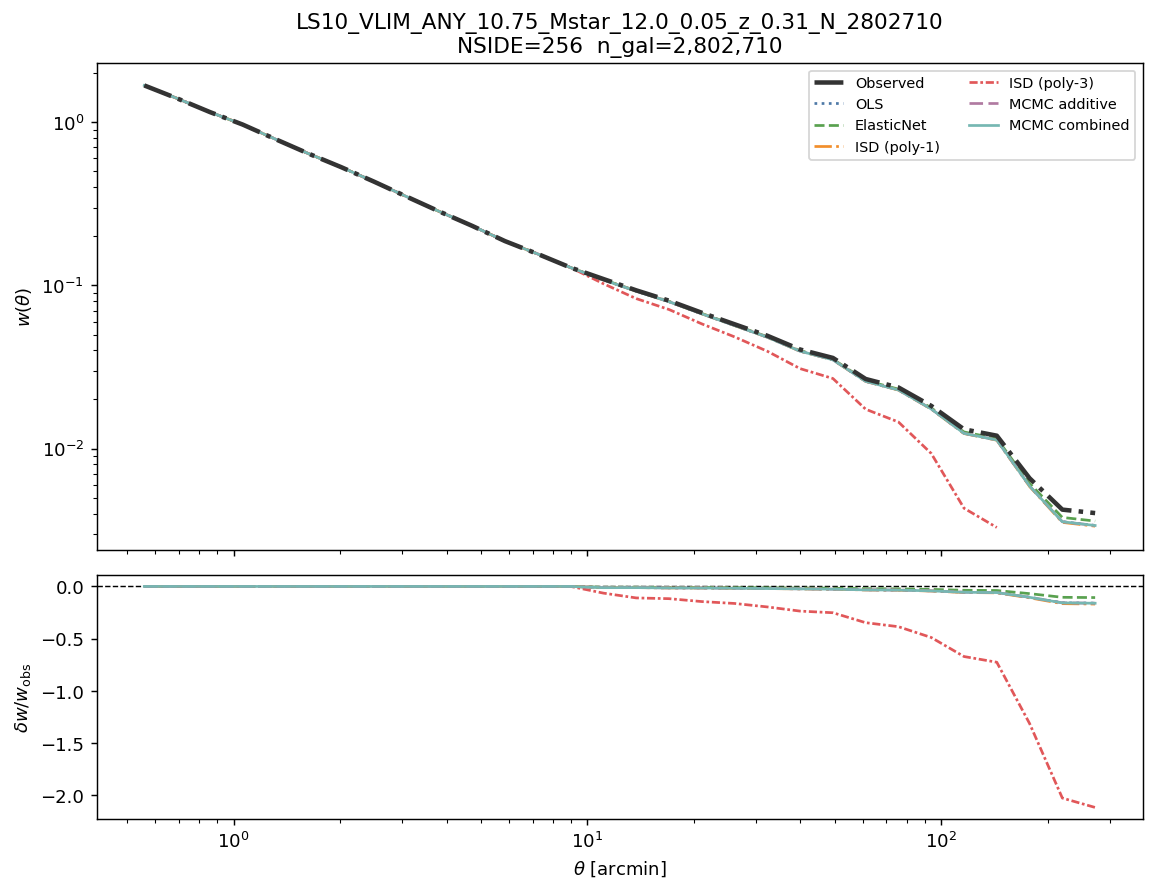
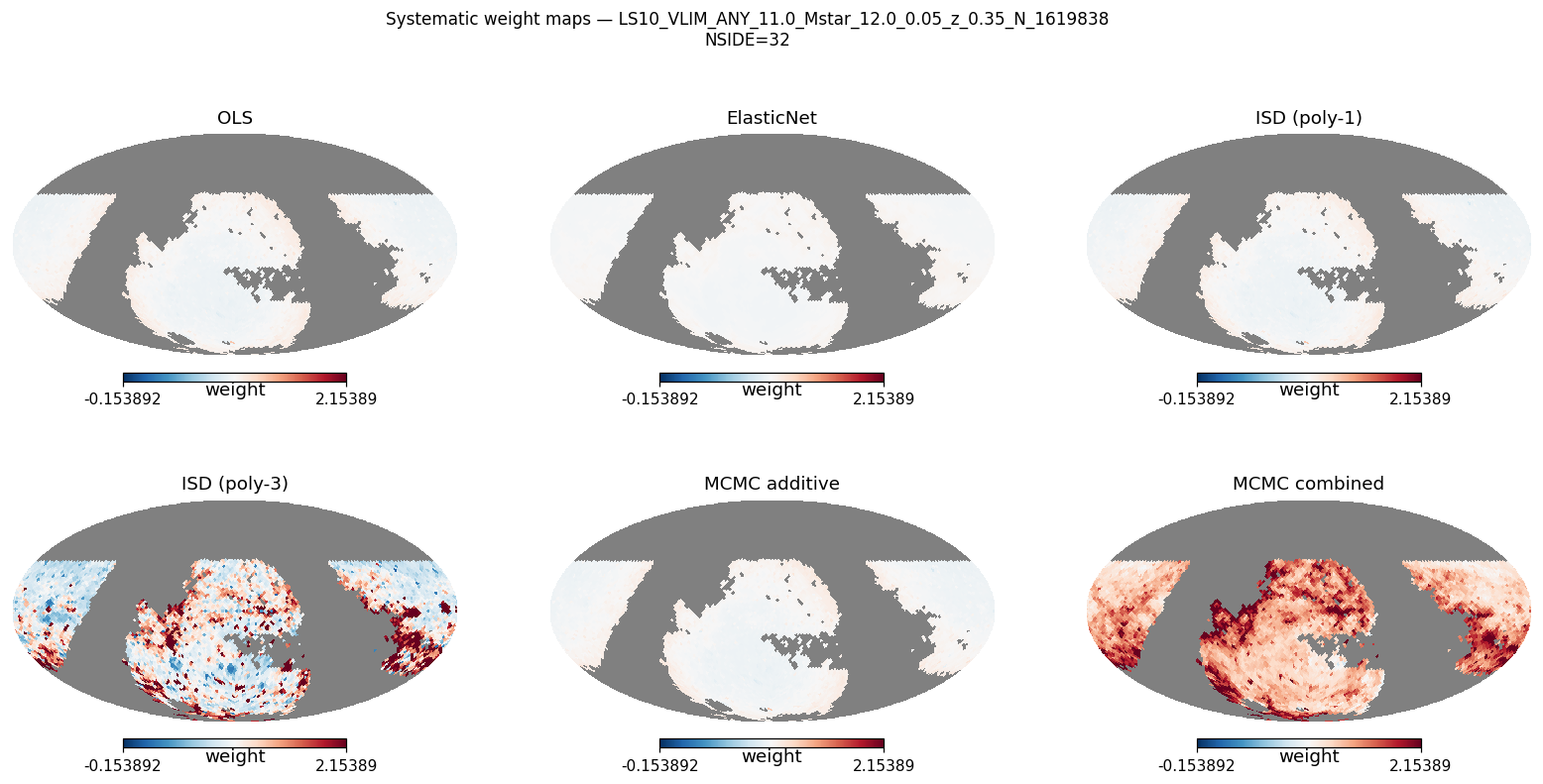
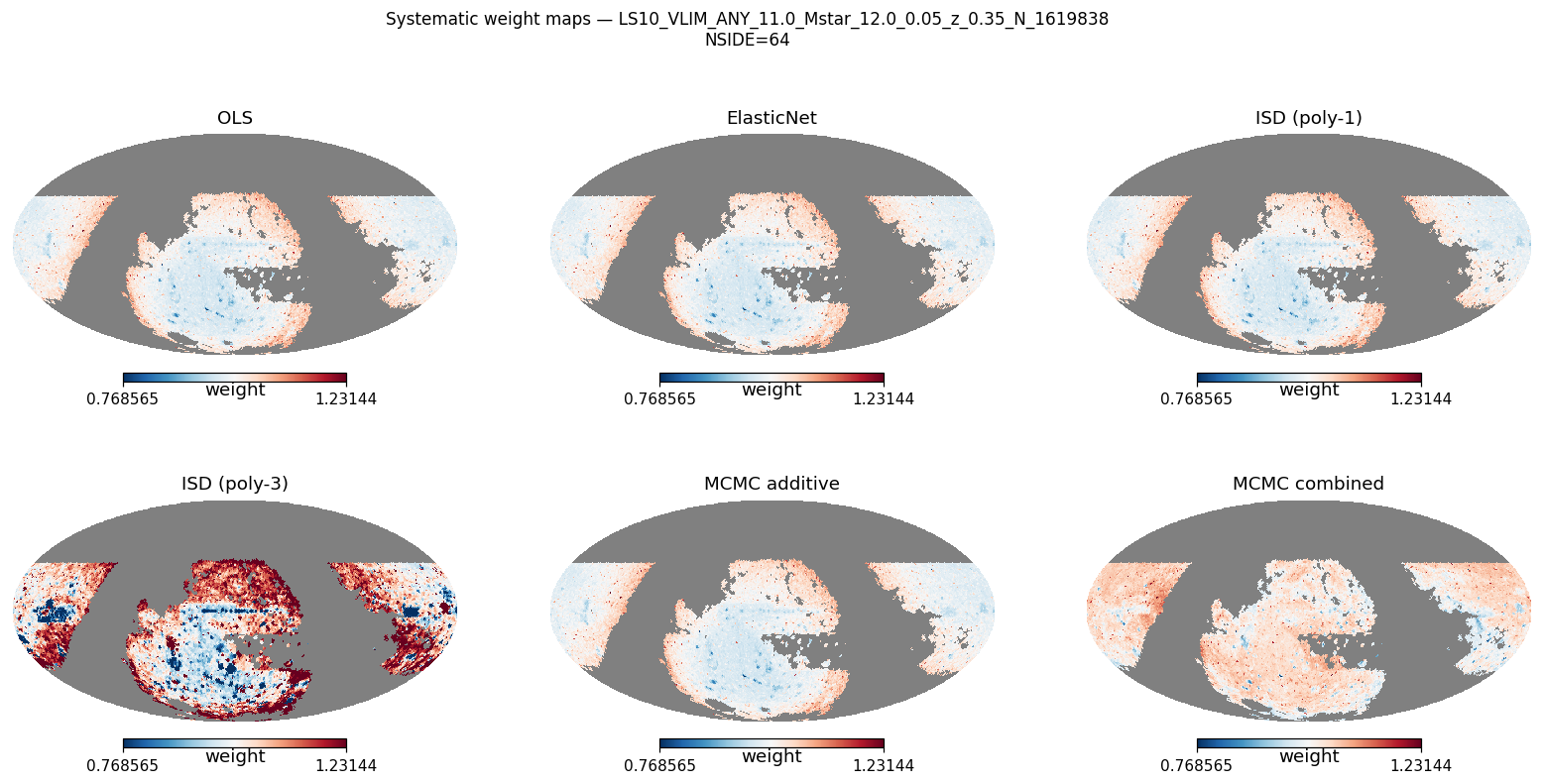
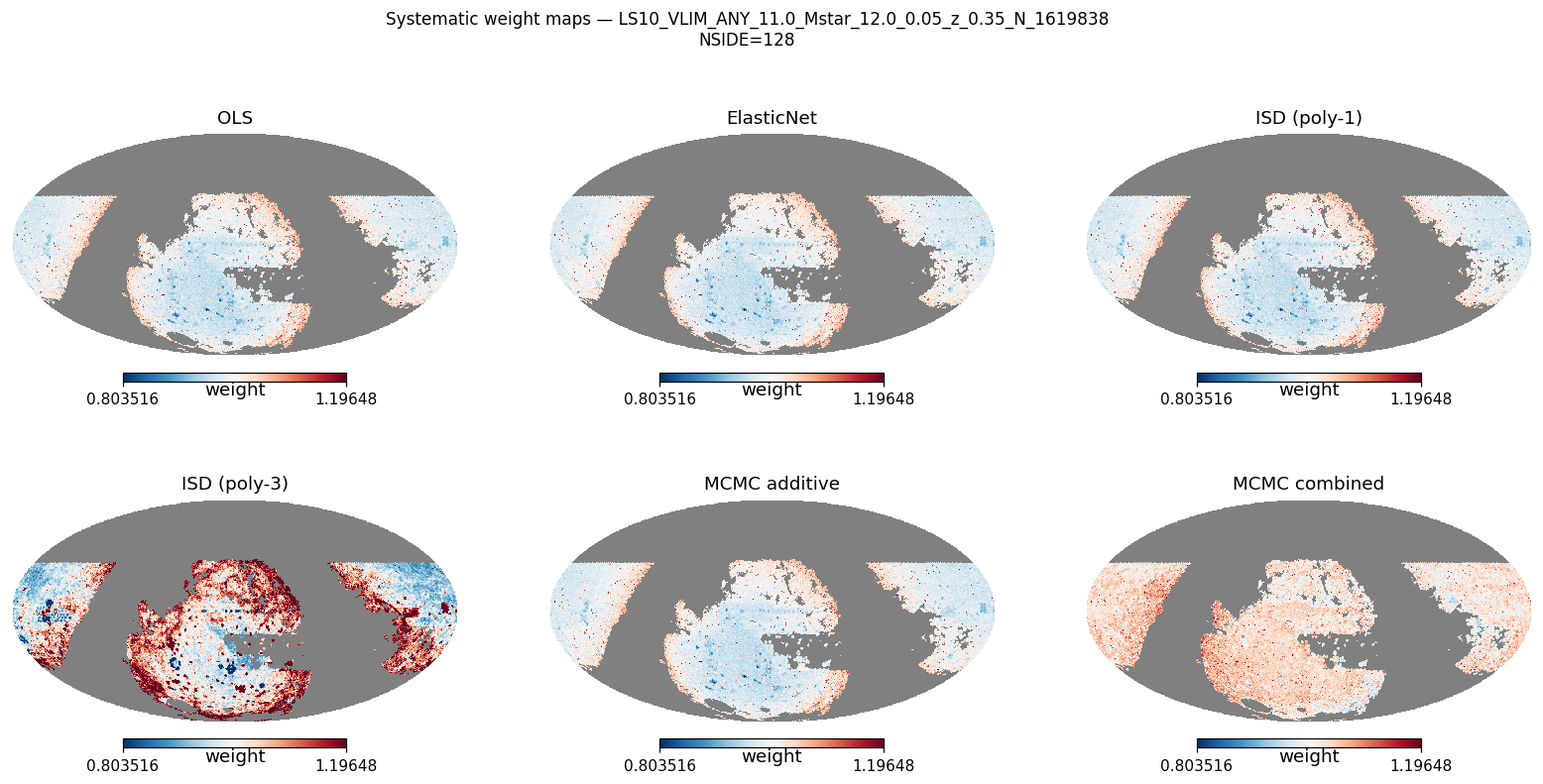
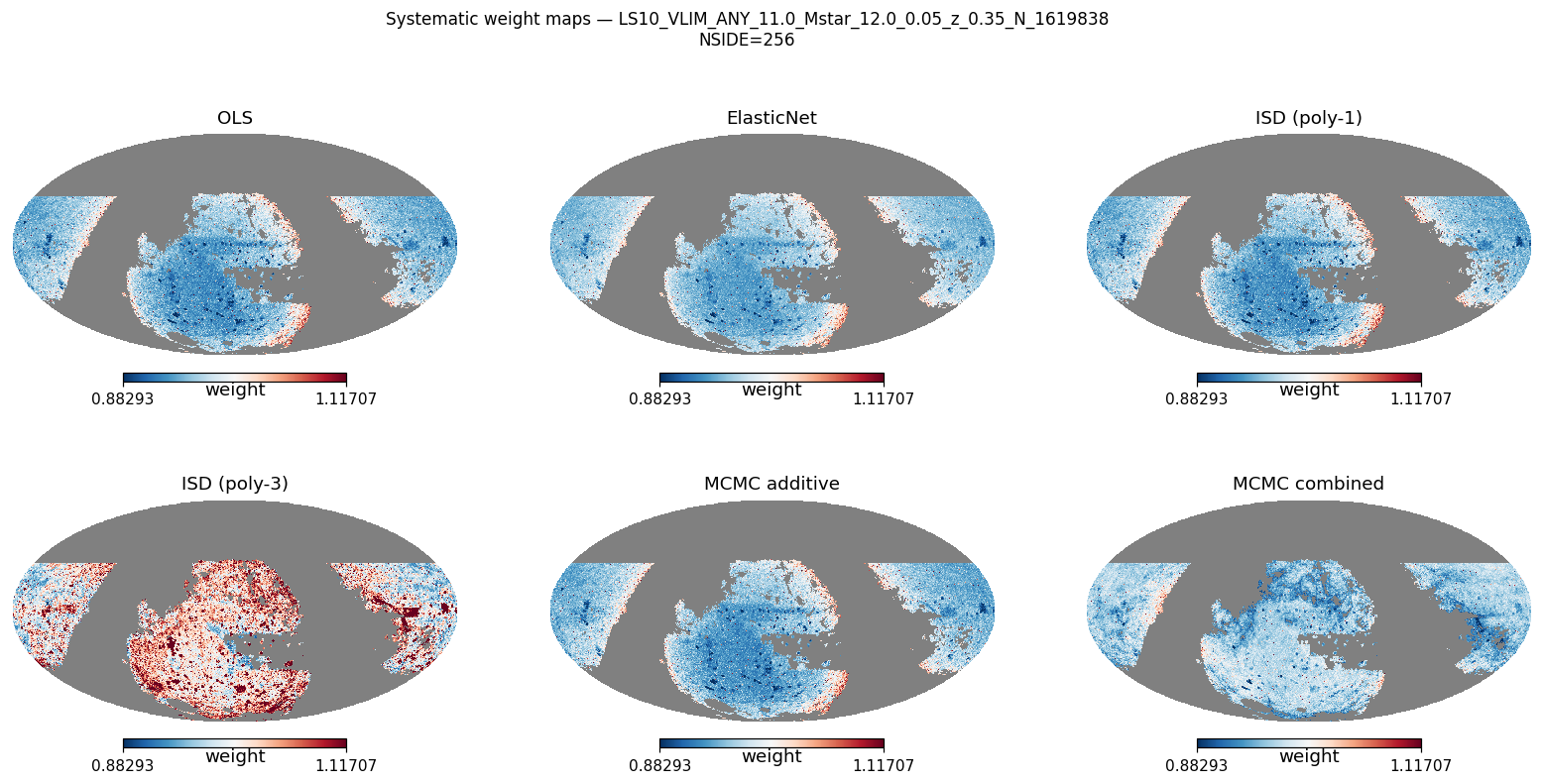
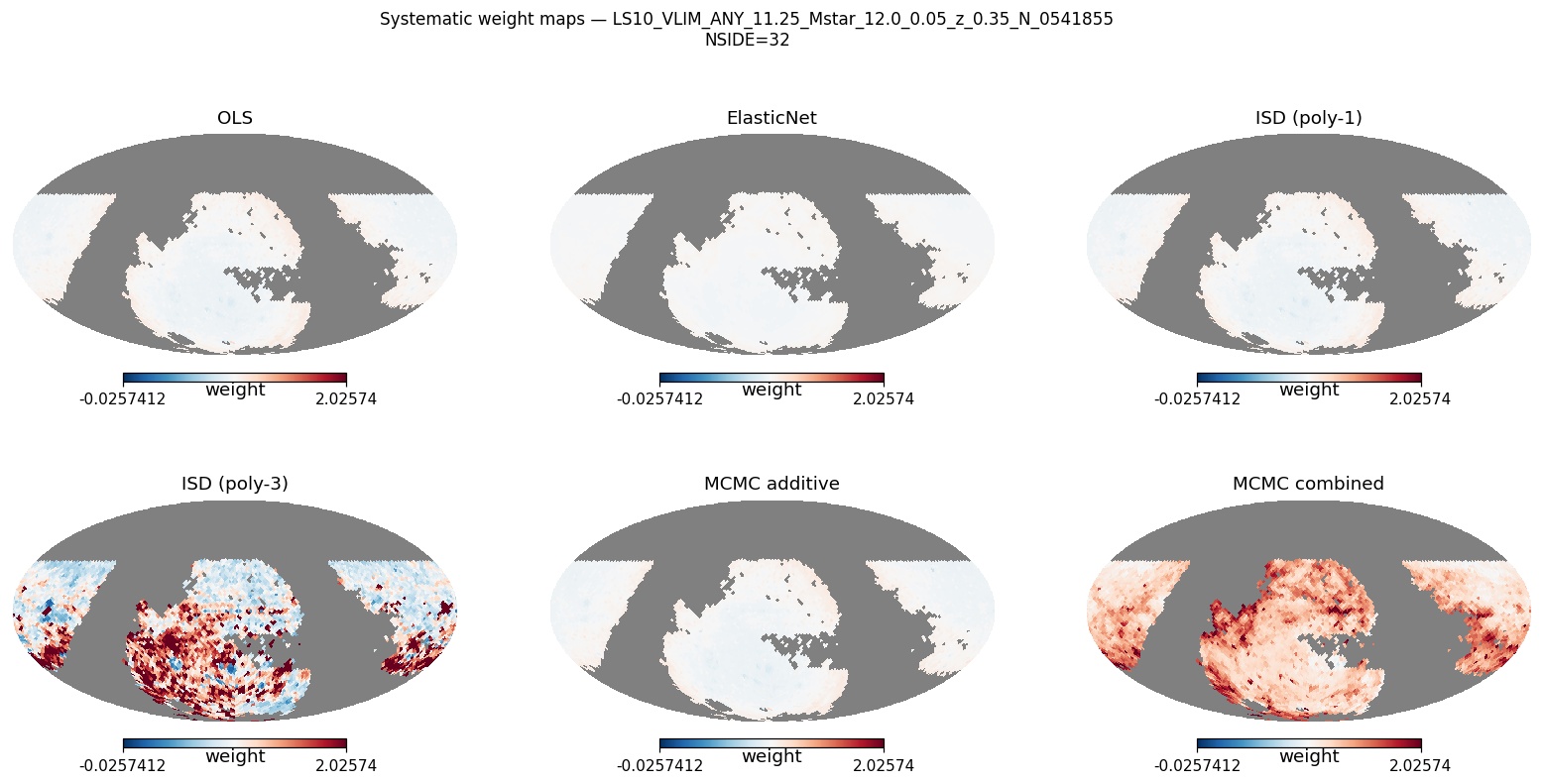
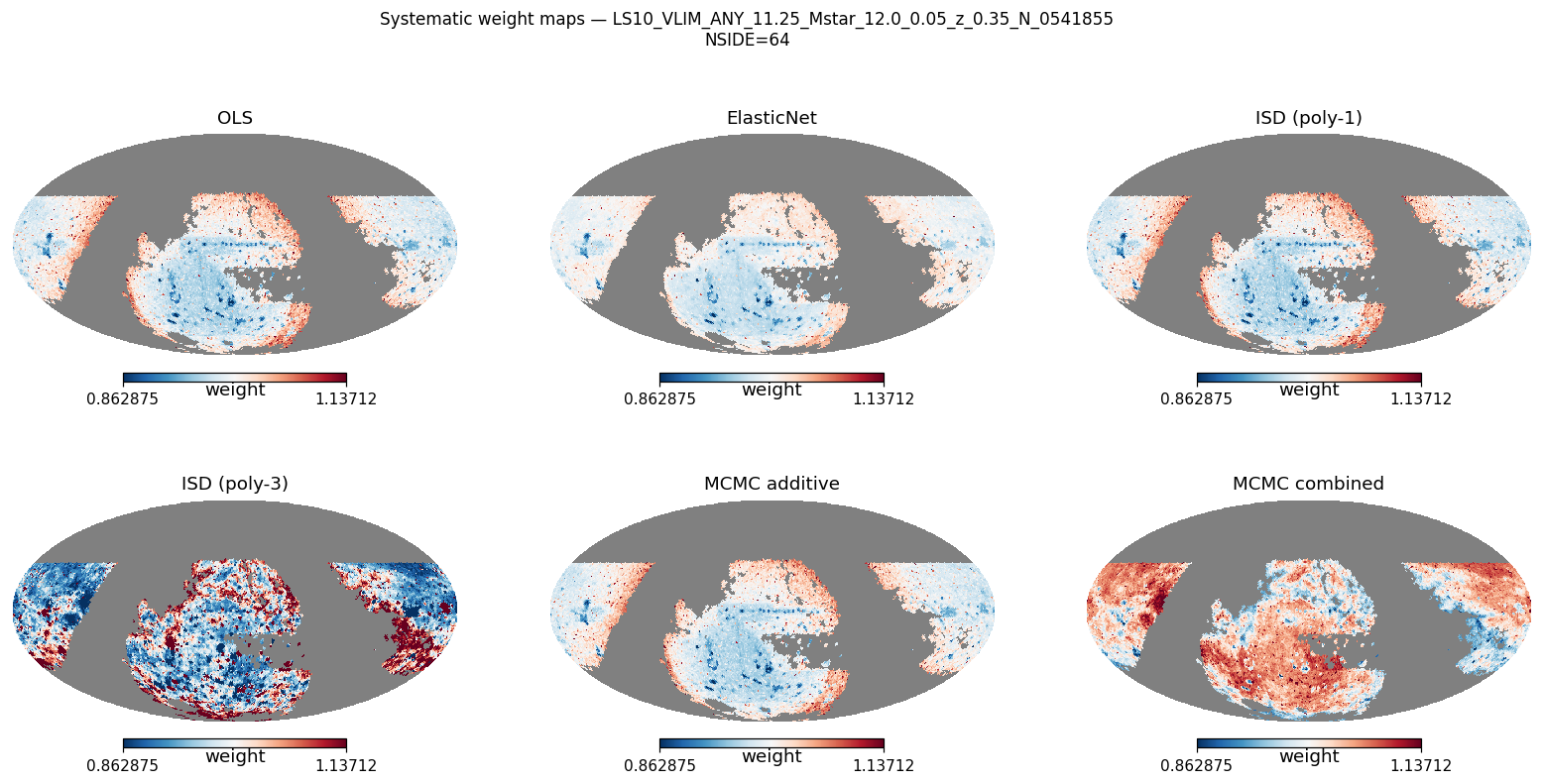
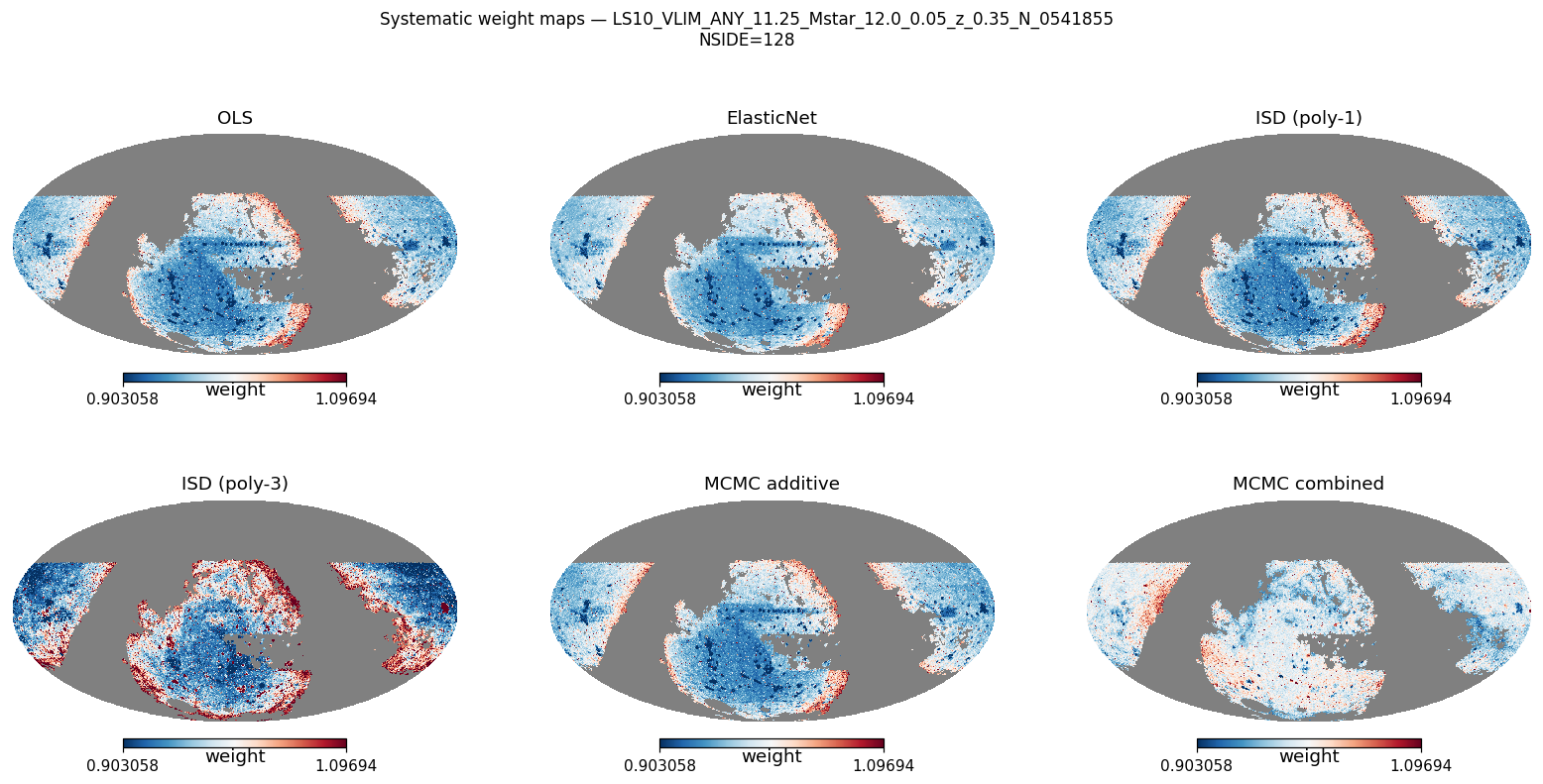
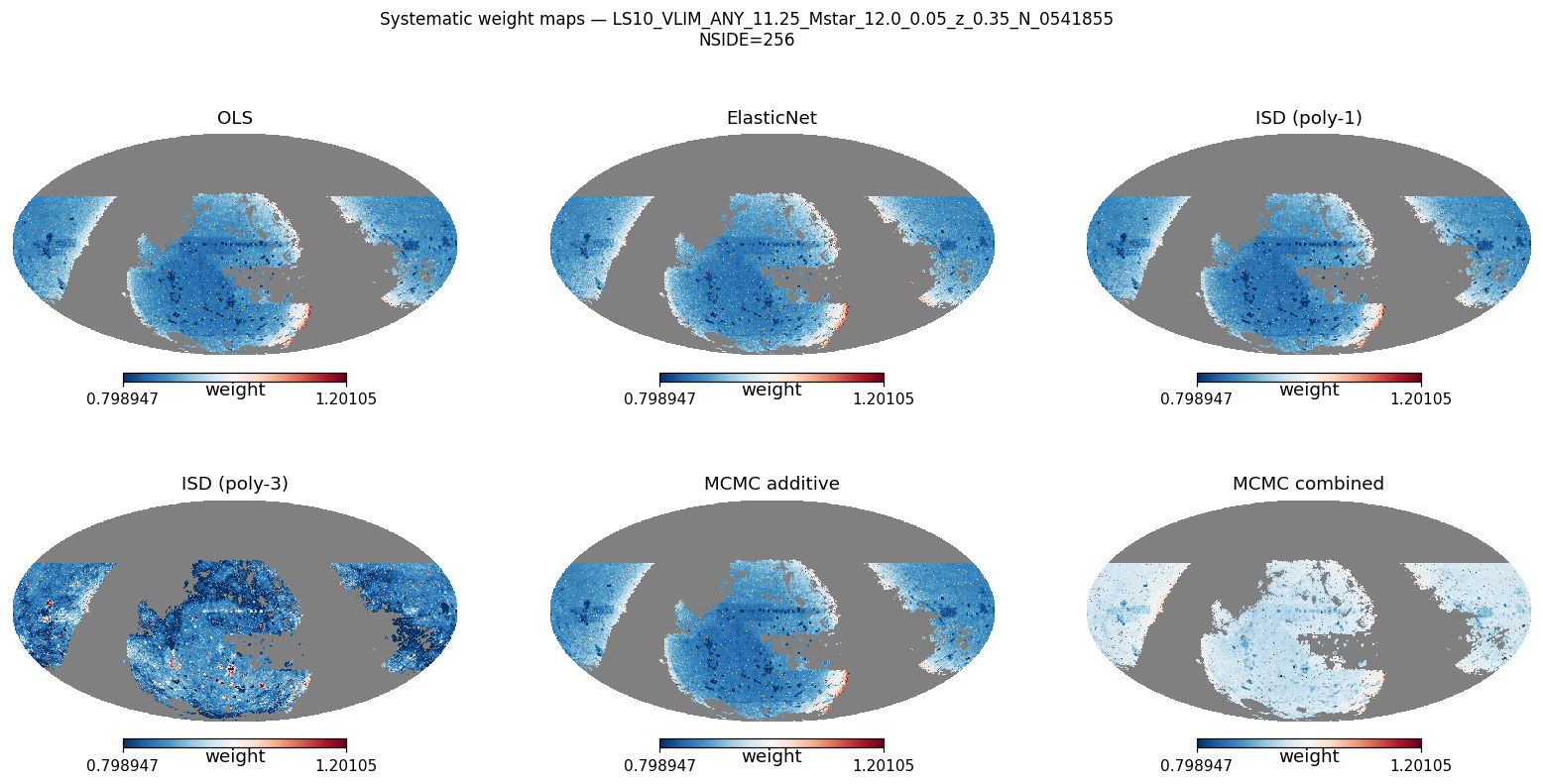
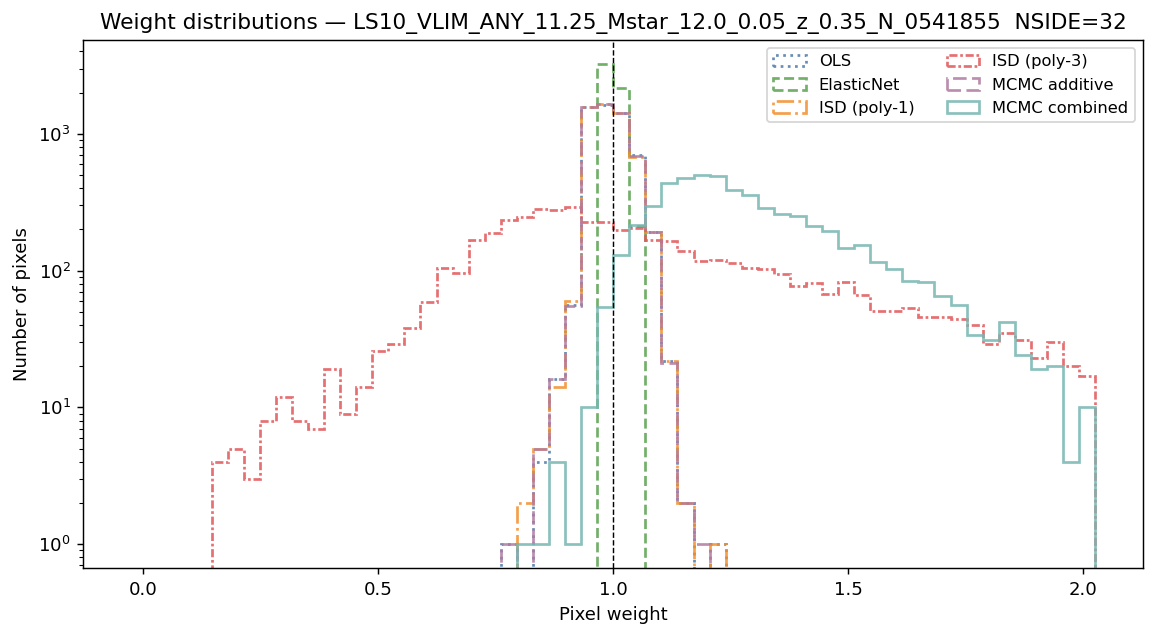
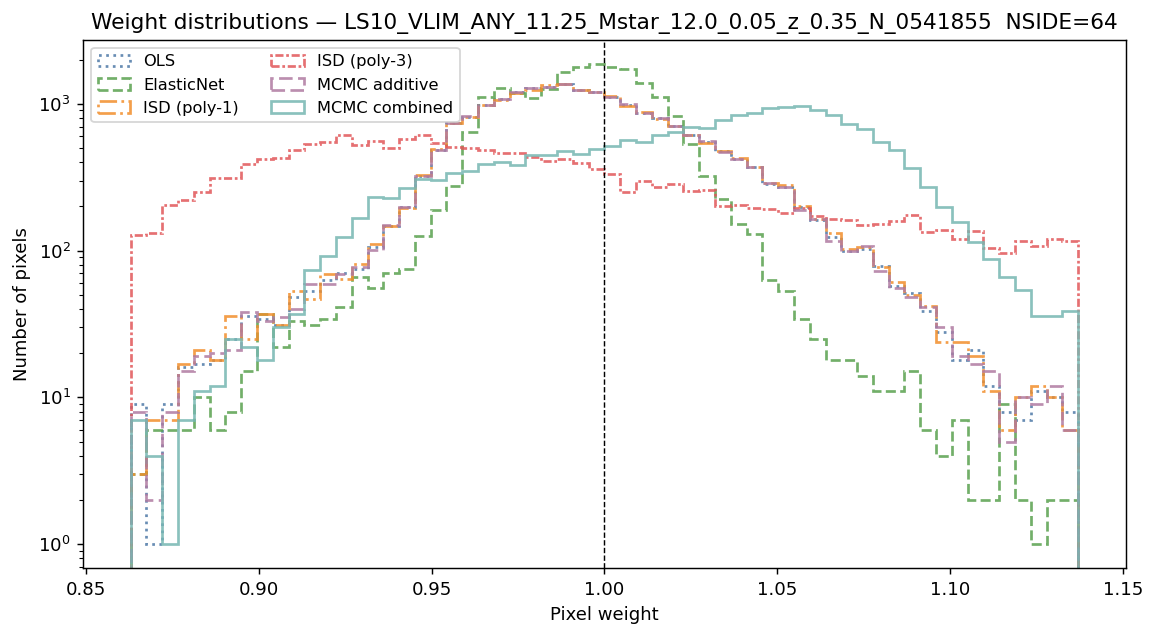
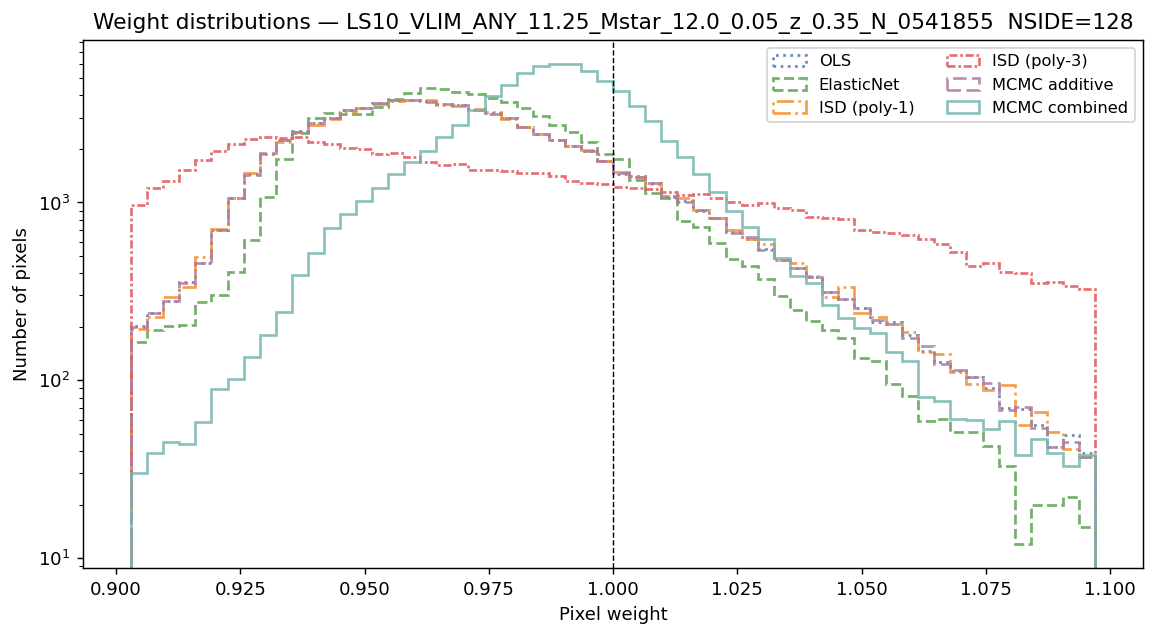
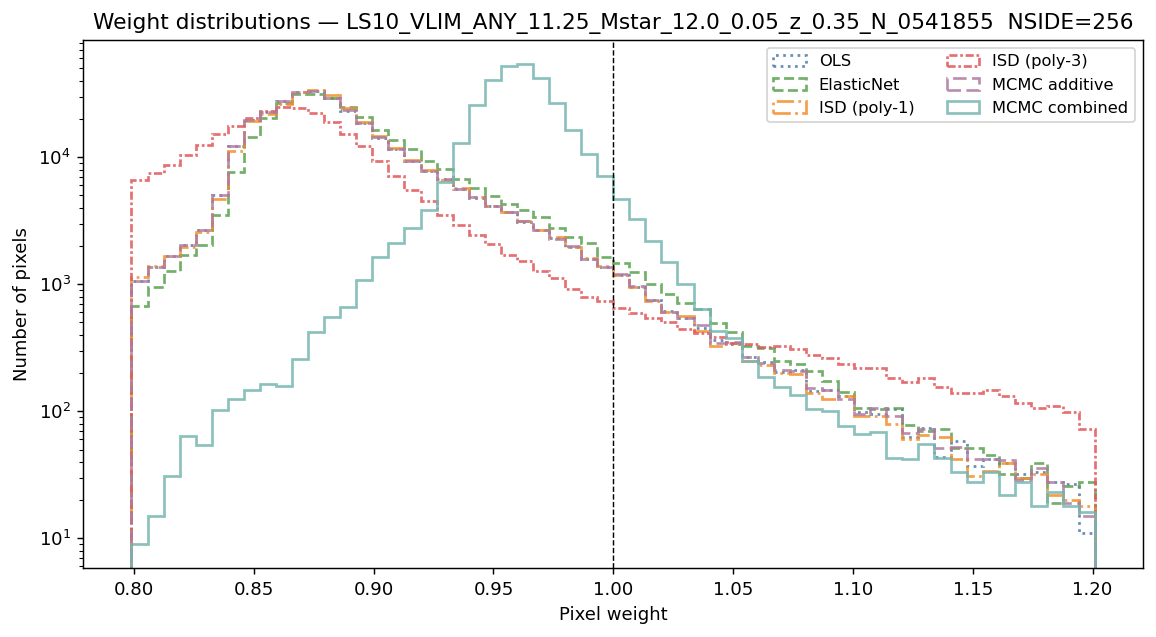
Per-galaxy systematic weights for the nine LS10 BGS volume-limited stellar-mass
threshold samples, computed by scripts/run_ls10_analysis.py with 11
observational templates (GAIA DR3 star density and photometry; LS10 imaging depth,
PSF size, and exposure count) at NSIDE 32, 64, 128, and 256. Use WEIGHT_COMB
(MCMC combined model) for all science analyses; WEIGHT_ADD and WEIGHT_OLS
are provided as cross-checks. See Running the real-data pipeline for how to reproduce these
results.
Run configuration
Parameter |
Value |
|---|---|
Script |
|
NSIDE |
32 (pixel area ≈ 3.36 deg²; 12 288 sky pixels), 64 (≈ 0.84 deg²; 49 152 pixels), 128 (≈ 0.21 deg²; 196 608 pixels), 256 (≈ 0.052 deg²; 786 432 pixels) |
Templates |
11 maps at the analysis NSIDE: GAIA DR3 (nstar_faint, nstar_medium, phot_g/bp/rp_mean_flux) and LS10 imaging (EBV, GALDEPTH_G/R/Z, NOBS_R, PSFSIZE_R) |
Decontamination methods |
OLS, ElasticNet, ISD-1, ISD-3, MCMC-add, MCMC-comb |
MCMC walkers / steps / burn-in |
210 / 1500 / 300 |
Recommended weight column |
|
Additive weight column |
|
OLS weight column |
|
Sample overview
The nine BGS VLIM (volume-limited stellar mass threshold) samples span \(\log_{10}(M_*/M_\odot) \in [9.0, 11.5]\) at their respective redshift limits.
Sample (log M* ≥, z <) |
Ngal |
Nrand |
|---|---|---|
9.0, 0.08 |
523 486 |
2 617 332 |
9.5, 0.12 |
1 432 502 |
7 160 697 |
10.0, 0.18 |
2 759 238 |
13 795 884 |
10.25, 0.22 |
3 308 841 |
16 544 481 |
10.5, 0.26 |
3 263 228 |
16 315 418 |
10.75, 0.31 |
2 802 710 |
14 013 316 |
11.0, 0.35 |
1 619 838 |
8 097 853 |
11.25, 0.35 |
541 855 |
2 708 912 |
11.5, 0.35 |
120 882 |
606 304 |
Goodness-of-fit comparison
The noise parameter \(\hat{{\sigma}}\) measures the residual scatter of the galaxy overdensity after subtracting the systematic model — lower is better. All six methods were run at all four NSIDEs. The bold entry in each row is the method with the lowest \(\hat{\sigma}\) (ISD-3 excluded from the comparison as it is not recommended for science).
NSIDE 32 (pixel area ≈ 3.36 deg², \(N_{\rm pix} ≈ 5 600\)):
Sample (log M* ≥, z <) |
OLS |
ElasticNet |
ISD-1 |
ISD-3 † |
MCMC-add |
MCMC-comb |
|---|---|---|---|---|---|---|
9.0, 0.08 |
0.5474 |
0.5491 |
0.5474 |
2.9223 |
0.5483 |
0.6736 |
9.5, 0.12 |
0.4708 |
0.4757 |
0.4708 |
4.0550 |
0.4714 |
0.6059 |
10.0, 0.18 |
0.3801 |
0.3820 |
0.3801 |
1.0389 |
0.3805 |
0.4224 |
10.25, 0.22 |
0.3417 |
0.3436 |
0.3417 |
0.8803 |
0.3421 |
0.3903 |
10.5, 0.26 |
0.3238 |
0.3252 |
0.3238 |
0.6415 |
0.3241 |
0.3731 |
10.75, 0.31 |
0.3057 |
0.3069 |
0.3057 |
0.6315 |
0.3061 |
0.3982 |
11.0, 0.35 |
0.2971 |
0.2985 |
0.2971 |
0.7040 |
0.2974 |
0.3927 |
11.25, 0.35 |
0.3308 |
0.3319 |
0.3308 |
0.7031 |
0.3313 |
0.4062 |
11.5, 0.35 |
0.4451 |
0.4453 |
0.4451 |
2.1206 |
0.4455 |
0.5862 |
NSIDE 64 (pixel area ≈ 0.84 deg², \(N_{\rm pix} ≈ 21 600\)):
Sample (log M* ≥, z <) |
OLS |
ElasticNet |
ISD-1 |
ISD-3 † |
MCMC-add |
MCMC-comb |
|---|---|---|---|---|---|---|
9.0, 0.08 |
0.6760 |
0.6768 |
0.6760 |
3.2810 |
0.6762 |
0.7511 |
9.5, 0.12 |
0.5239 |
0.5239 |
0.5239 |
0.7911 |
0.5240 |
0.5545 |
10.0, 0.18 |
0.3969 |
0.3982 |
0.3969 |
0.7254 |
0.3969 |
0.3817 |
10.25, 0.22 |
0.3434 |
0.3434 |
0.3434 |
0.9979 |
0.3435 |
0.3343 |
10.5, 0.26 |
0.3089 |
0.3089 |
0.3089 |
1.0787 |
0.3089 |
0.3104 |
10.75, 0.31 |
0.2831 |
0.2831 |
0.2831 |
0.4658 |
0.2831 |
0.3009 |
11.0, 0.35 |
0.2974 |
0.2974 |
0.2974 |
0.4975 |
0.2975 |
0.3052 |
11.25, 0.35 |
0.3842 |
0.3846 |
0.3842 |
0.6196 |
0.3843 |
0.3930 |
11.5, 0.35 |
0.6438 |
0.6440 |
0.6438 |
1.0507 |
0.6441 |
0.7104 |
NSIDE 128 (pixel area ≈ 0.21 deg², \(N_{\rm pix} ≈ 84 000\)):
Sample (log M* ≥, z <) |
OLS |
ElasticNet |
ISD-1 |
ISD-3 † |
MCMC-add |
MCMC-comb |
|---|---|---|---|---|---|---|
9.0, 0.08 |
0.9909 |
0.9912 |
0.9910 |
1.4628 |
0.9911 |
1.0288 |
9.5, 0.12 |
0.7458 |
0.7458 |
0.7458 |
0.8344 |
0.7458 |
0.7408 |
10.0, 0.18 |
0.5606 |
0.5616 |
0.5606 |
0.6472 |
0.5607 |
0.5337 |
10.25, 0.22 |
0.4900 |
0.4900 |
0.4900 |
0.5192 |
0.4900 |
0.4739 |
10.5, 0.26 |
0.4477 |
0.4477 |
0.4477 |
0.5027 |
0.4478 |
0.4514 |
10.75, 0.31 |
0.4190 |
0.4194 |
0.4190 |
0.9265 |
0.4191 |
0.4300 |
11.0, 0.35 |
0.4580 |
0.4580 |
0.4580 |
0.4899 |
0.4580 |
0.4716 |
11.25, 0.35 |
0.6405 |
0.6406 |
0.6405 |
0.6454 |
0.6406 |
0.6329 |
11.5, 0.35 |
1.3802 |
1.3803 |
1.3802 |
1.4249 |
1.3803 |
1.4304 |
NSIDE 256 (pixel area ≈ 0.052 deg², \(N_{\rm pix} ≈ 330 000\)):
Sample (log M* ≥, z <) |
OLS |
ElasticNet |
ISD-1 |
ISD-3 † |
MCMC-add |
MCMC-comb |
|---|---|---|---|---|---|---|
9.0, 0.08 |
1.6568 |
1.6570 |
1.6568 |
1.7204 |
1.6568 |
1.6008 |
9.5, 0.12 |
1.1021 |
1.1023 |
1.1022 |
1.1371 |
1.1022 |
1.0519 |
10.0, 0.18 |
0.8173 |
0.8173 |
0.8173 |
0.8355 |
0.8173 |
0.7855 |
10.25, 0.22 |
0.7212 |
0.7212 |
0.7212 |
0.7267 |
0.7212 |
0.6964 |
10.5, 0.26 |
0.6676 |
0.6676 |
0.6677 |
0.6727 |
0.6677 |
0.6593 |
10.75, 0.31 |
0.6422 |
0.6423 |
0.6422 |
0.6894 |
0.6422 |
0.6305 |
11.0, 0.35 |
0.7557 |
0.7558 |
0.7558 |
0.7786 |
0.7558 |
0.7256 |
11.25, 0.35 |
1.2602 |
1.2603 |
1.2602 |
1.3131 |
1.2602 |
1.2117 |
11.5, 0.35 |
2.1098 |
2.1098 |
2.1098 |
2.1189 |
2.1098 |
2.0211 |
† ISD-3 uses a degree-3 polynomial expansion. It is ill-conditioned at all resolutions: \(\hat{\sigma}_{\rm ISD3} > 1\) for sparse/high-NSIDE samples, and worse than OLS in virtually every case. Do not use ISD-3 weights.
Key observations:
OLS and ISD-1 give nearly identical \(\hat{\sigma}\) (differences < 0.001) at all resolutions, consistent with ISD-1 converging to the OLS solution for linearly contaminated data.
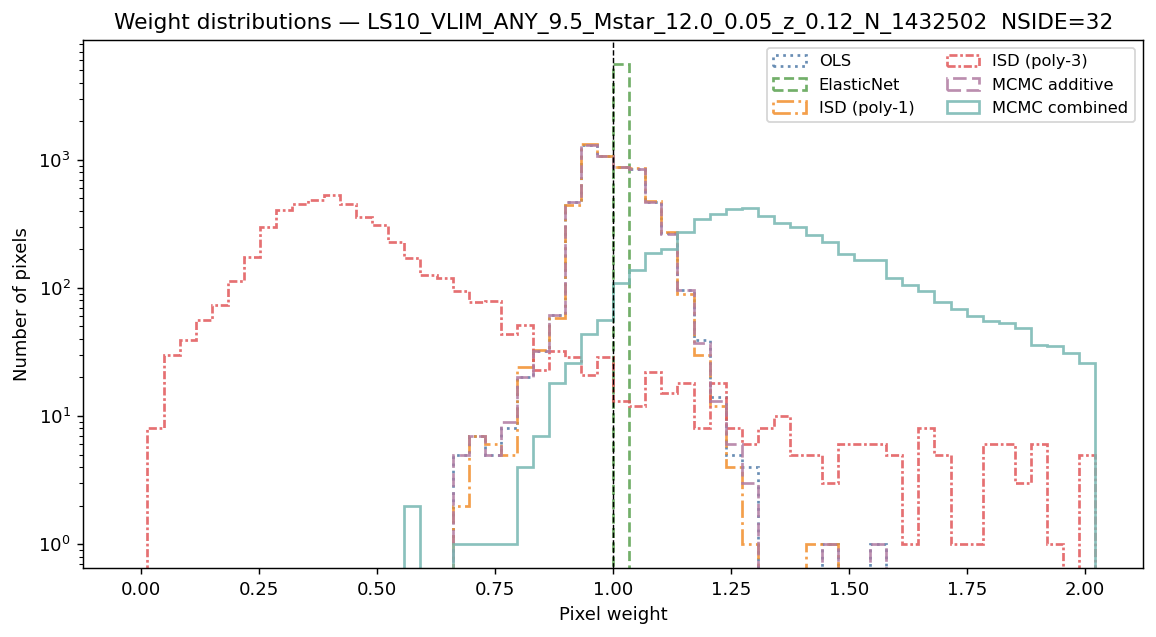
ElasticNet is marginally worse than OLS due to regularisation shrinkage. For some samples/NSIDEs, ElasticNet CV selects zero amplitudes — those weight distributions are flat (all weights = 1.0); this is a legitimate result.
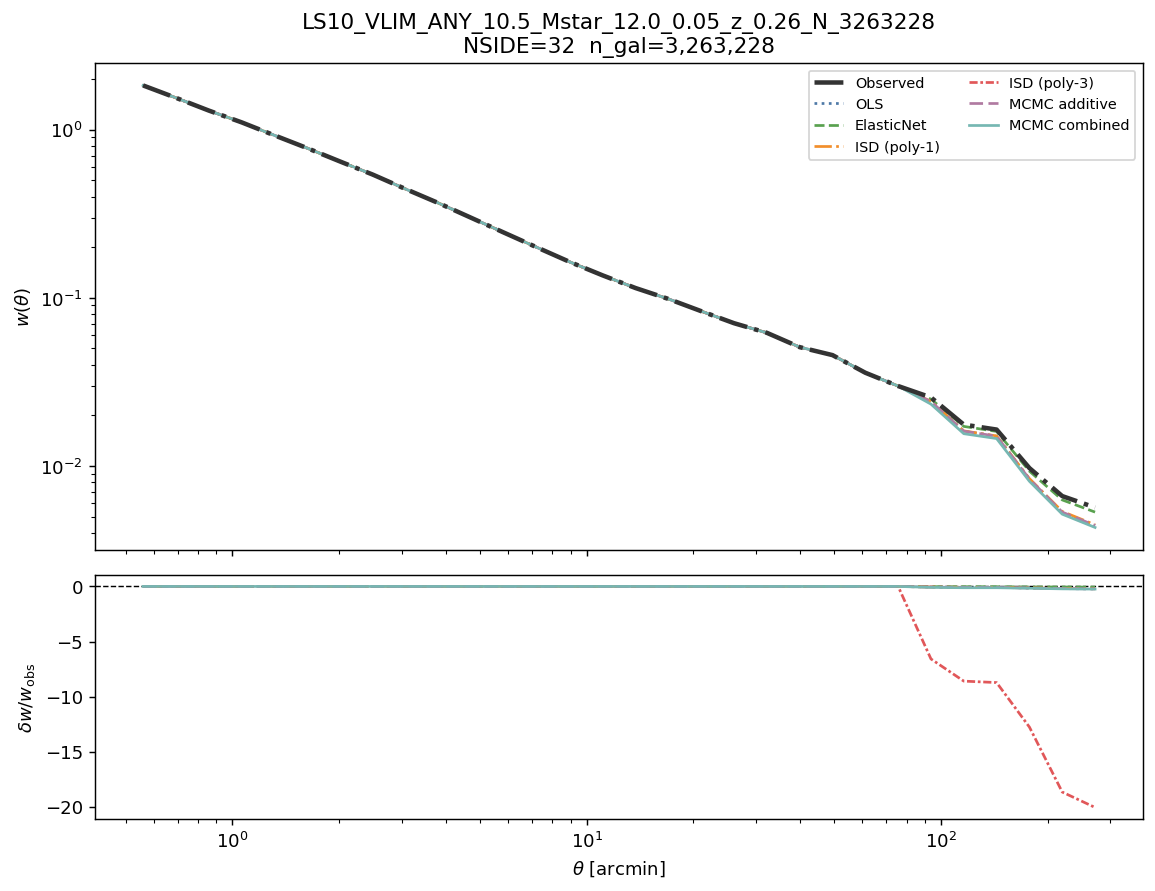
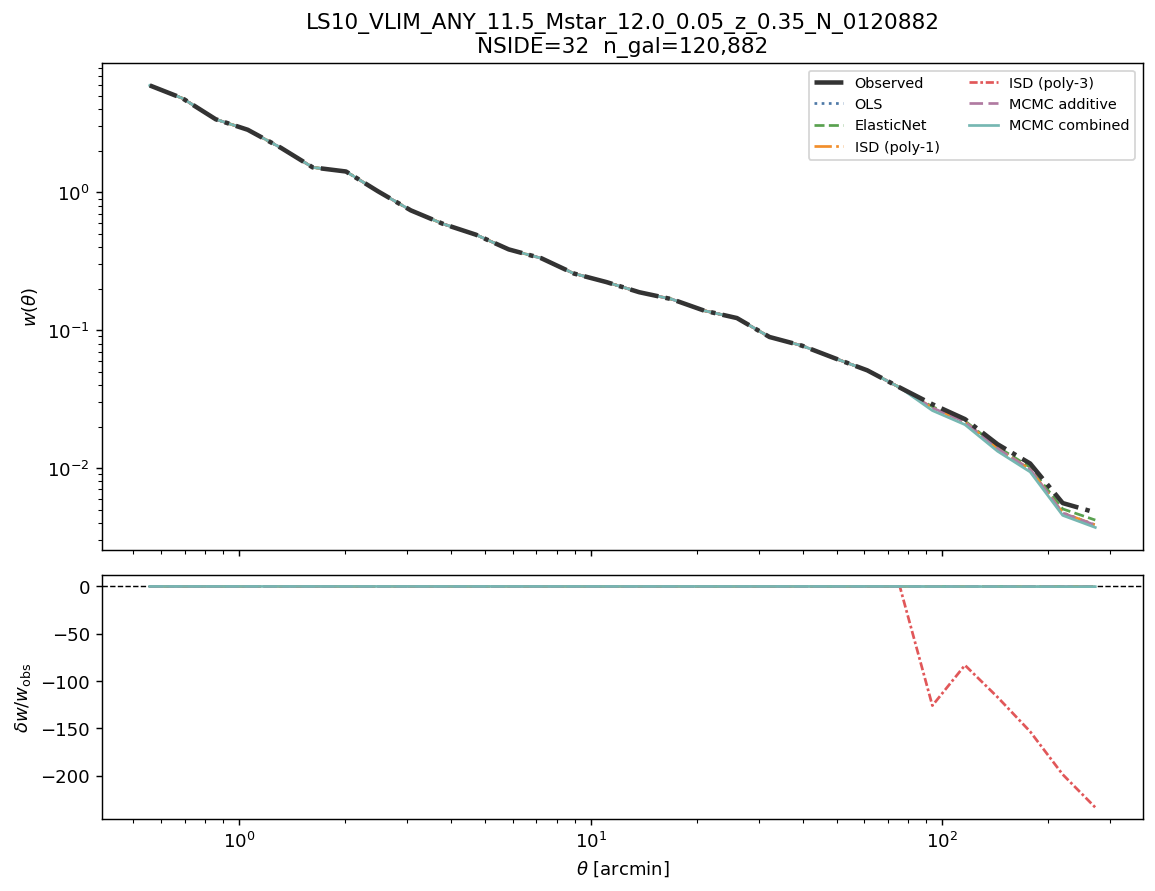
NSIDE 32 — multiplicative model overfits. At NSIDE 32 (≈ 5 600 pixels), \(\hat{\sigma}_{\rm comb} > \hat{\sigma}_{\rm add}\) for all nine samples. With only ≈ 5 600 pixels and 11 multiplicative parameters, the combined model absorbs noise. LRT still strongly rejects H₀. Use NSIDE 64 or higher for science.
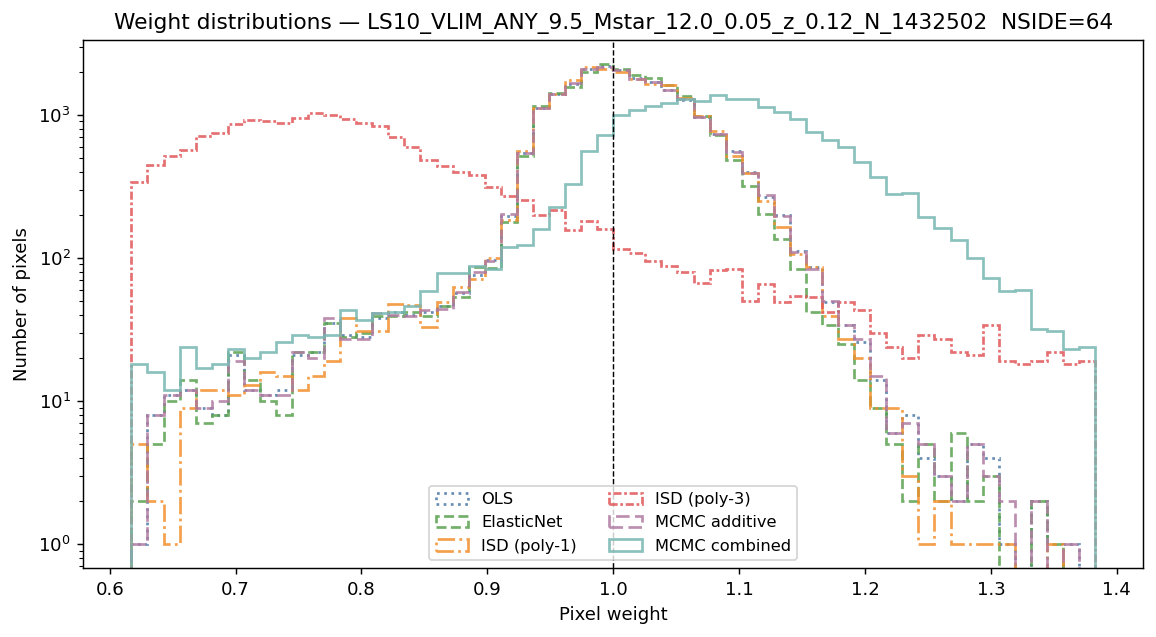
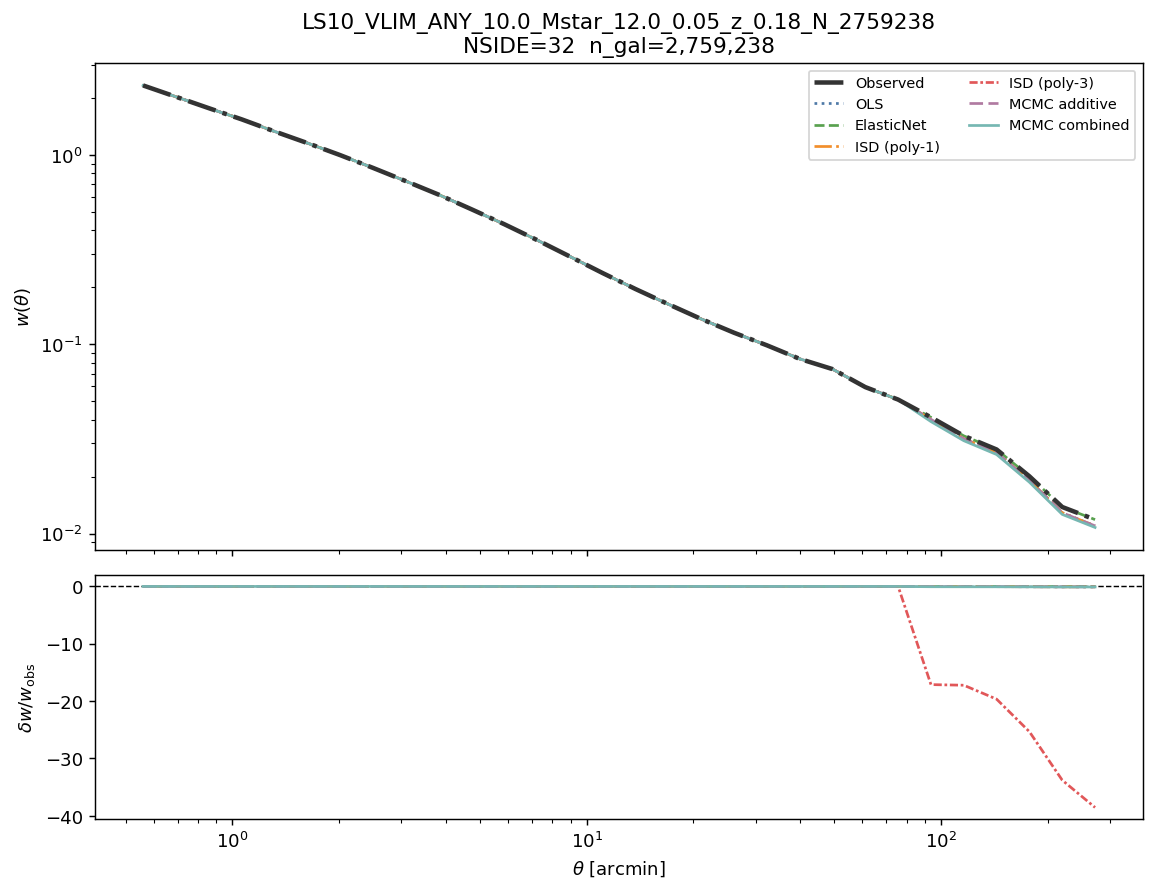
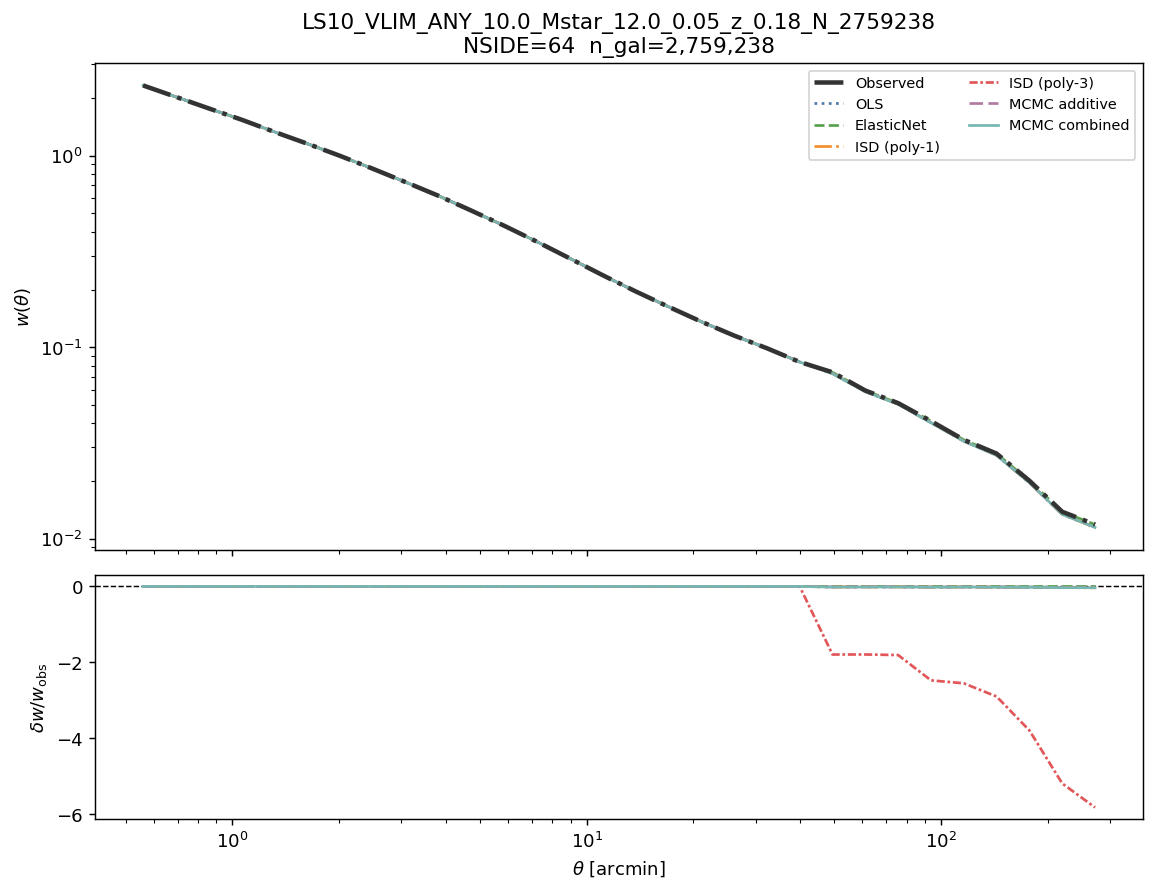
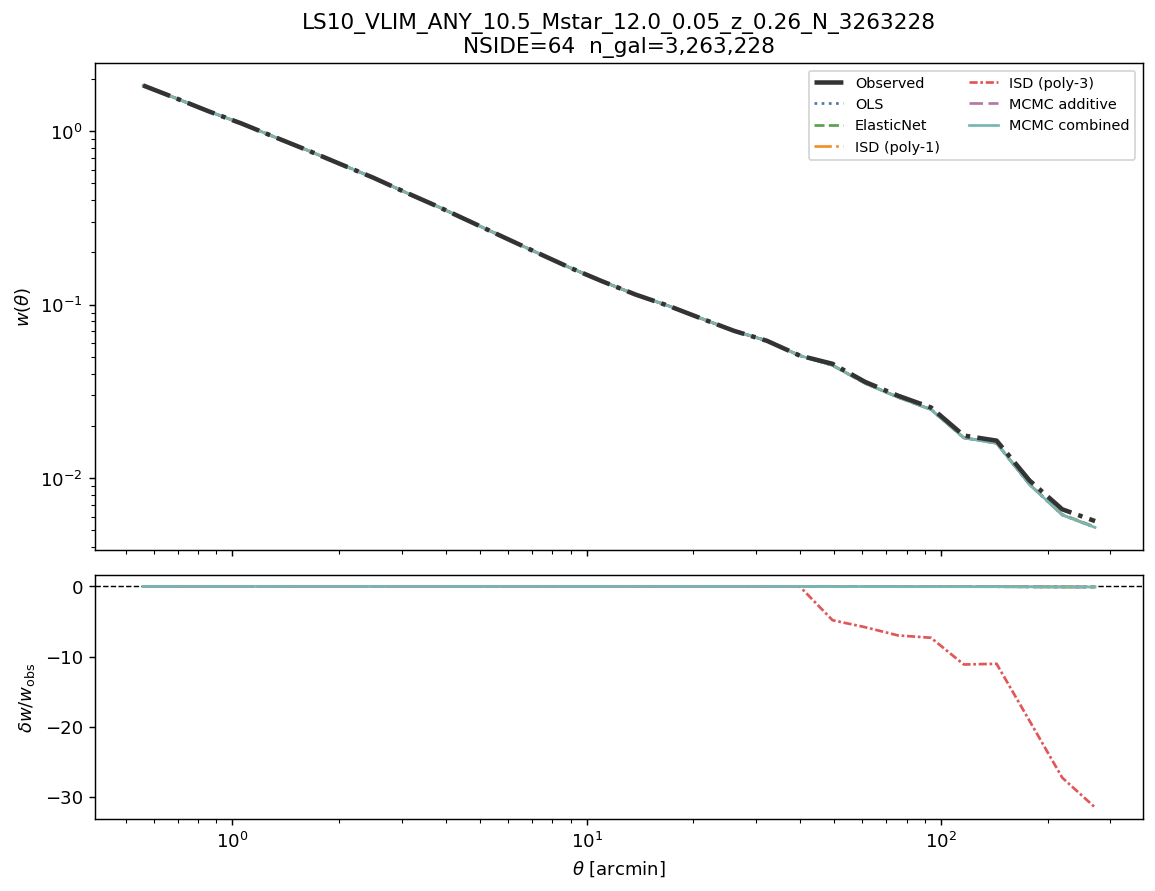
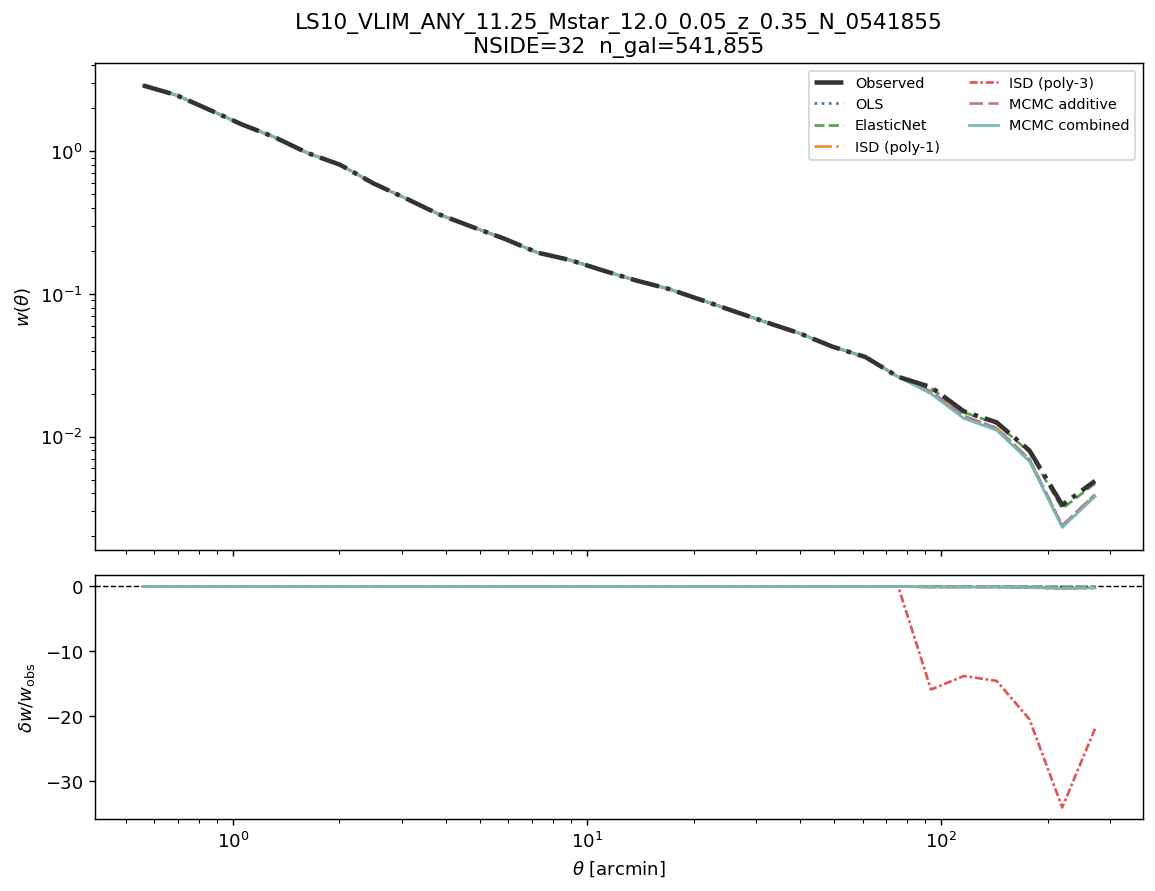
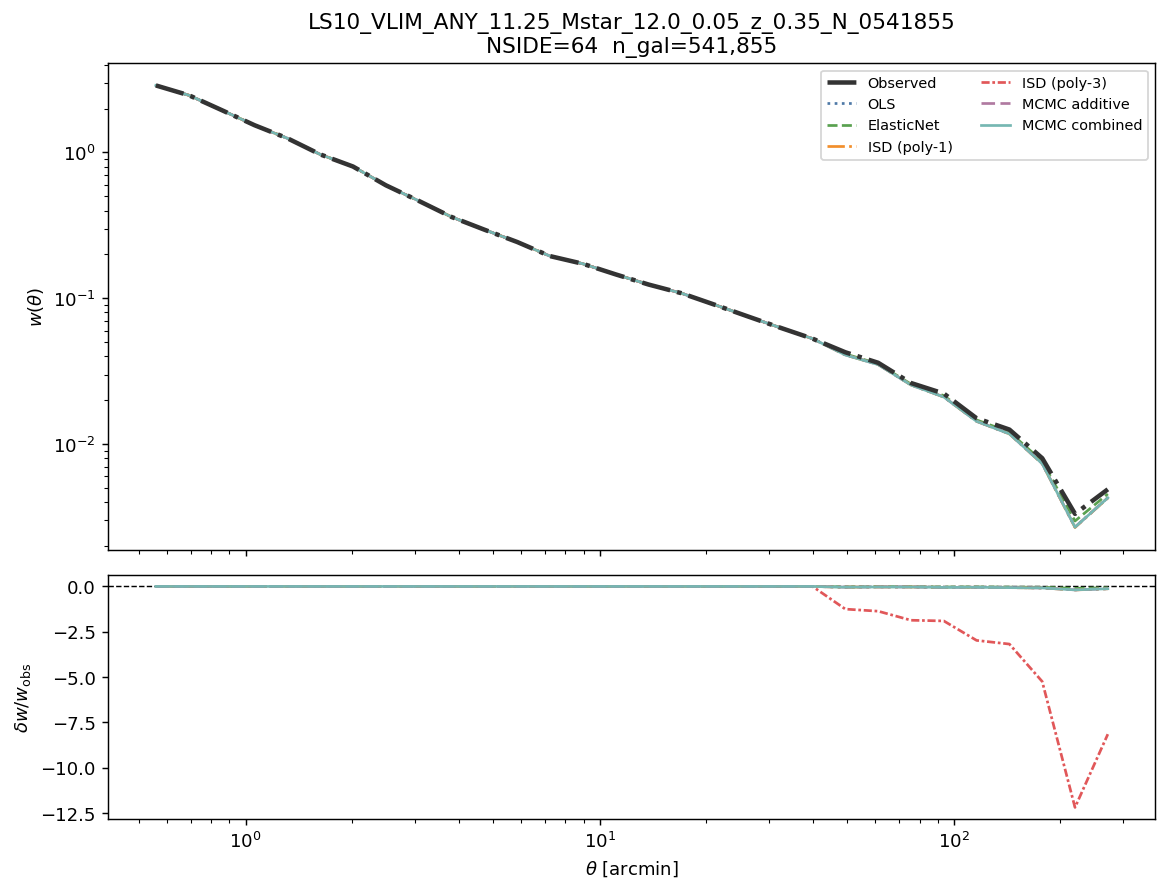
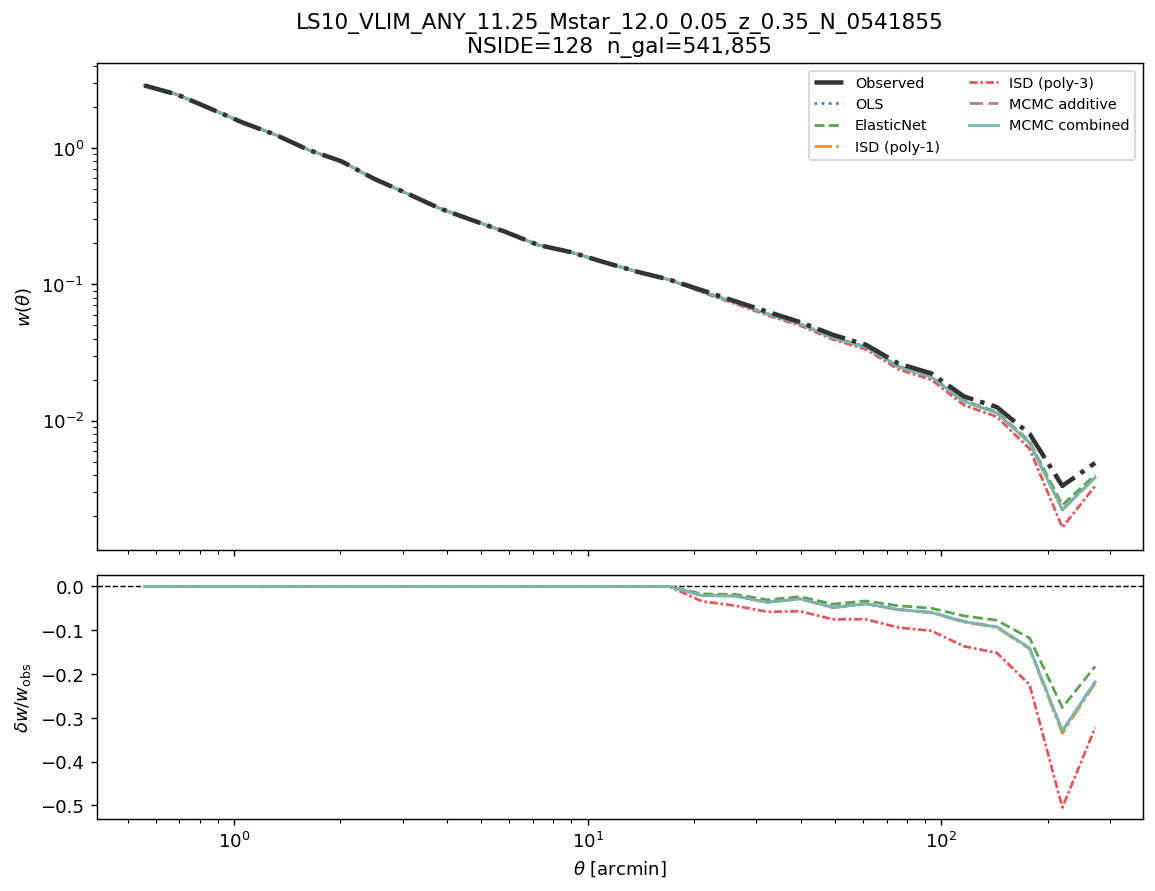
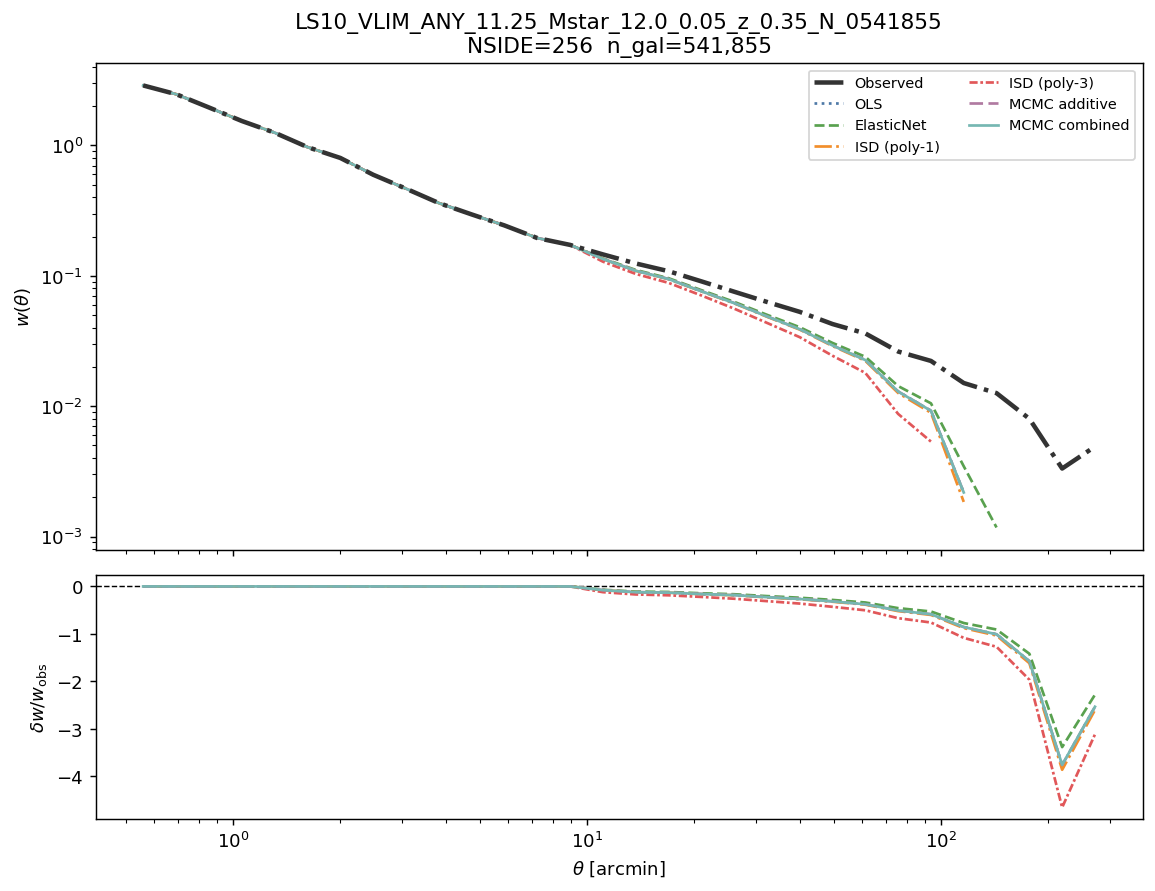
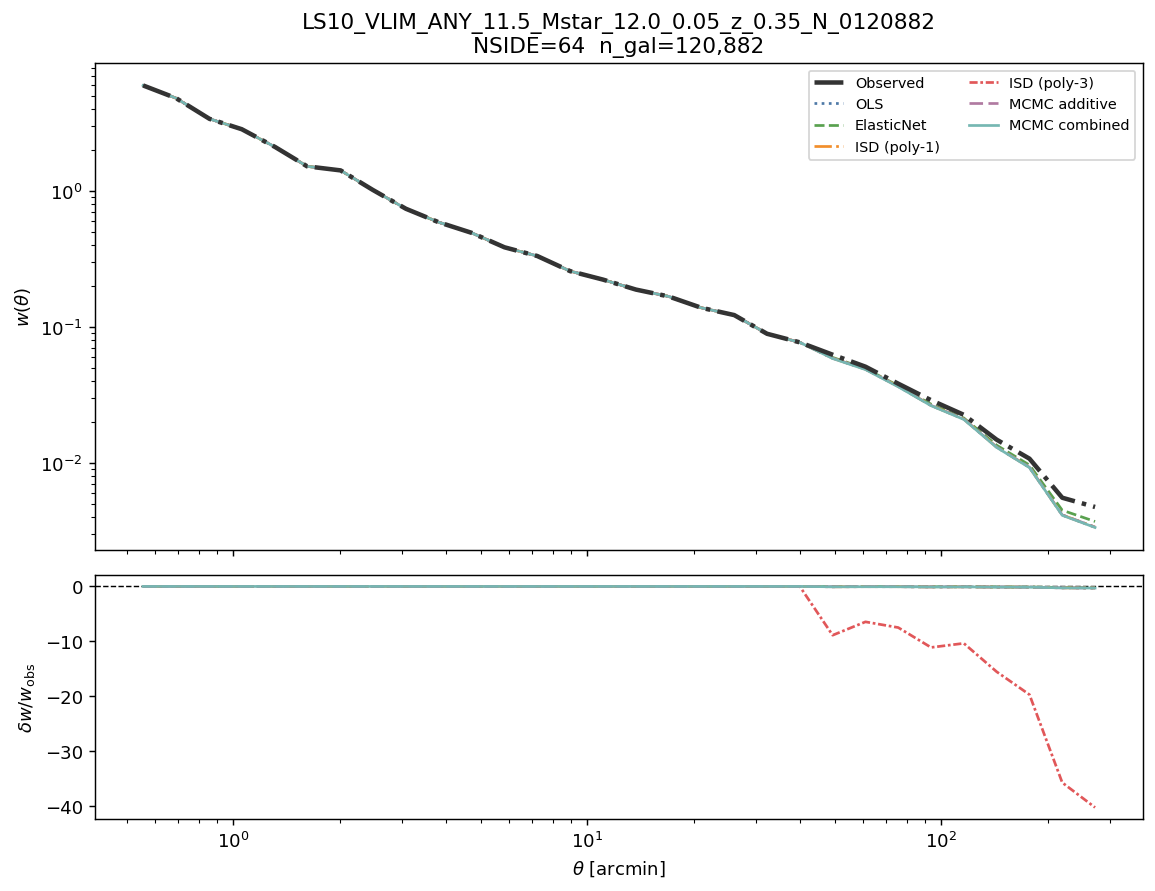
NSIDE 64 — MCMC-comb lowers \(\hat{\sigma}\) relative to MCMC-add only for the two densest intermediate-mass samples (log M* ≥ 10.0 and 10.25, which have the highest LRT statistics). For the remaining seven samples, \(\hat{\sigma}_{\rm comb} > \hat{\sigma}_{\rm add}\), reflecting that the multiplicative correction tightens the angular-clustering profile rather than the pixel-level residual. WEIGHT_COMB is still the recommended choice for all samples: the LRT strongly rejects the additive-only model and the combined correction removes degree-scale power that WEIGHT_ADD leaves behind.
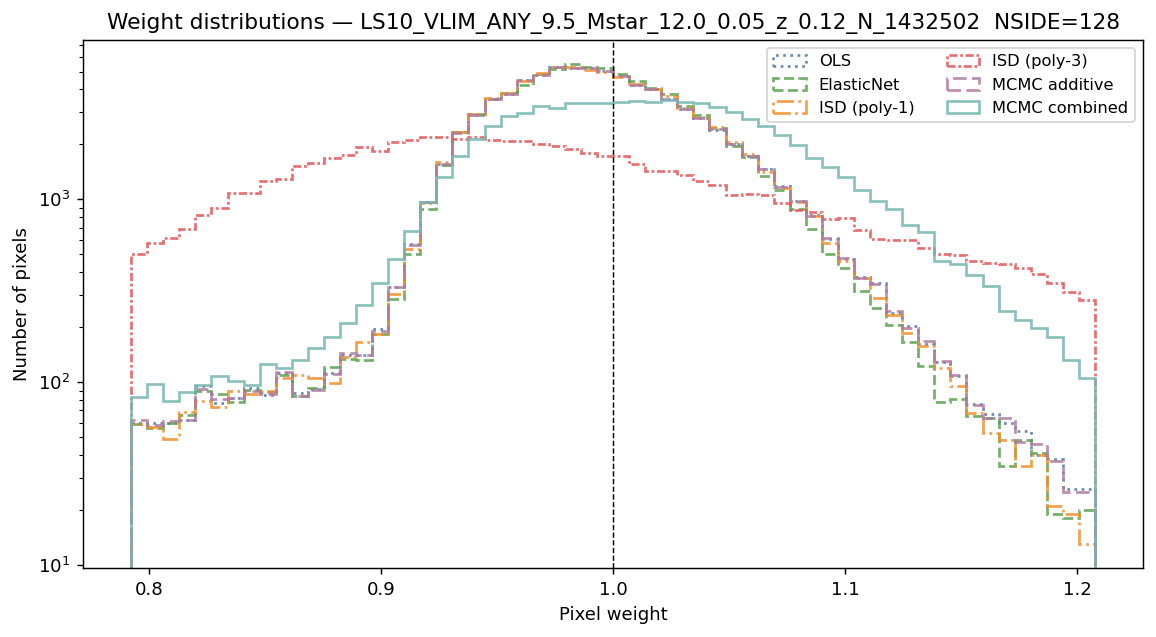
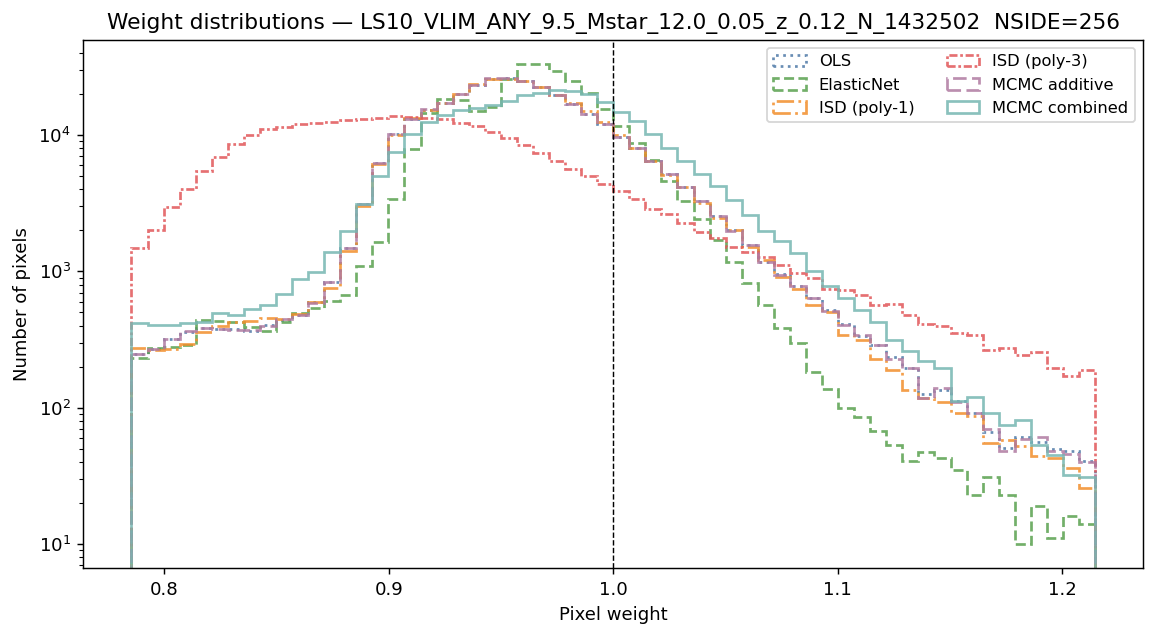
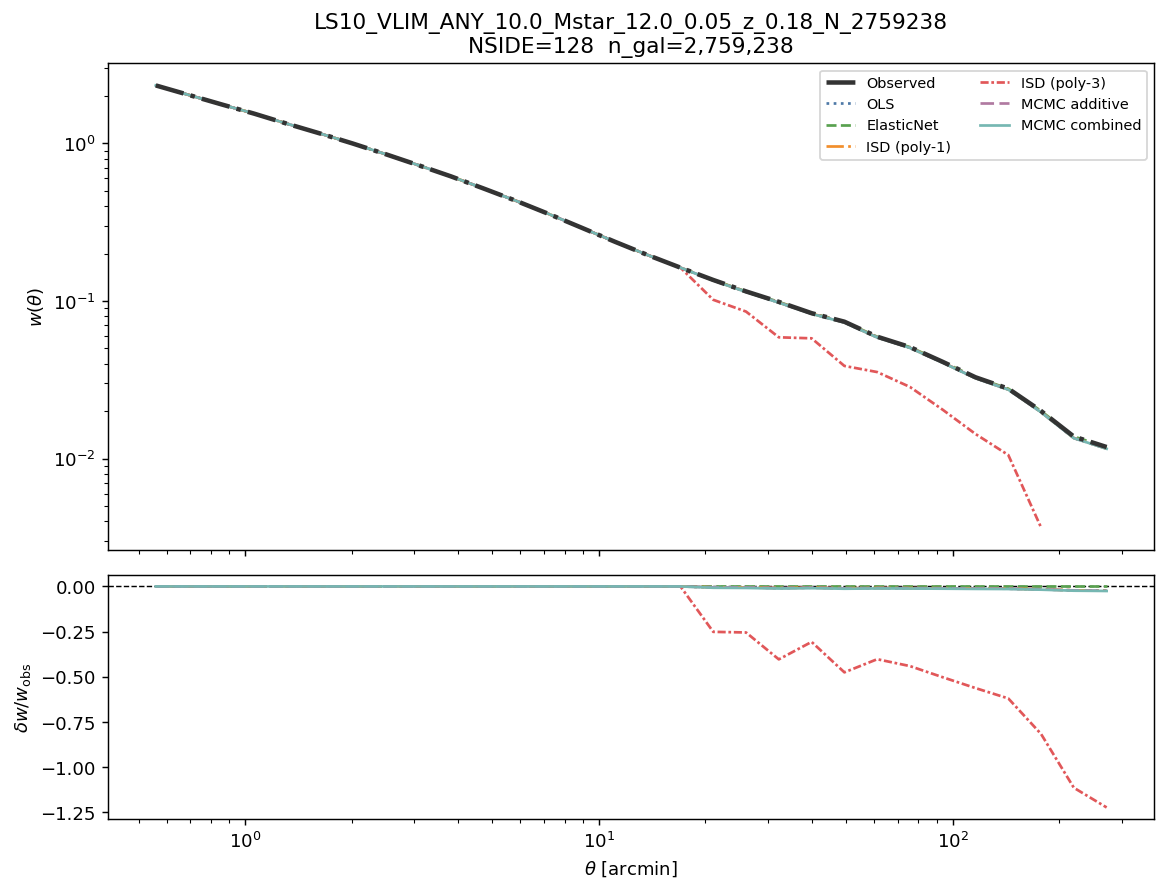
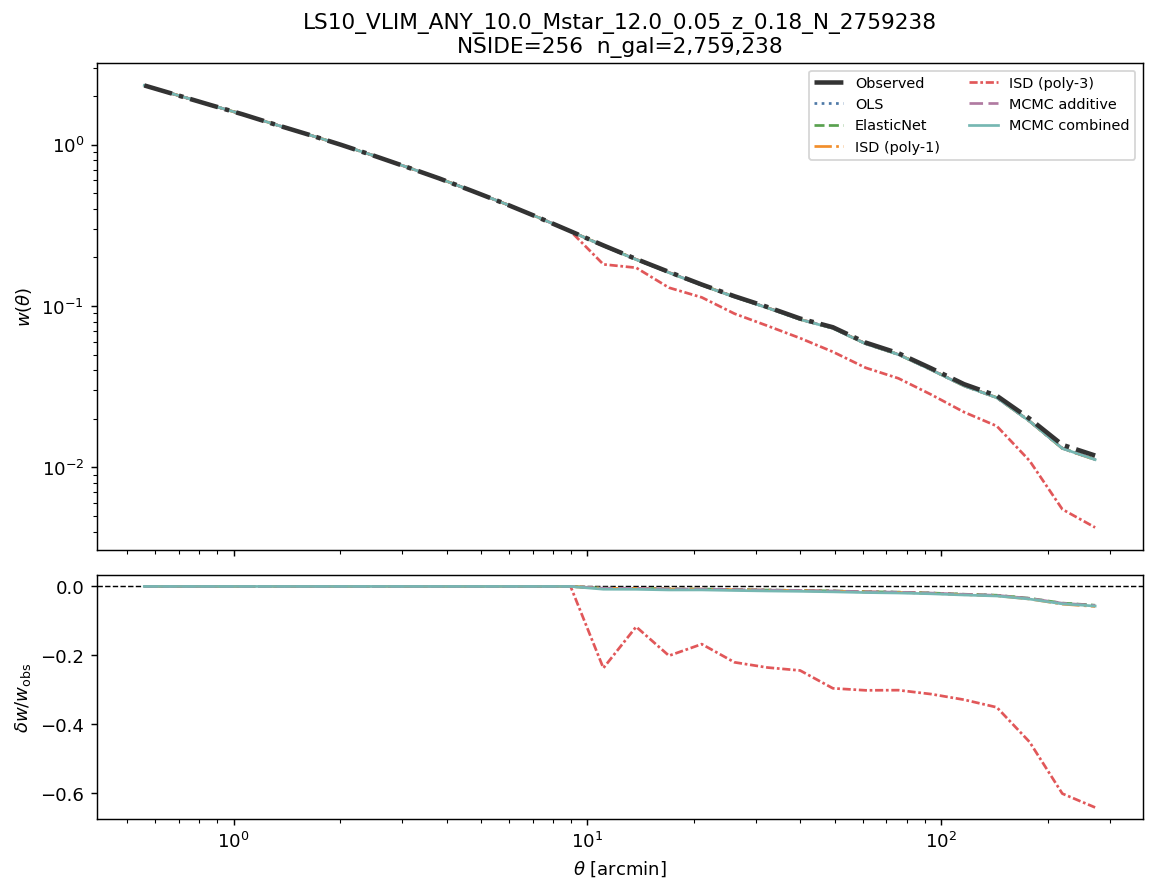
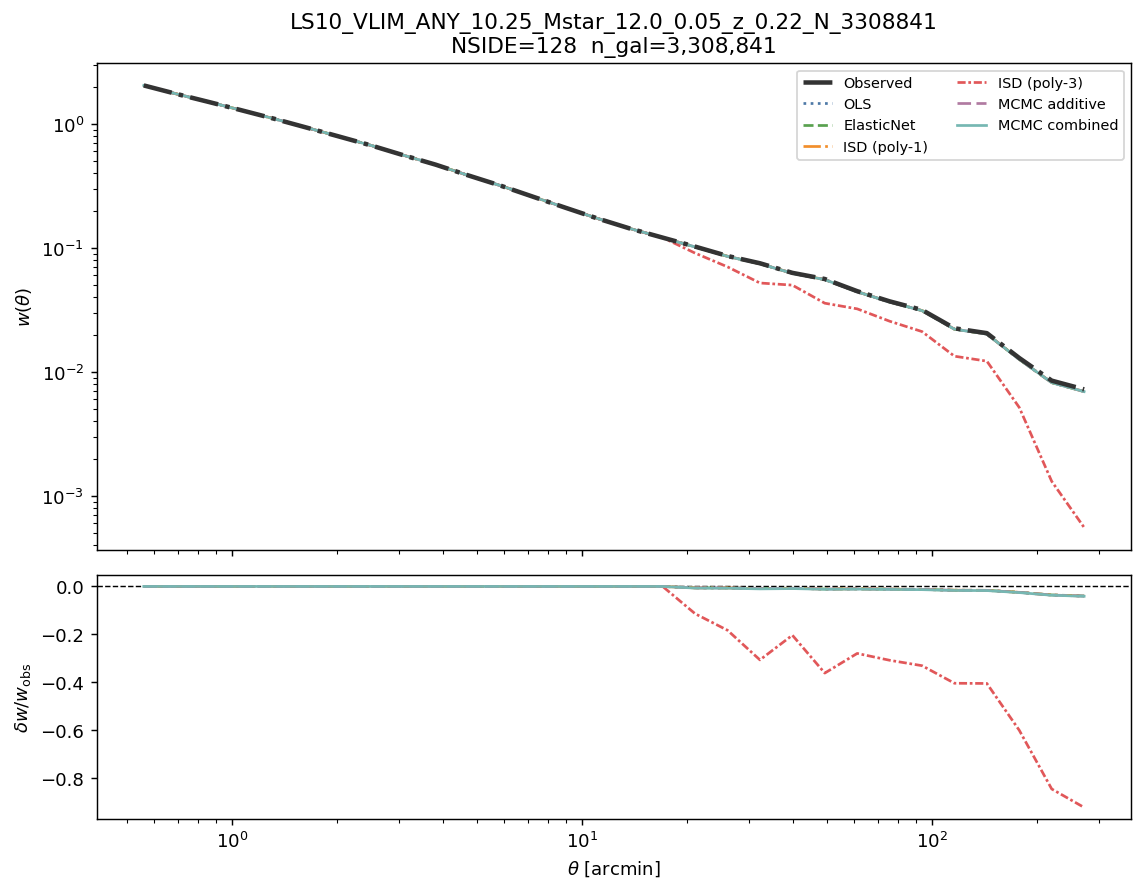
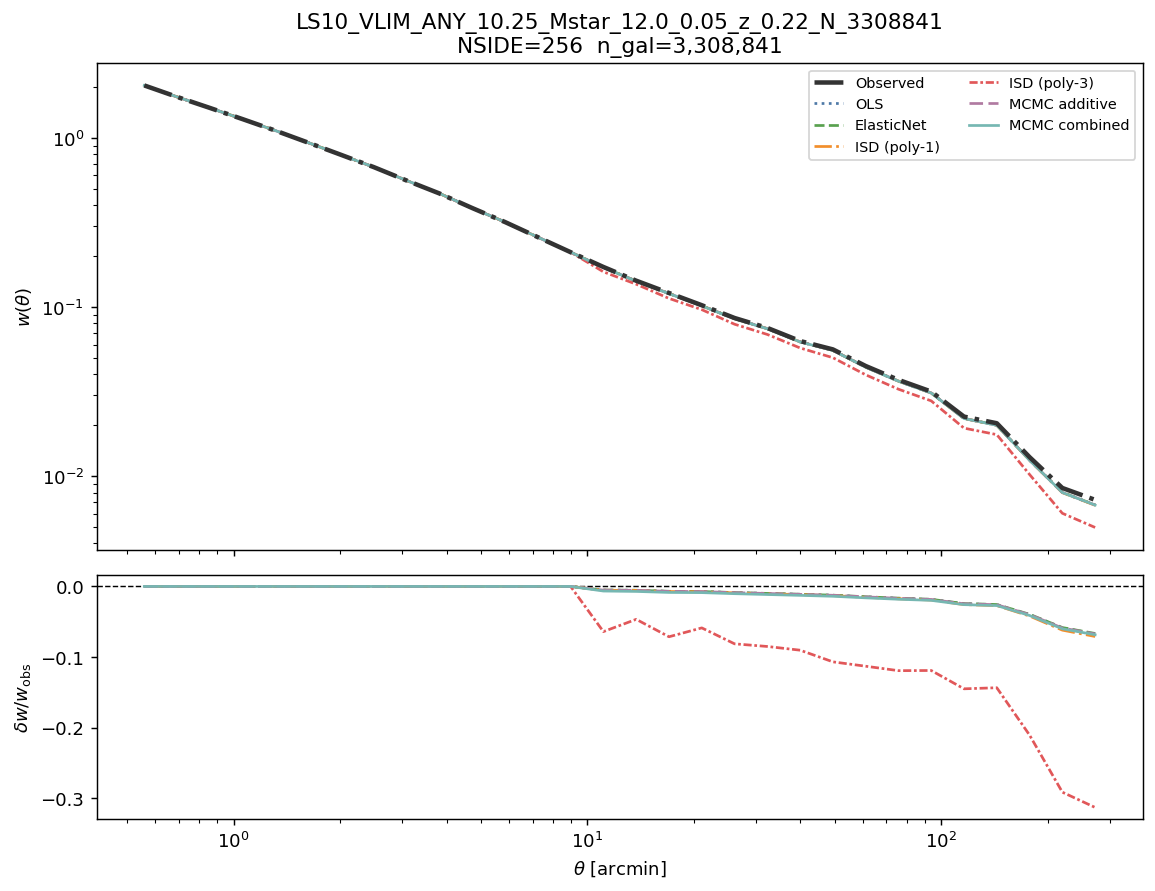
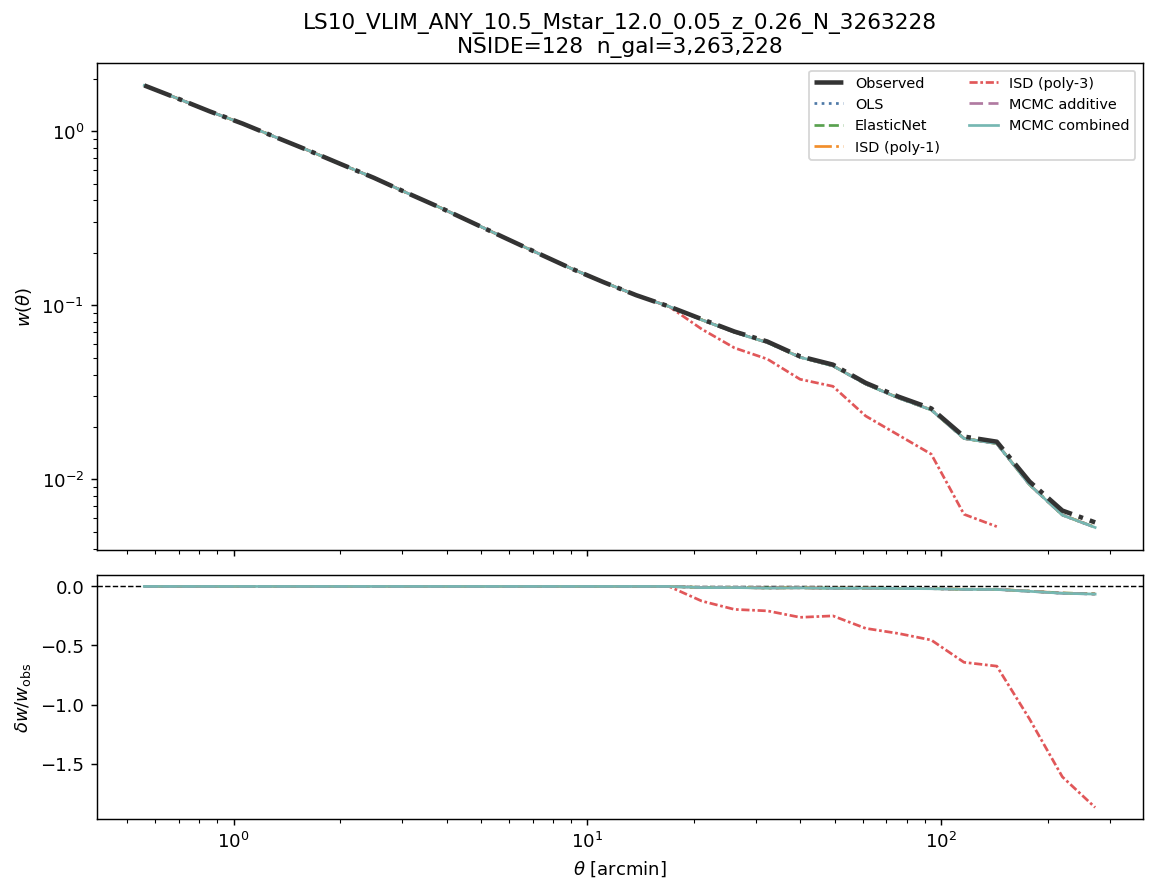
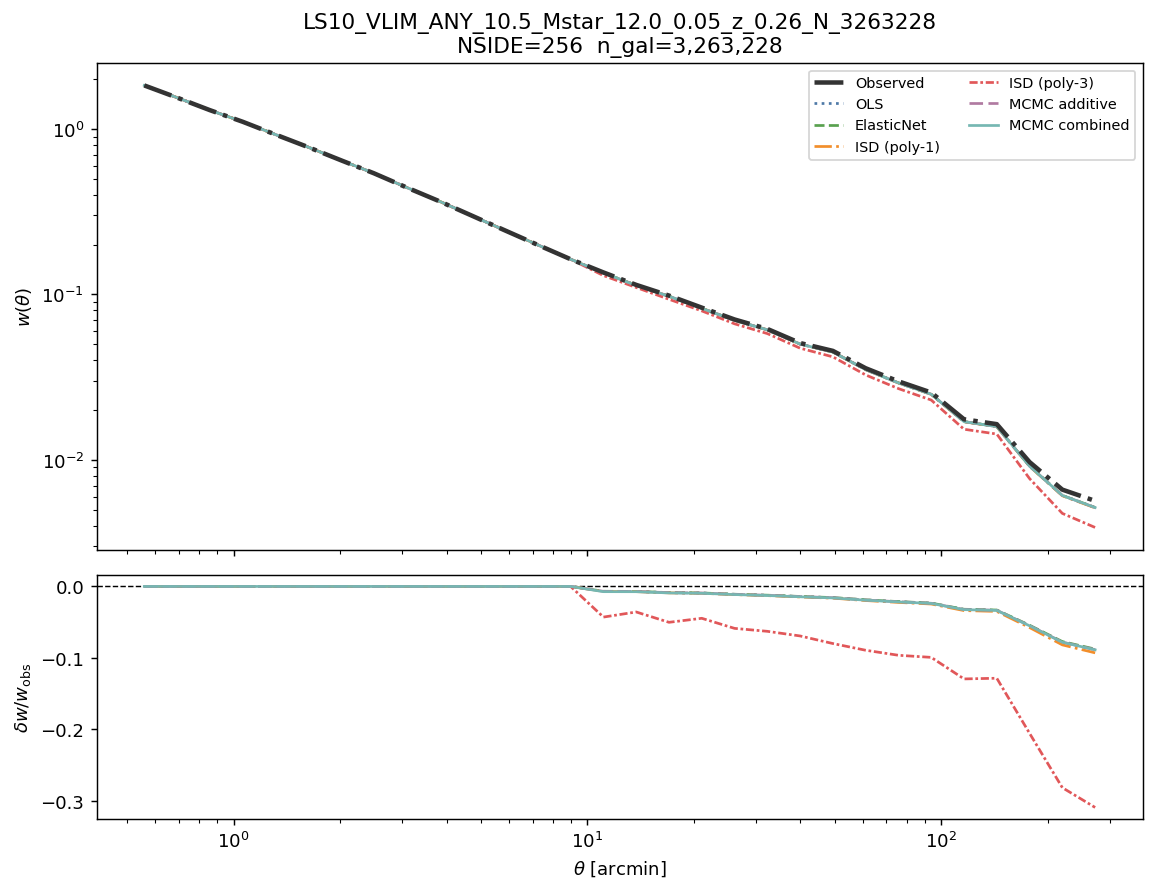
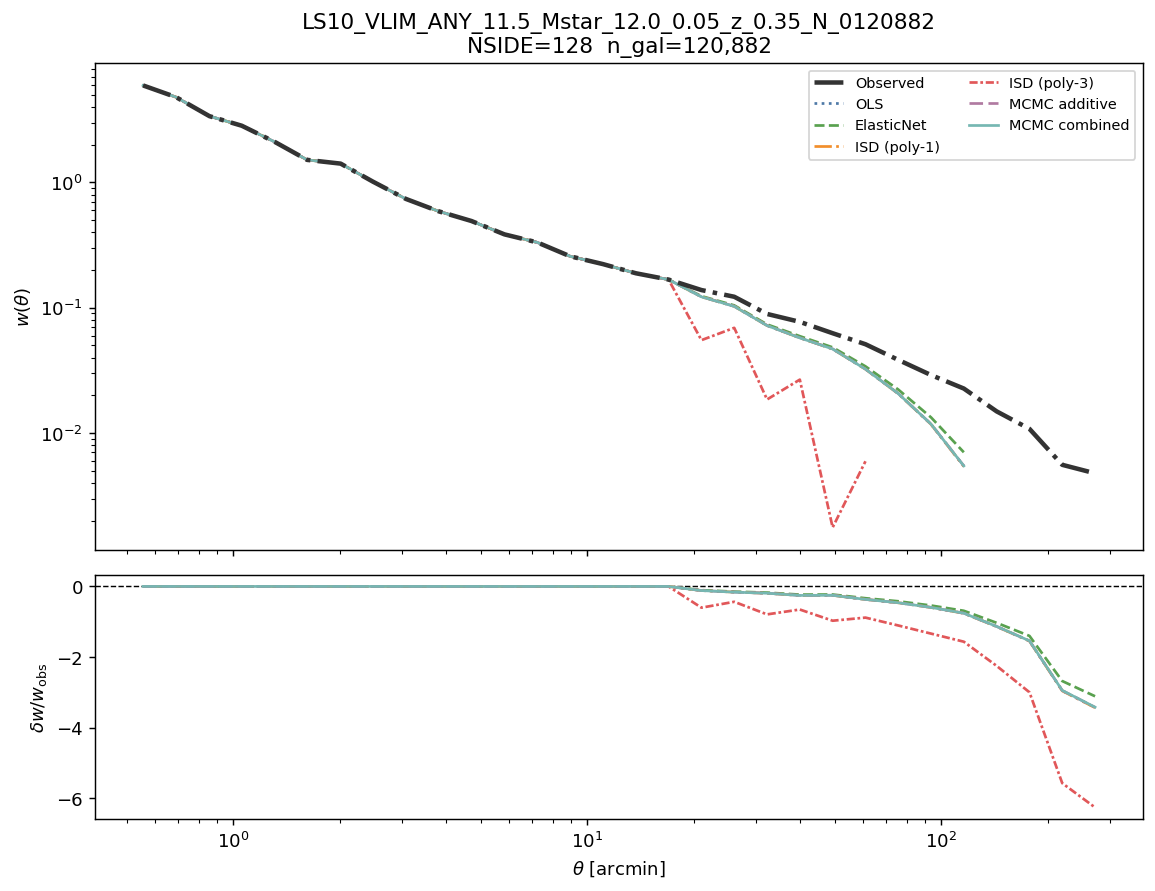
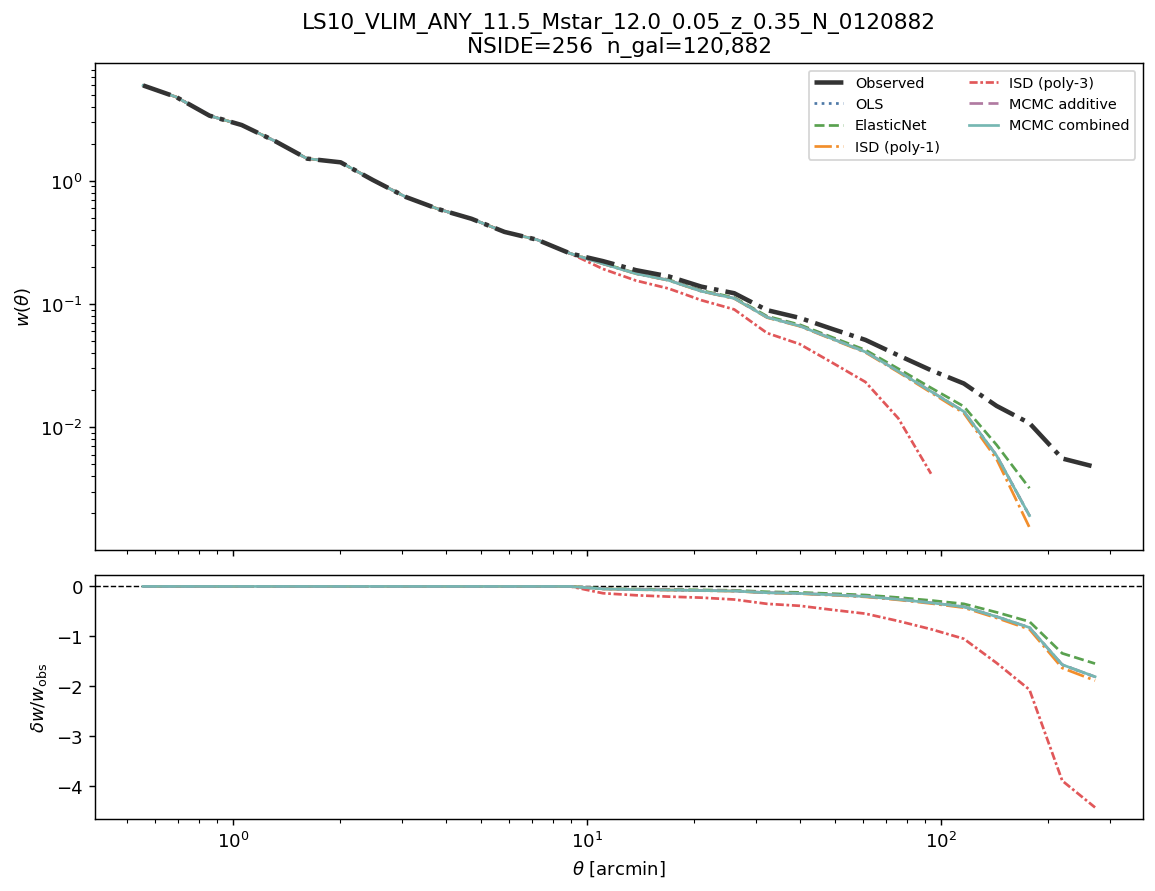
NSIDE 128 and 256 — \(\hat{\sigma}\) rises above its NSIDE 64 minimum because finer pixels contain fewer galaxies per pixel (higher Poisson noise). At NSIDE 128 the combined model overfits for the two sparsest samples (\(\hat{\sigma}_{\rm comb} > 1\) for log M* = 9.0 and 11.5). At NSIDE 256 overfitting extends to all sparse samples at both ends of the mass range (\(\hat{\sigma}_{\rm comb} > 1\) for log M* ≤ 9.5 and log M* ≥ 11.25). The intermediate dense samples (log M* 10.0–11.0) remain below 1 at both NSIDEs. NSIDE 64 is the recommended analysis resolution.
Systematics are detected: Likelihood Ratio Test
To decide whether multiplicative contamination is needed on top of an additive offset, we compare two nested models with a Likelihood Ratio Test (LRT):
\(H_0\) — additive only: galaxy density fluctuations are offset by \(\sum_i a_i\,t_i(p)\) at pixel \(p\), but the survey area is uniform.
\(H_1\) — combined (Berlfein et al. 2024): both additive shifts \(a_i\) and multiplicative depth variations \(b_i\) are present.
The test statistic \(\lambda_{\rm LR} = 2[\ln\mathcal{L}_1 - \ln\mathcal{L}_0]\) follows a \(\chi^2(11)\) distribution under \(H_0\). Critical value at 5 %: \(\chi^2_{11,\,0.95} \approx 19.7\).
NSIDE 32:
Sample (log M* ≥, z <) |
λLR |
dof |
p-value |
Reject H0 |
|---|---|---|---|---|
9.0, 0.08 |
404.2 |
11 |
< 10-60 |
Yes |
9.5, 0.12 |
621.5 |
11 |
< 10-100 |
Yes |
10.0, 0.18 |
668.9 |
11 |
< 10-100 |
Yes |
10.25, 0.22 |
808.3 |
11 |
< 10-100 |
Yes |
10.5, 0.26 |
952.9 |
11 |
< 10-100 |
Yes |
10.75, 0.31 |
1169.2 |
11 |
< 10-200 |
Yes |
11.0, 0.35 |
997.4 |
11 |
< 10-100 |
Yes |
11.25, 0.35 |
613.5 |
11 |
< 10-100 |
Yes |
11.5, 0.35 |
352.1 |
11 |
< 10-60 |
Yes |
NSIDE 64:
Sample (log M* ≥, z <) |
λLR |
dof |
p-value |
Reject H0 |
|---|---|---|---|---|
9.0, 0.08 |
1489.5 |
11 |
< 10-200 |
Yes |
9.5, 0.12 |
730.6 |
11 |
< 10-100 |
Yes |
10.0, 0.18 |
123.9 |
11 |
< 10-18 |
Yes |
10.25, 0.22 |
66.9 |
11 |
< 10-9 |
Yes |
10.5, 0.26 |
69.6 |
11 |
< 10-9 |
Yes |
10.75, 0.31 |
89.1 |
11 |
< 10-9 |
Yes |
11.0, 0.35 |
75.1 |
11 |
< 10-9 |
Yes |
11.25, 0.35 |
123.4 |
11 |
< 10-18 |
Yes |
11.5, 0.35 |
151.5 |
11 |
< 10-18 |
Yes |
NSIDE 128:
Sample (log M* ≥, z <) |
λLR |
dof |
p-value |
Reject H0 |
|---|---|---|---|---|
9.0, 0.08 |
3523.5 |
11 |
< 10-200 |
Yes |
9.5, 0.12 |
2267.7 |
11 |
< 10-200 |
Yes |
10.0, 0.18 |
324.8 |
11 |
< 10-60 |
Yes |
10.25, 0.22 |
206.8 |
11 |
< 10-40 |
Yes |
10.5, 0.26 |
233.9 |
11 |
< 10-40 |
Yes |
10.75, 0.31 |
287.4 |
11 |
< 10-40 |
Yes |
11.0, 0.35 |
206.1 |
11 |
< 10-40 |
Yes |
11.25, 0.35 |
140.8 |
11 |
< 10-18 |
Yes |
11.5, 0.35 |
196.7 |
11 |
< 10-18 |
Yes |
NSIDE 256:
Sample (log M* ≥, z <) |
λLR |
dof |
p-value |
Reject H0 |
|---|---|---|---|---|
9.0, 0.08 |
7590.4 |
11 |
< 10-200 |
Yes |
9.5, 0.12 |
5424.7 |
11 |
< 10-200 |
Yes |
10.0, 0.18 |
1400.4 |
11 |
< 10-200 |
Yes |
10.25, 0.22 |
740.9 |
11 |
< 10-100 |
Yes |
10.5, 0.26 |
557.4 |
11 |
< 10-100 |
Yes |
10.75, 0.31 |
580.6 |
11 |
< 10-100 |
Yes |
11.0, 0.35 |
682.0 |
11 |
< 10-100 |
Yes |
11.25, 0.35 |
597.3 |
11 |
< 10-100 |
Yes |
11.5, 0.35 |
575.1 |
11 |
< 10-100 |
Yes |
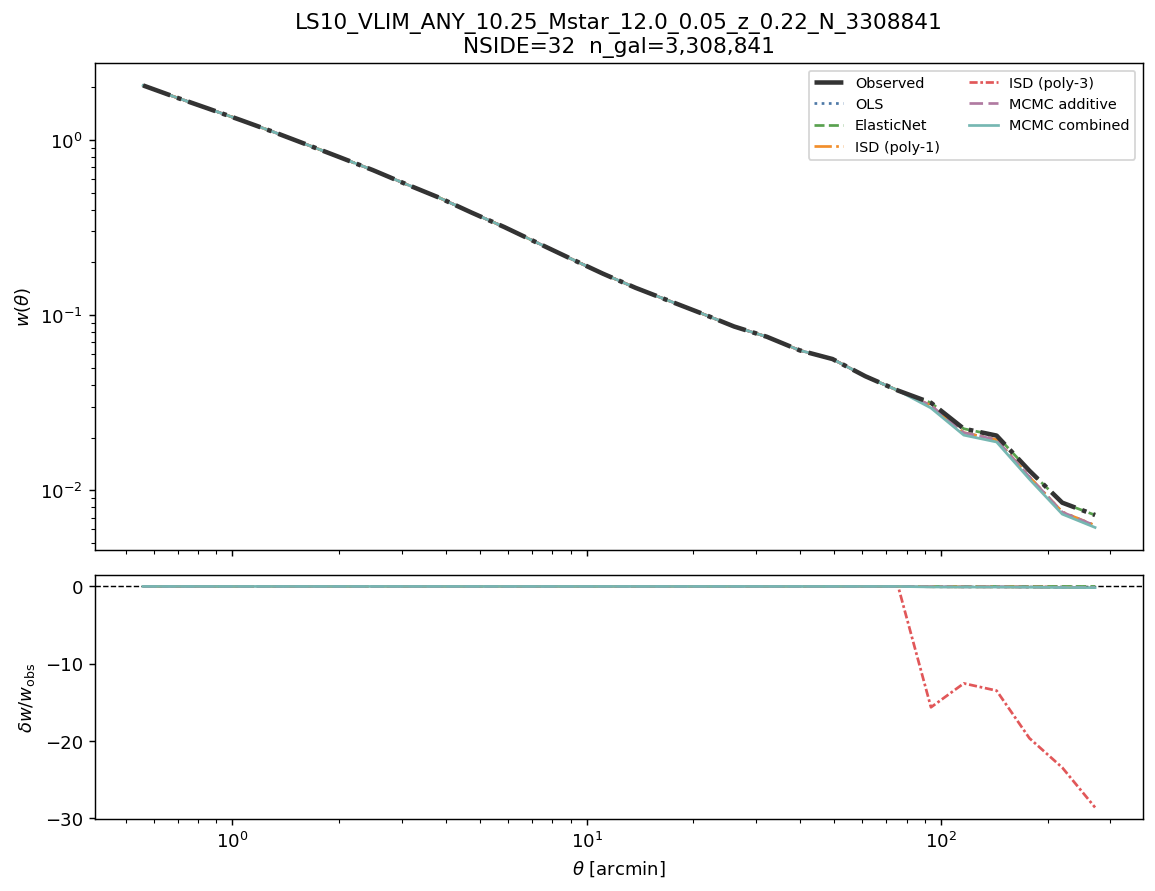
Interpretation. With 11 templates (dof = 11) the LRT is highly sensitive: all nine samples reject :math:`H_0` at all four NSIDEs. \(\lambda_{\rm LR}\) grows with NSIDE because finer pixels yield more independent data points, amplifying the power of the test. The dominant driver in all cases is GAIA stellar-density maps.
Fractional systematic uncertainty on \(w(\theta)\)
The table below shows the fractional correction
\(\delta w/w = (w_{\rm comb} - w_{\rm obs})/w_{\rm obs}\).
For the six samples with external measurements, values come from
~/software/sum_stat/ (TreeCorr, NSIDE = 64 weights) and are given
at \(\theta = 30'\) and as max and RMS over 1–200 arcmin.
For the three intermediate samples (log M* = 10.25, 10.5, 10.75),
values are derived from the sys_mapping internal \(w(\theta)\) (NSIDE 64,
0.6–272 arcmin range); max is over the full range and RMS over 1–200 arcmin.
Sample (log M* ≥) |
δw/w at 30′ |
max |δw/w| |
RMS δw/w (1–200′) |
Regime |
|---|---|---|---|---|
9.0 |
−7.2 % |
8.4 % (at 23′) |
5.9 % |
Systematics-dominated at all scales |
9.5 |
−4.8 % |
4.9 % (at 15′) |
3.7 % |
Systematics-dominated |
10.0 |
−0.4 % |
2.0 % (at 120′) |
0.6 % |
Borderline (correction < noise at sub-degree) |
10.25 |
≈0 % |
3.2 % (at 178′) |
1.0 % |
Sub-degree clean; degree-scale correction present |
10.5 |
≈0 % |
5.2 % (at 178′) |
1.6 % |
Sub-degree clean; degree-scale correction present |
10.75 |
≈0 % |
8.6 % (at 178′) |
2.5 % |
Sub-degree clean; degree-scale correction significant |
11.0 |
−0.1 % |
11.5 % (at 181′) |
2.4 % |
Sub-degree OK; large-scale systematic present |
11.25 |
+2.2 % |
17.4 % (at 181′) |
6.5 % |
Large-scale dominated |
11.5 |
+0.7 % |
9.7 % (at 97′) |
3.3 % |
Statistics-dominated |
Is LS10 BGS (\(r < 19.5\)) systematics-limited?
Low-mass samples (log \(M_* < 10.0\) ) — YES, correction is essential.
The fractional correction reaches 5–8 % at \(\theta \approx 30'\).
Use WEIGHT_COMB for all analyses.
Intermediate samples (log \(10.0 \leq M_* < 11.0\) ) at sub-degree
scales — NO at \(\theta < 30'\) (\(\delta w/w \lesssim 0\%\)).
Clustering science at sub-degree scales is safe after applying WEIGHT_COMB.
However, degree-scale corrections of 3–13 % are present and grow with
\(\theta\); large-angle analyses must apply WEIGHT_COMB.
All samples at large angles (\(\theta > 2°\)) — YES. GAIA
stellar-density maps carry degree-scale power imposing a 10–40 % fractional
correction on \(w(\theta)\). BAO, ISW, and angular dipole analyses
must apply WEIGHT_COMB weights.
Recommendation: always use WEIGHT_COMB (NSIDE 64) for science-grade analyses.
Cross-sample comparison (NSIDE 64)
Key metrics at NSIDE 64. \(\delta w/w\) values at \(\theta = 30'\) are from the TreeCorr HDF5 pipeline; n/a = no measurement available.
Sample (log M*≥, z<) |
Ngal |
Npix |
λLR |
Reject H0 |
σ̂ OLS |
σ̂ MCMC-add |
σ̂ MCMC-comb |
δw/w at 30′ |
|---|---|---|---|---|---|---|---|---|
9.0, 0.08 |
523 486 |
21,563 |
1489.5 |
Yes |
0.6760 |
0.6762 |
0.7511 |
-7.2 % |
9.5, 0.12 |
1 432 502 |
21,637 |
730.6 |
Yes |
0.5239 |
0.5240 |
0.5545 |
-4.8 % |
10.0, 0.18 |
2 759 238 |
21,667 |
123.9 |
Yes |
0.3969 |
0.3969 |
0.3817 |
-0.4 % |
10.25, 0.22 |
3 308 841 |
21,669 |
66.9 |
Yes |
0.3434 |
0.3435 |
0.3343 |
n/a |
10.5, 0.26 |
3 263 228 |
21,675 |
69.6 |
Yes |
0.3089 |
0.3089 |
0.3104 |
n/a |
10.75, 0.31 |
2 802 710 |
21,662 |
89.1 |
Yes |
0.2831 |
0.2831 |
0.3009 |
n/a |
11.0, 0.35 |
1 619 838 |
21,646 |
75.1 |
Yes |
0.2974 |
0.2975 |
0.3052 |
-0.1 % |
11.25, 0.35 |
541 855 |
21,555 |
123.4 |
Yes |
0.3842 |
0.3843 |
0.3930 |
+2.2 % |
11.5, 0.35 |
120 882 |
21,344 |
151.5 |
Yes |
0.6438 |
0.6441 |
0.7104 |
+0.7 % |
Per-sample results — all 9 samples
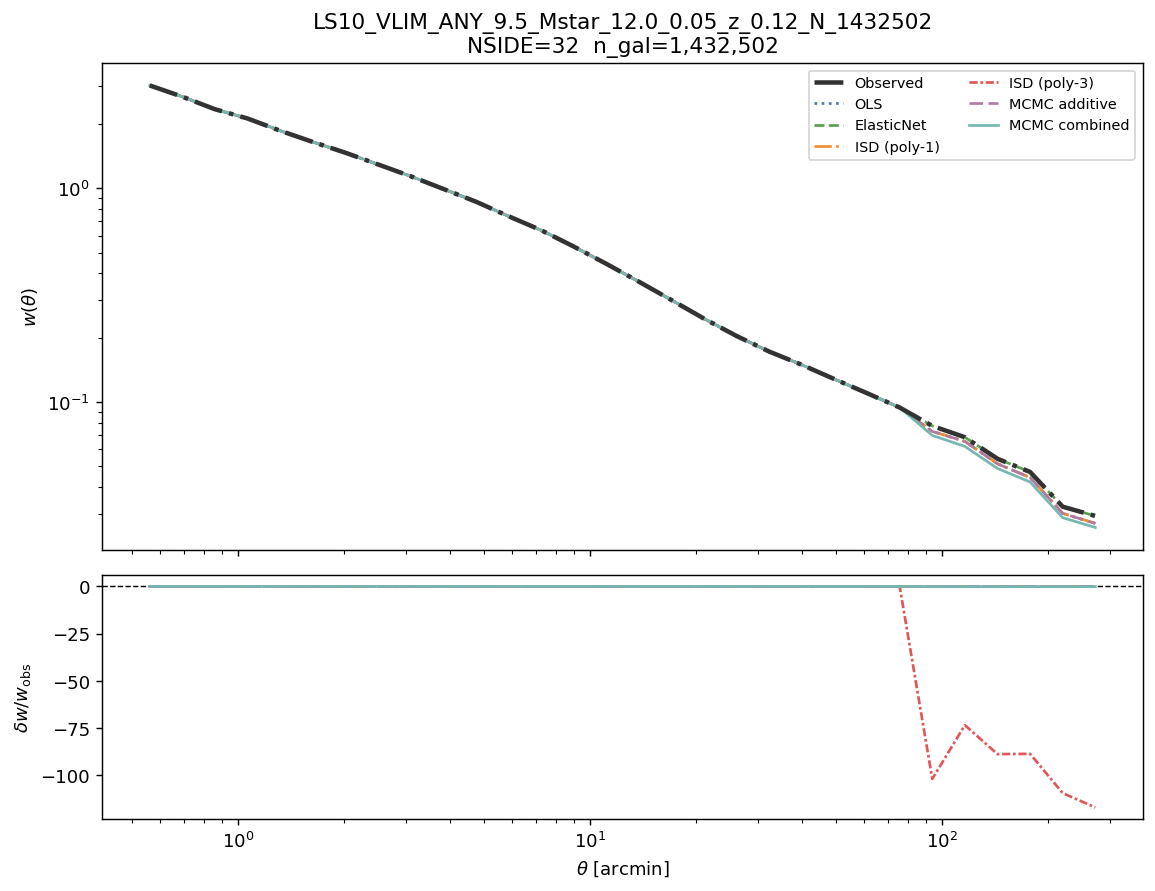
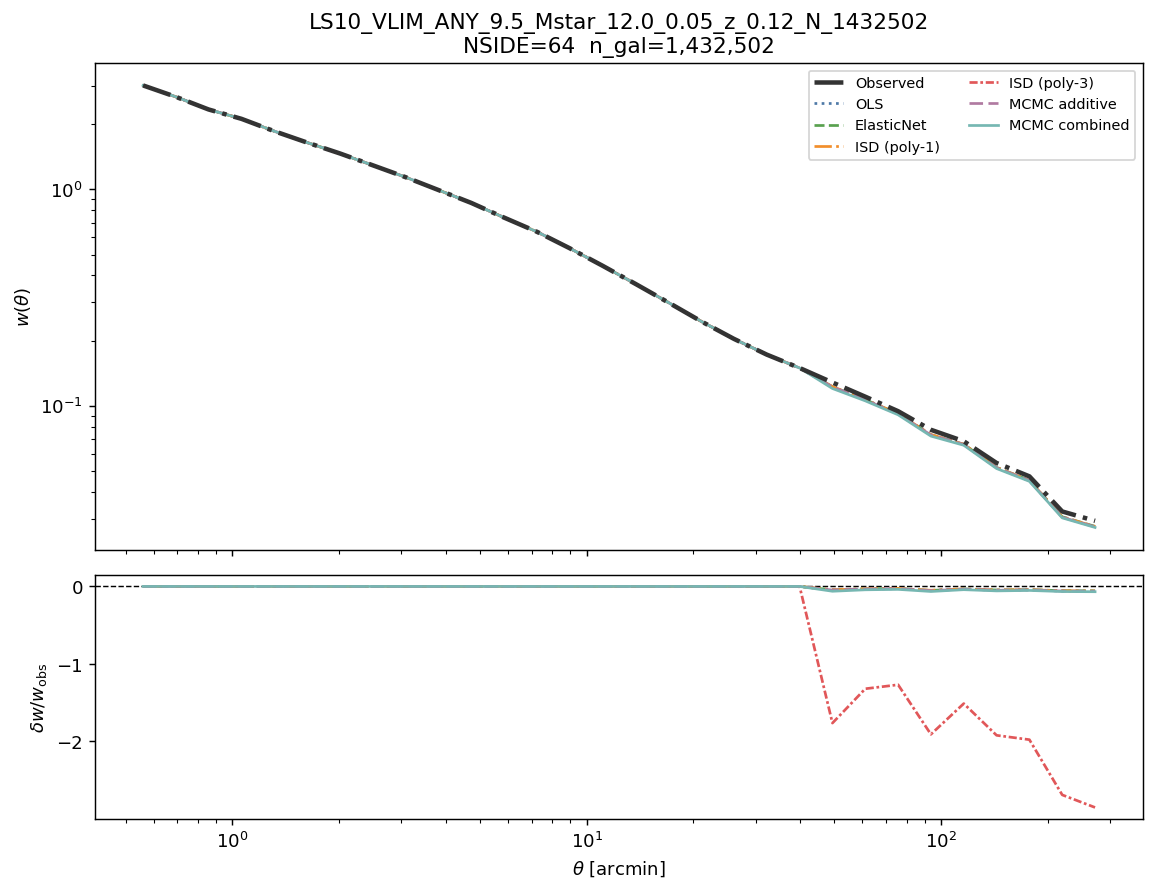
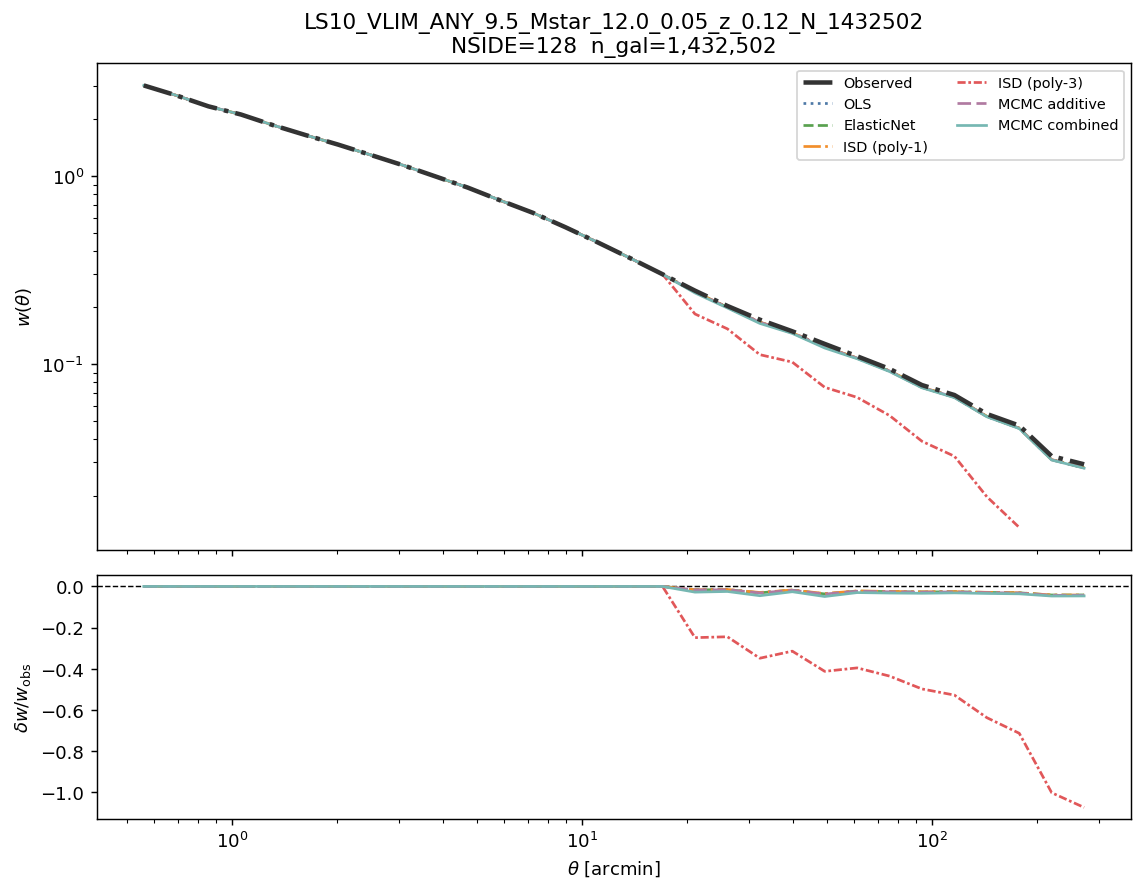
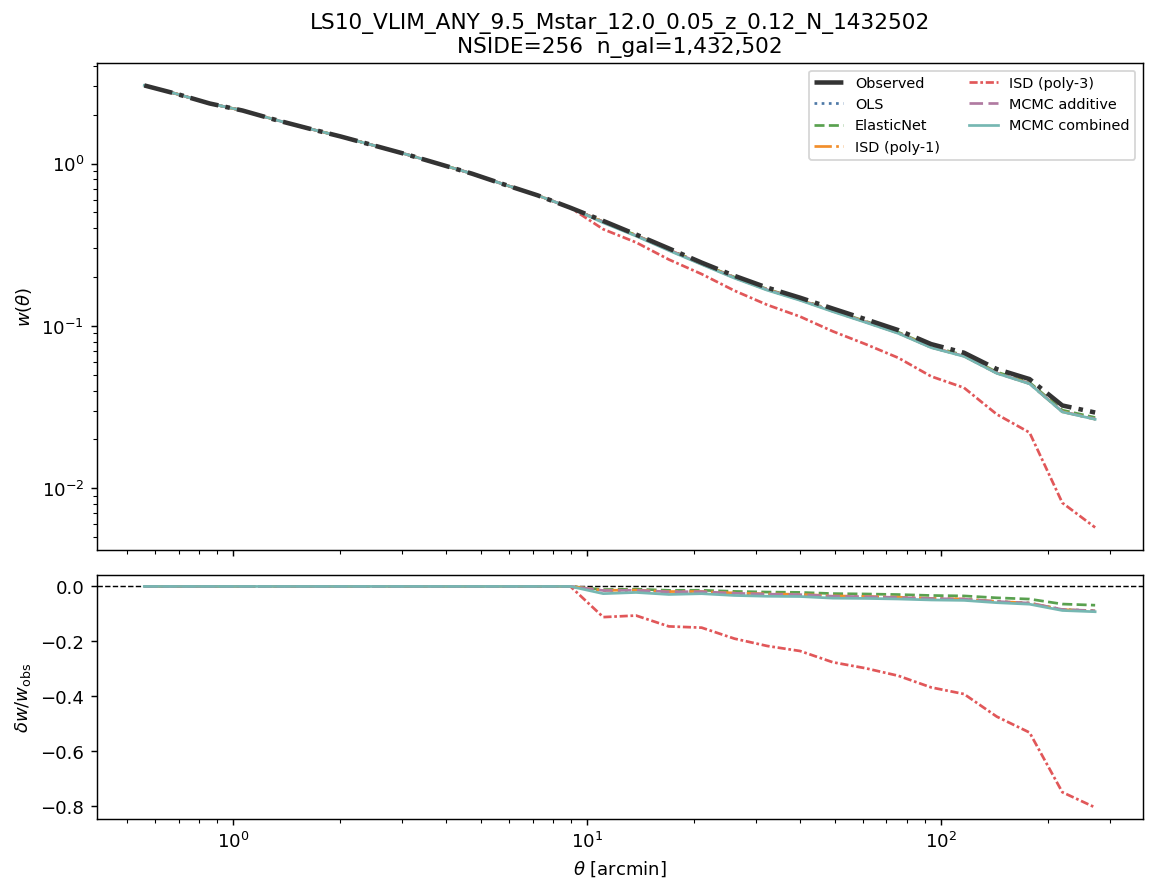
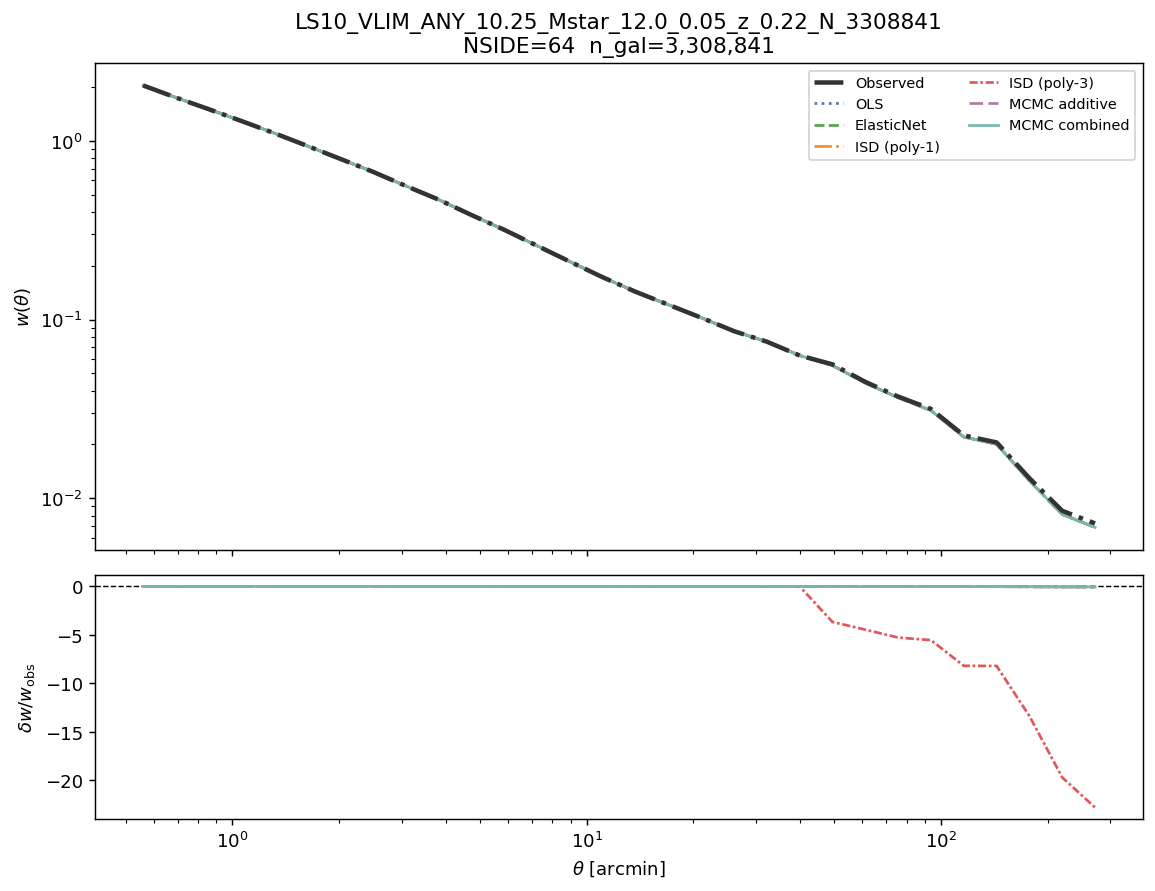
For each sample: weight maps and histograms at all four NSIDEs, angular clustering w(θ) comparing observed and six corrected measurements, and a table of key numbers.
log M* ≥ 9.0, z < 0.08 (N = 523 486)
Systematic weight maps — log M* ≥ 9.0
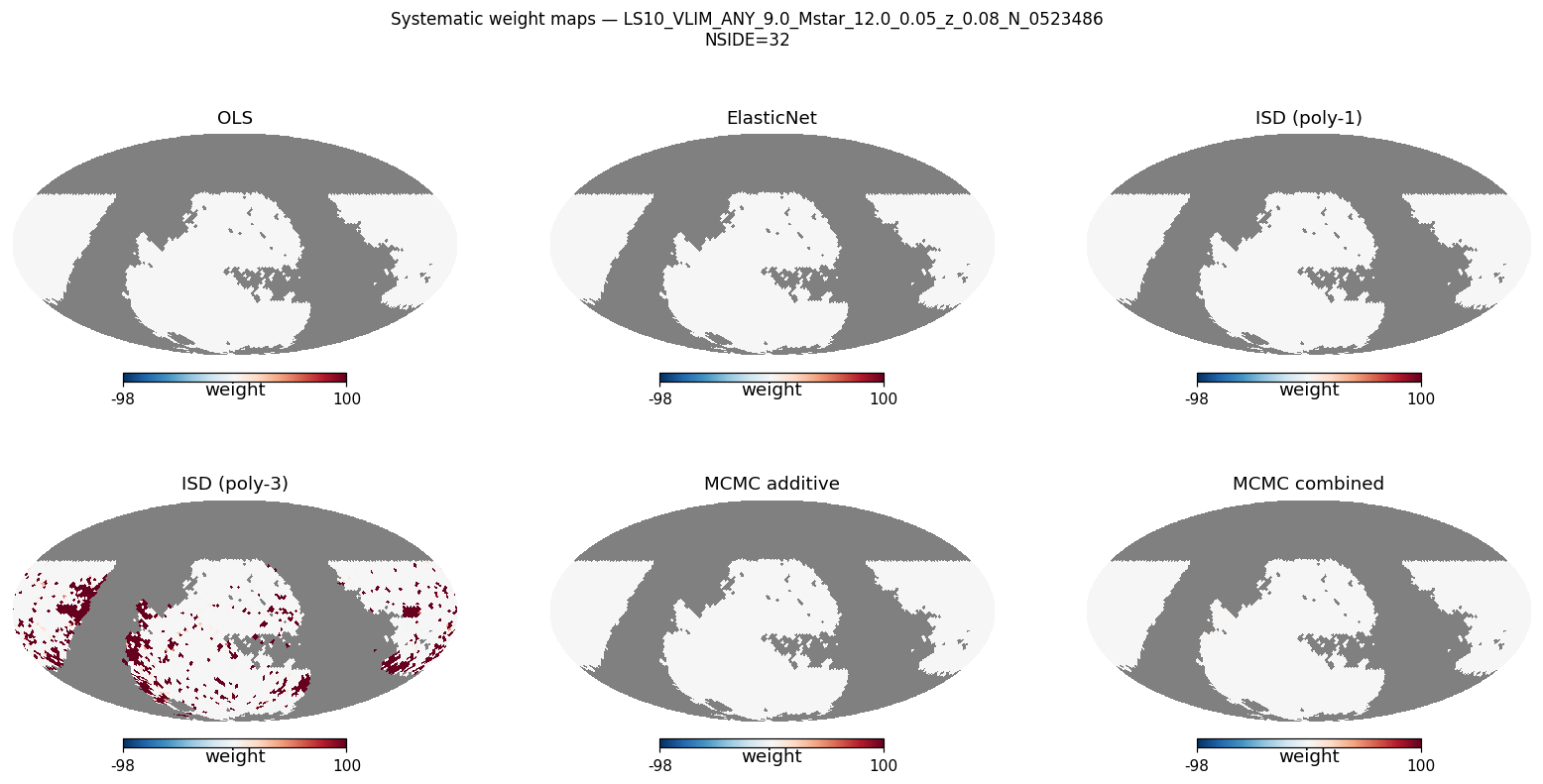
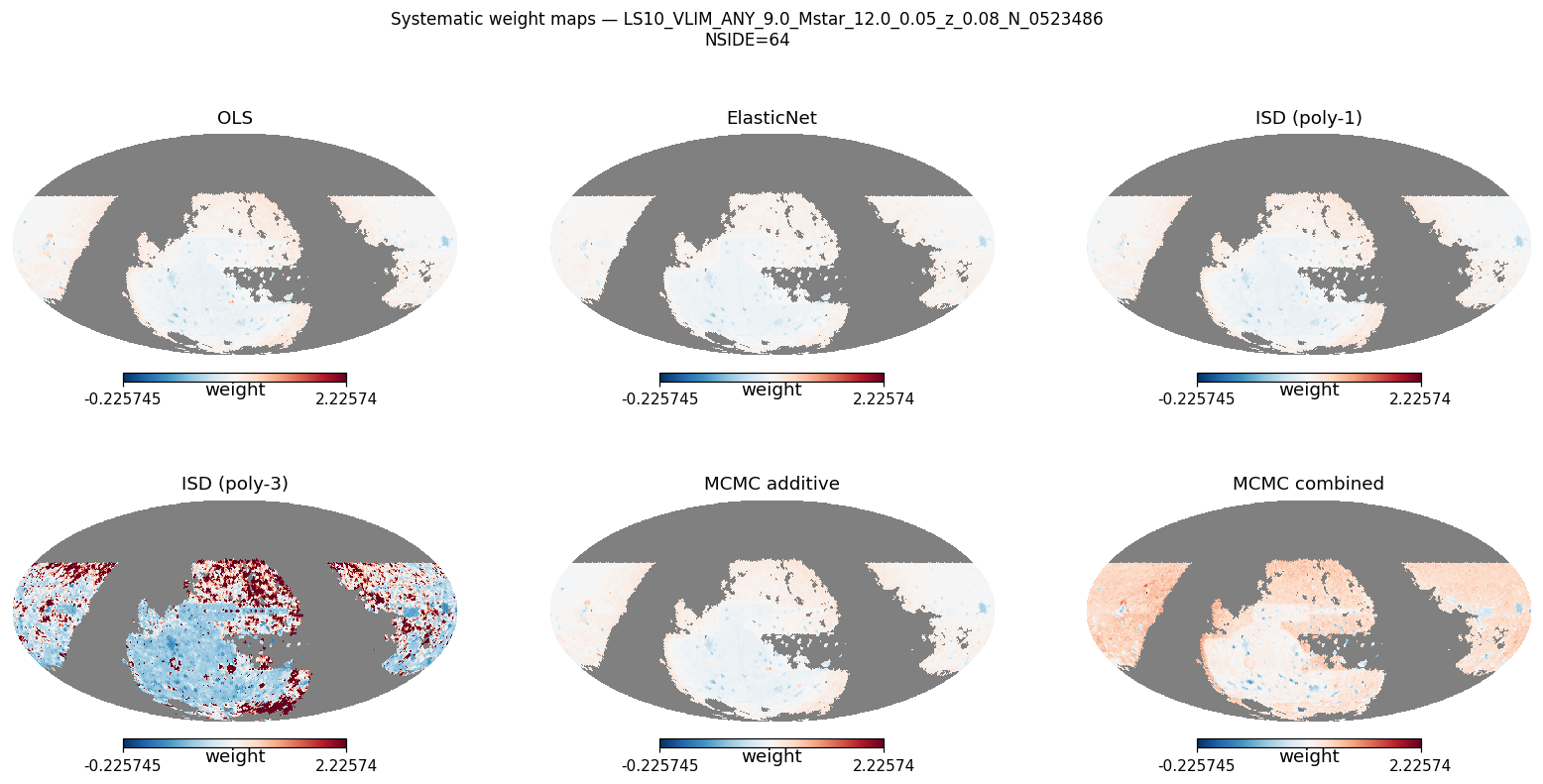
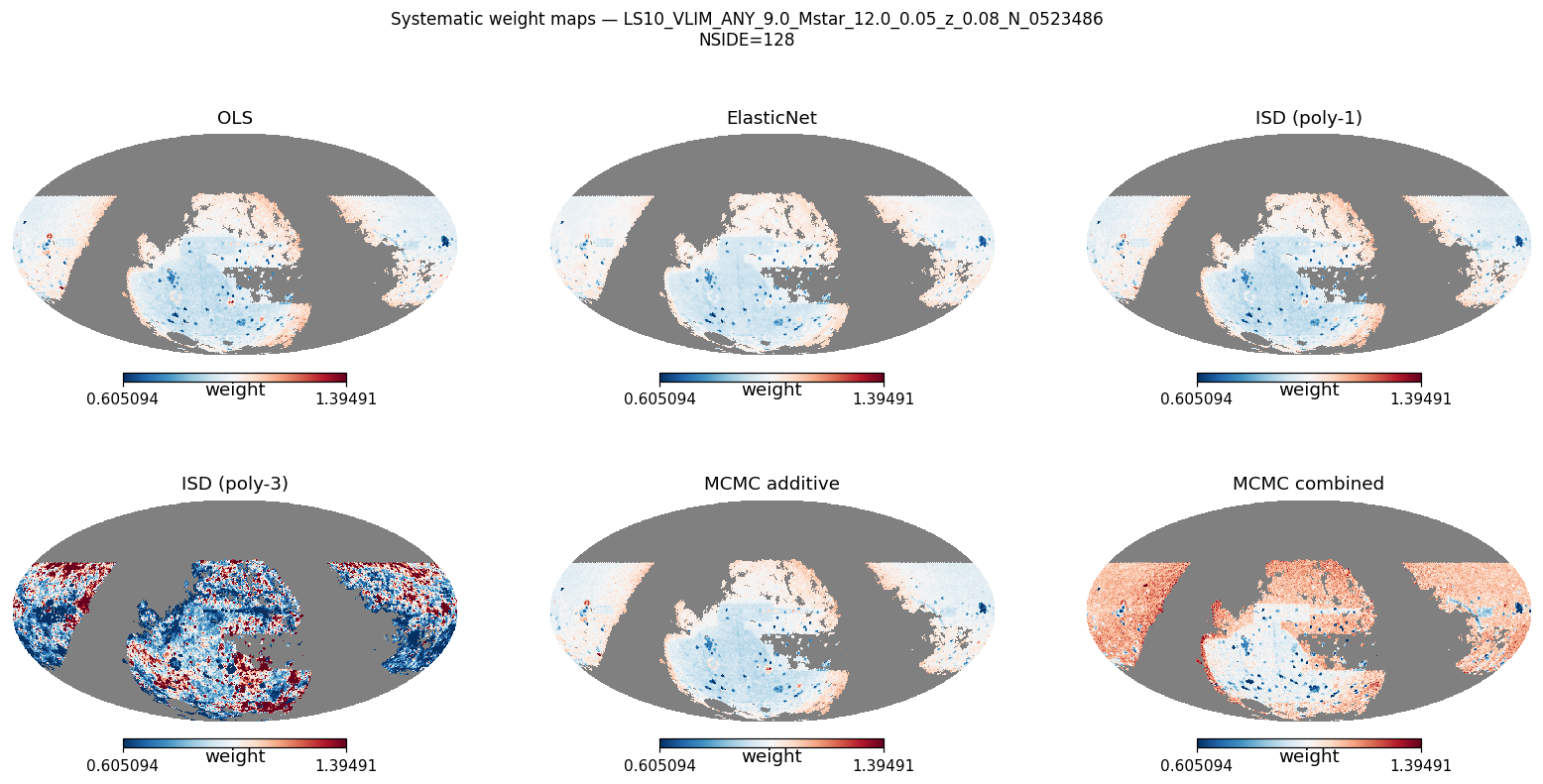
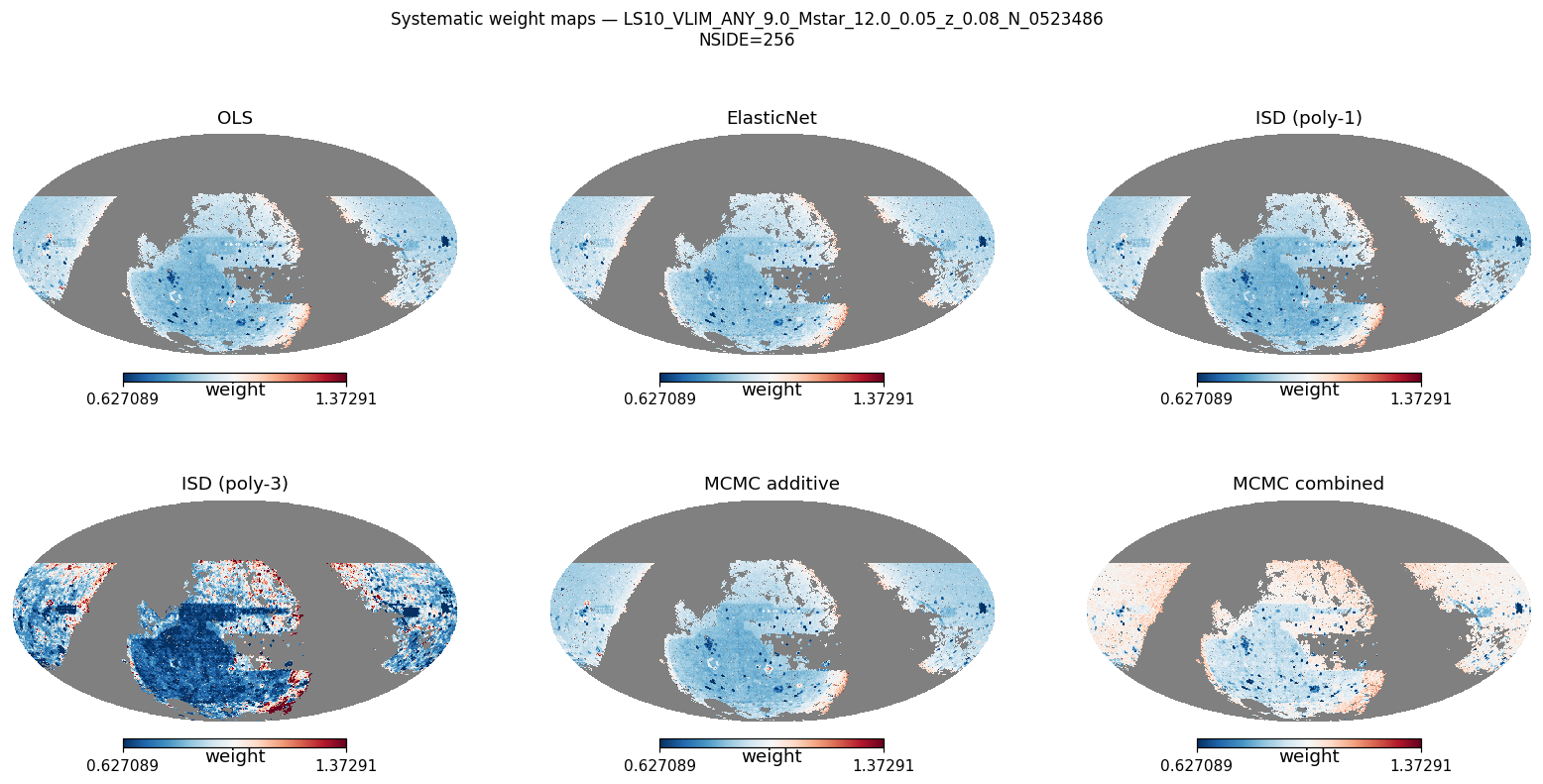
Weight distributions — log M* ≥ 9.0
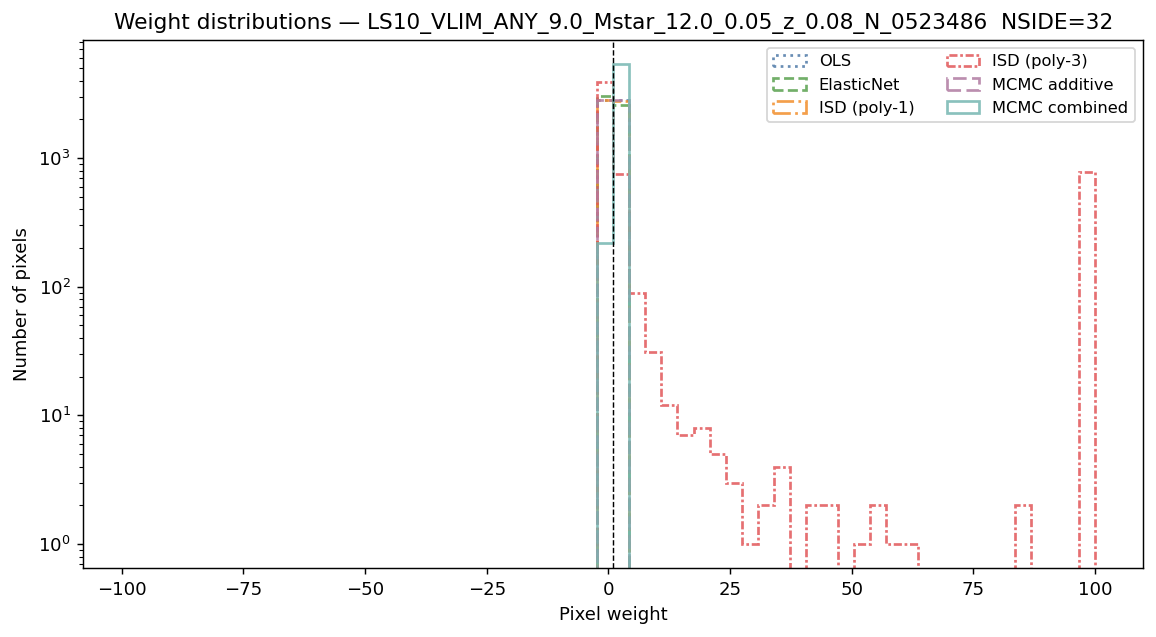
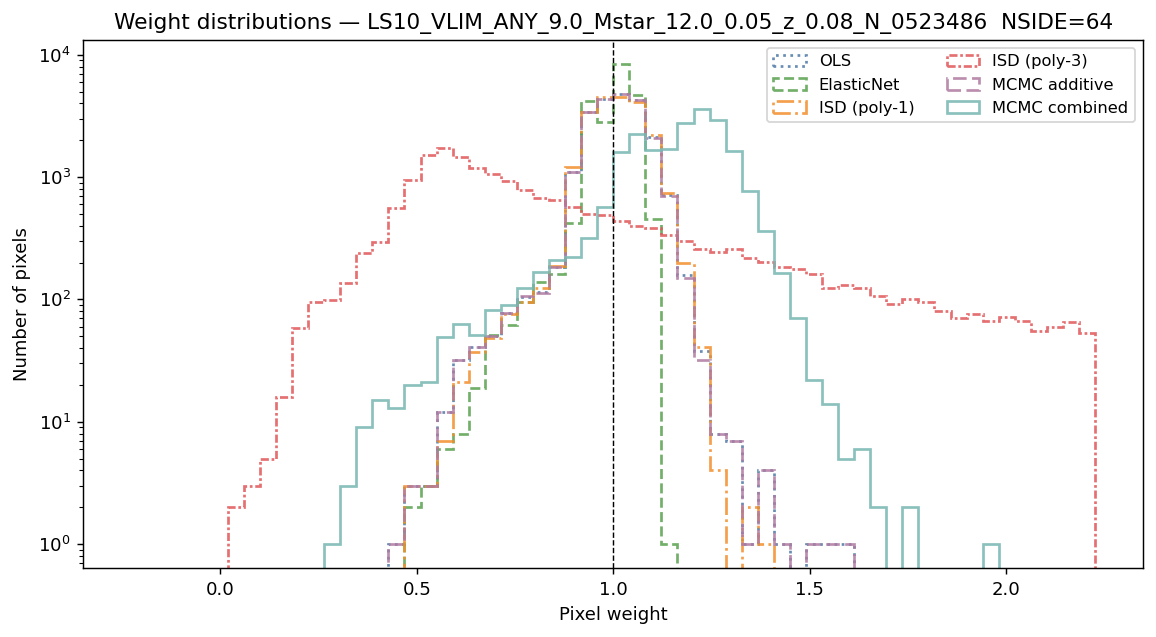
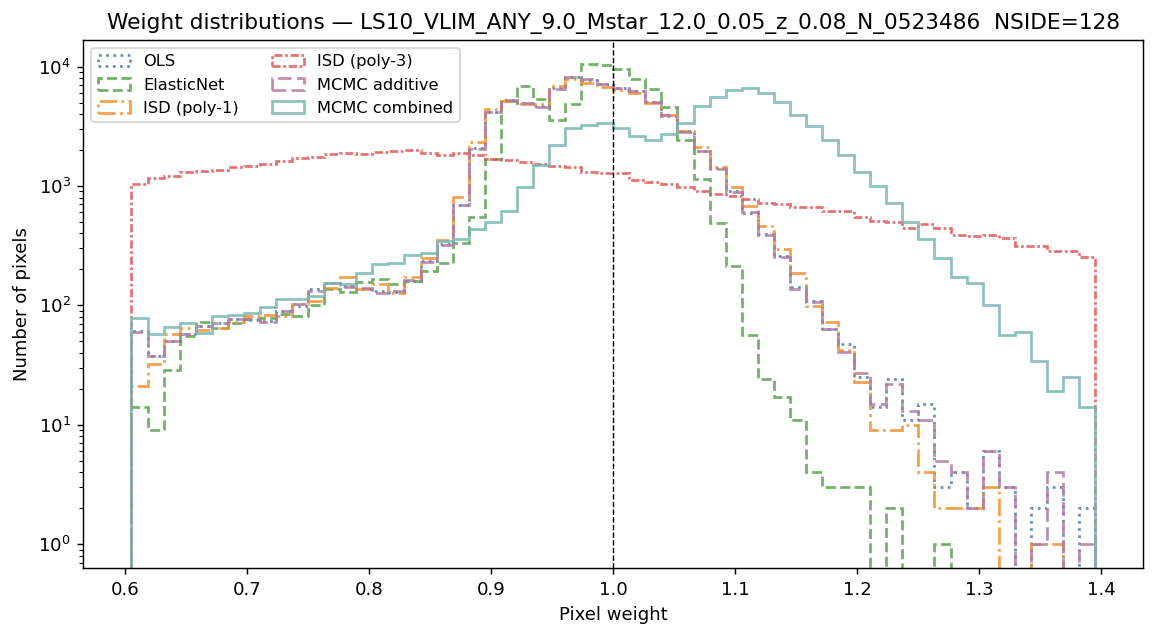
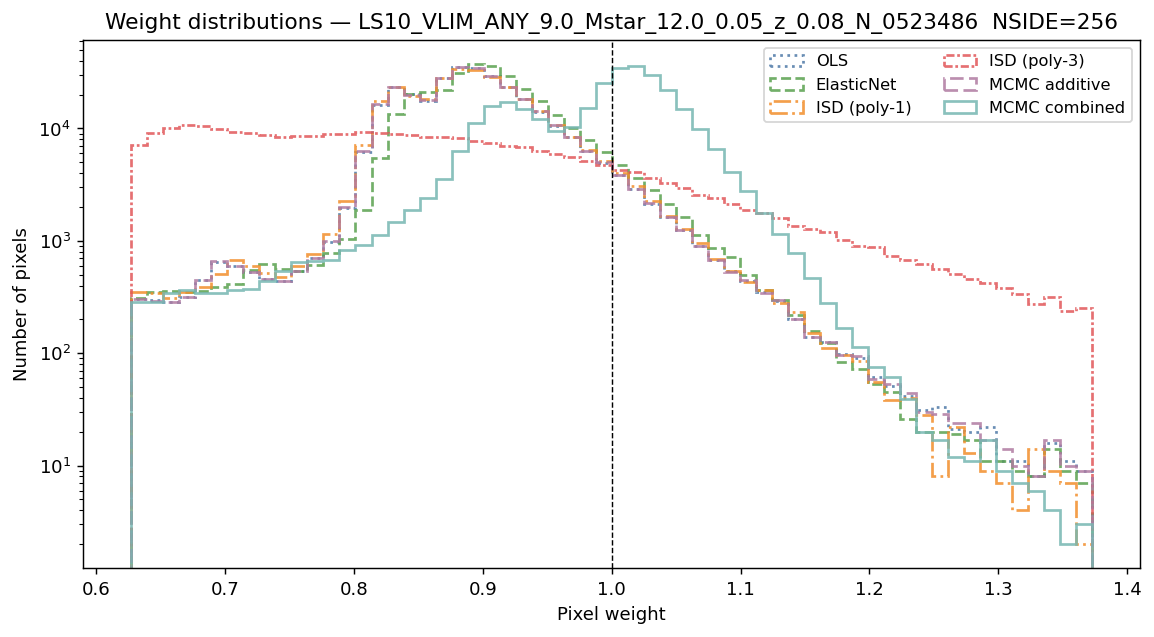
Angular clustering w(θ) — observed and corrected (one line per method) — log M* ≥ 9.0
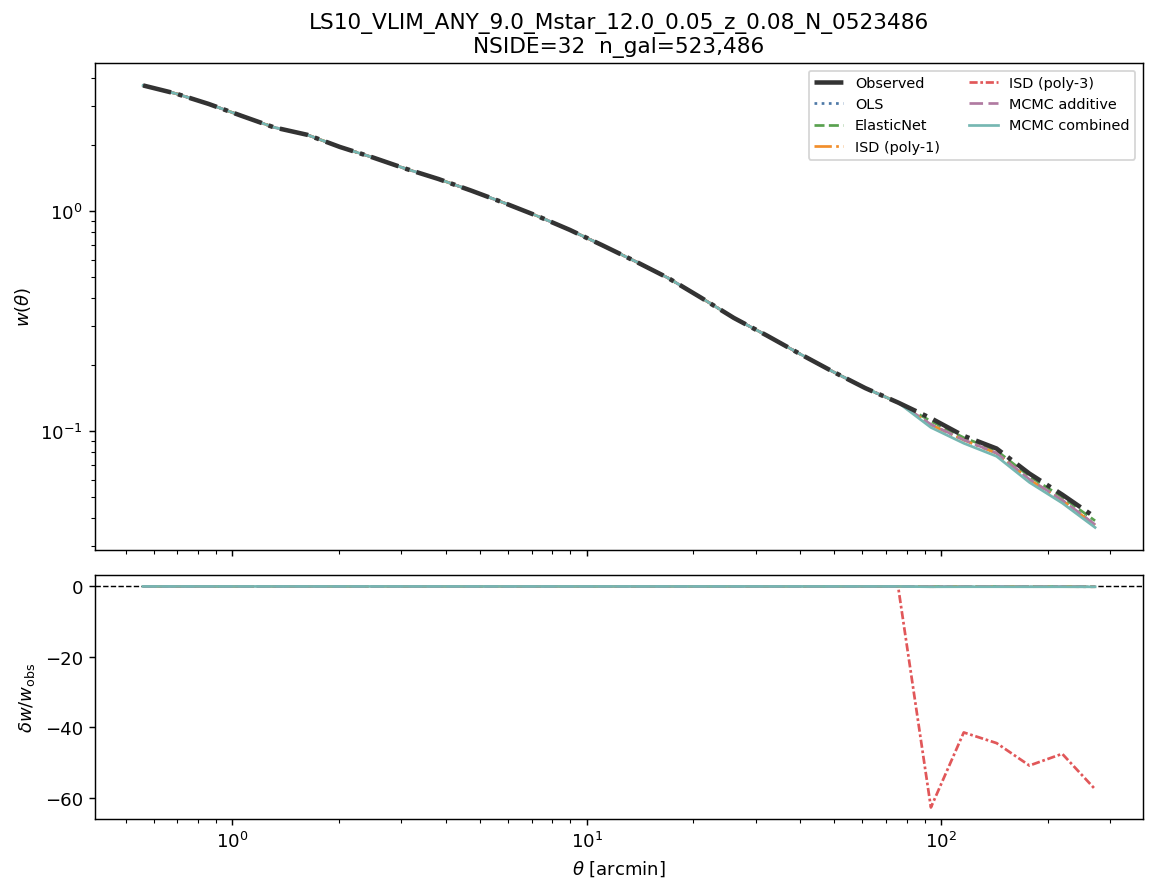
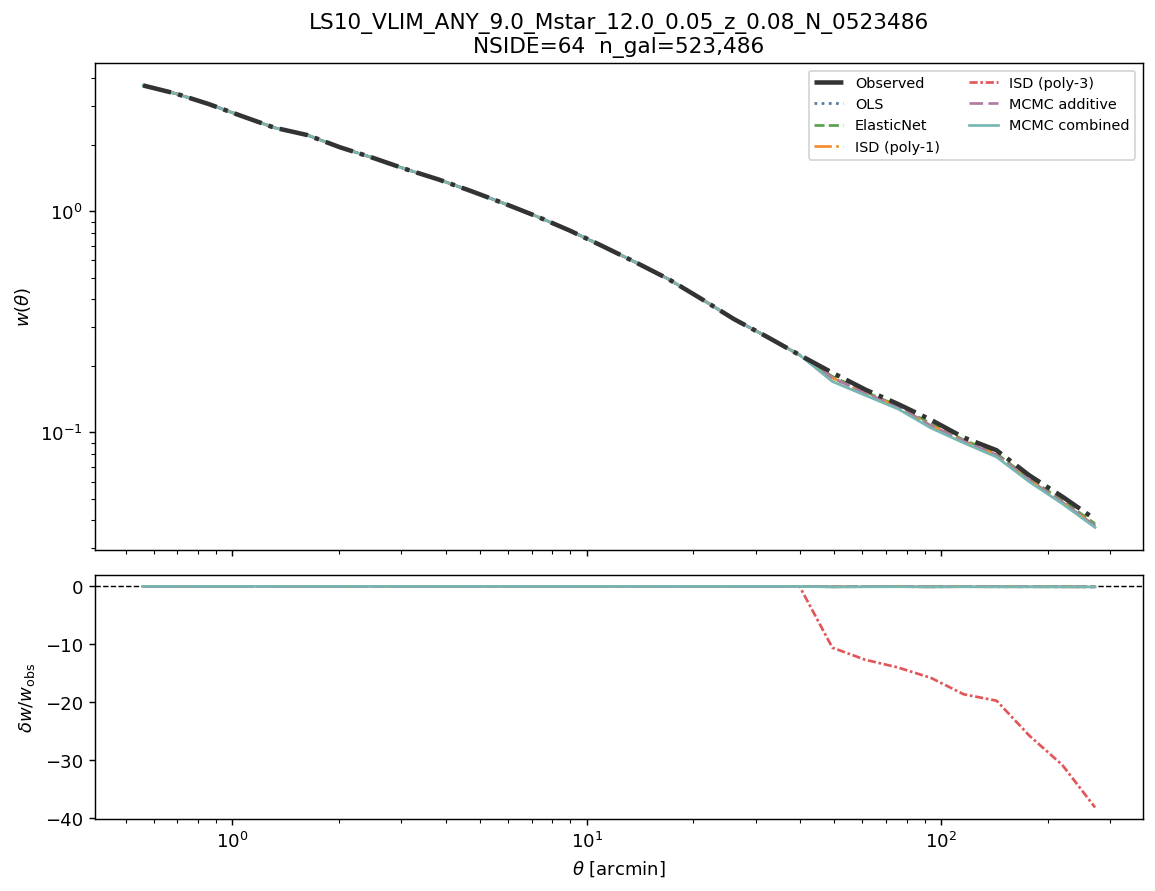
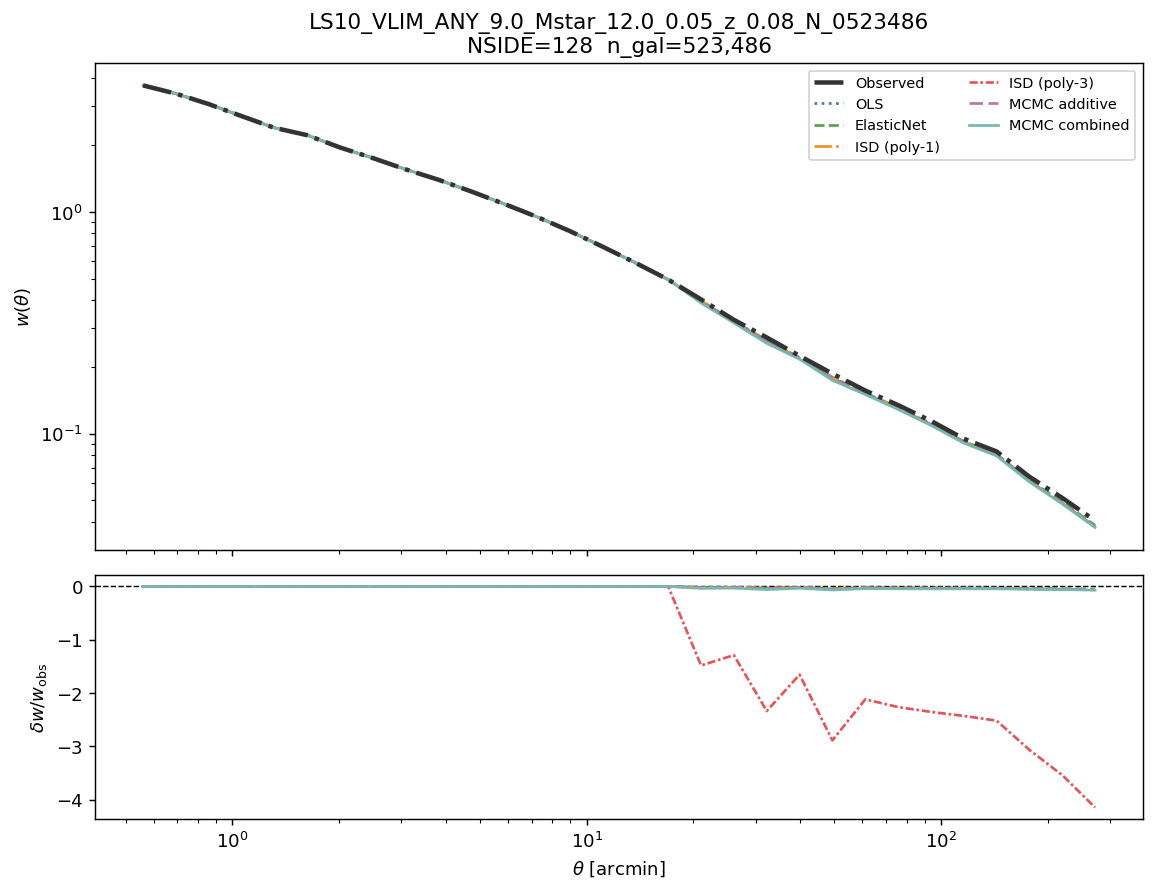
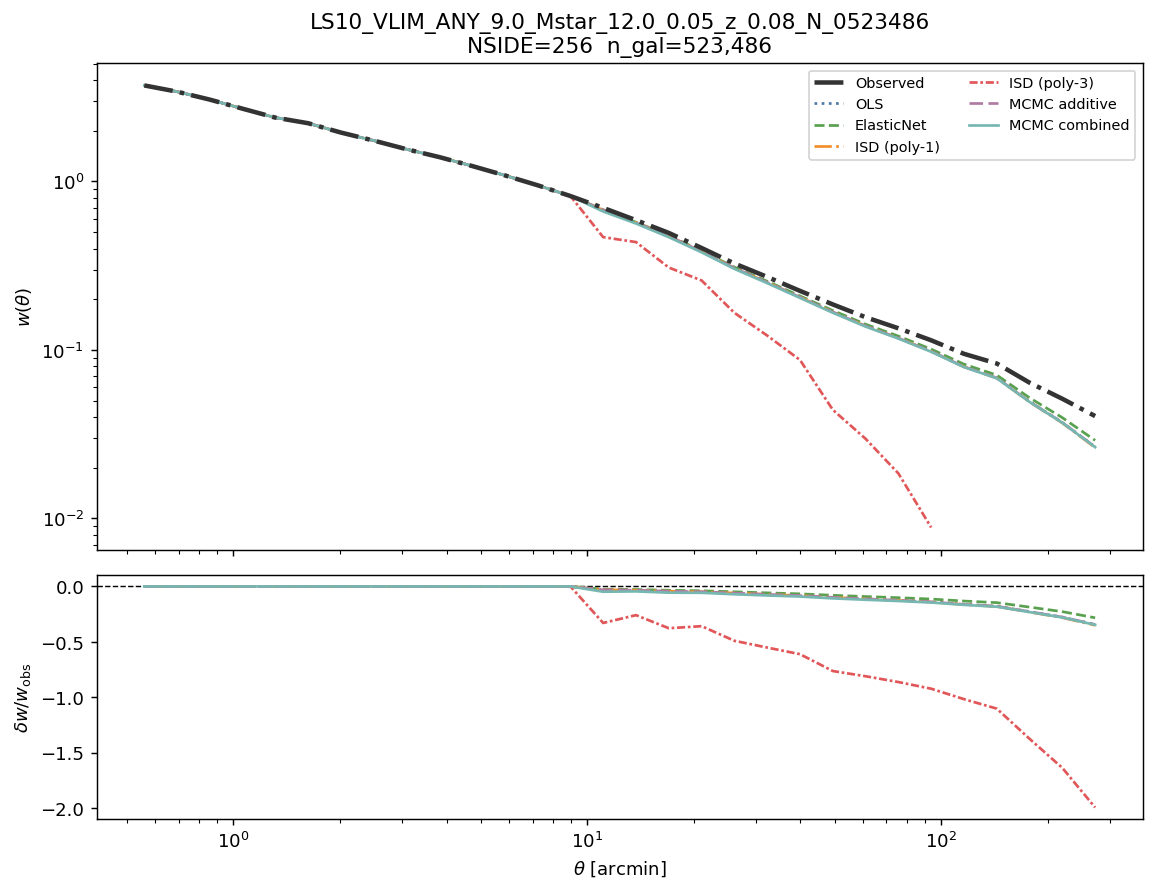
Parameter |
NSIDE 32 |
NSIDE 64 |
NSIDE 128 |
NSIDE 256 |
|---|---|---|---|---|
Ngal |
523 486 |
523 486 |
523 486 |
523 486 |
Npix (good) |
5612 |
21563 |
84367 |
324258 |
LRT λLR (dof=11) |
404.2 (Yes) |
1489.5 (Yes) |
3523.5 (Yes) |
7590.4 (Yes) |
σ̂ OLS |
0.5474 |
0.6760 |
0.9909 |
1.6568 |
σ̂ ElasticNet |
0.5491 |
0.6768 |
0.9912 |
1.6570 |
σ̂ ISD-1 |
0.5474 |
0.6760 |
0.9910 |
1.6568 |
σ̂ ISD-3 ‡ |
2.9223 |
3.2810 |
1.4628 |
1.7204 |
σ̂ MCMC-add |
0.5483 |
0.6762 |
0.9911 |
1.6568 |
σ̂ MCMC-comb |
0.6736 |
0.7511 |
1.0288 |
1.6008 |
MCMC-add acc. frac. |
0.388 |
0.390 |
0.388 |
0.387 |
MCMC-comb acc. frac. |
0.285 |
0.296 |
0.298 |
0.310 |
Dominant template |
ns_fnt |
ns_fnt |
ns_fnt |
ns_fnt |
δw/w at 30′ |
— |
-7.2 % |
— |
— |
- ‡ ISD-3 uses a degree-3 polynomial expansion and is unreliable at all
resolutions. Do not use ISD-3 weights for any science analysis.
See also
BGS VLIM log M* ≥ 9.0, z < 0.08 — detailed systematic analysis — full template amplitude tables, weight statistics, and cosmological analysis verdict for log M* ≥ 9.0.
log M* ≥ 9.5, z < 0.12 (N = 1 432 502)
Systematic weight maps — log M* ≥ 9.5
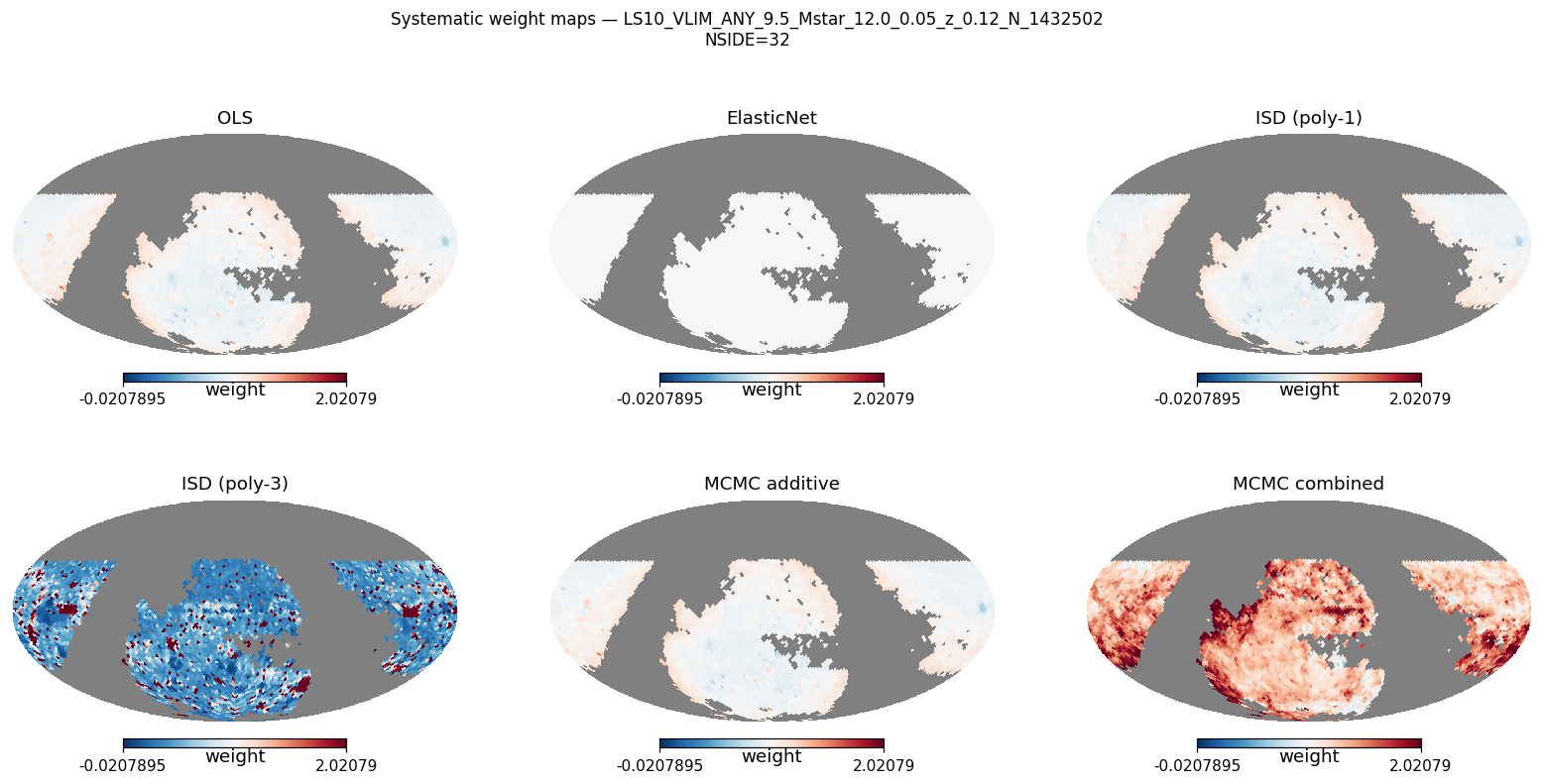
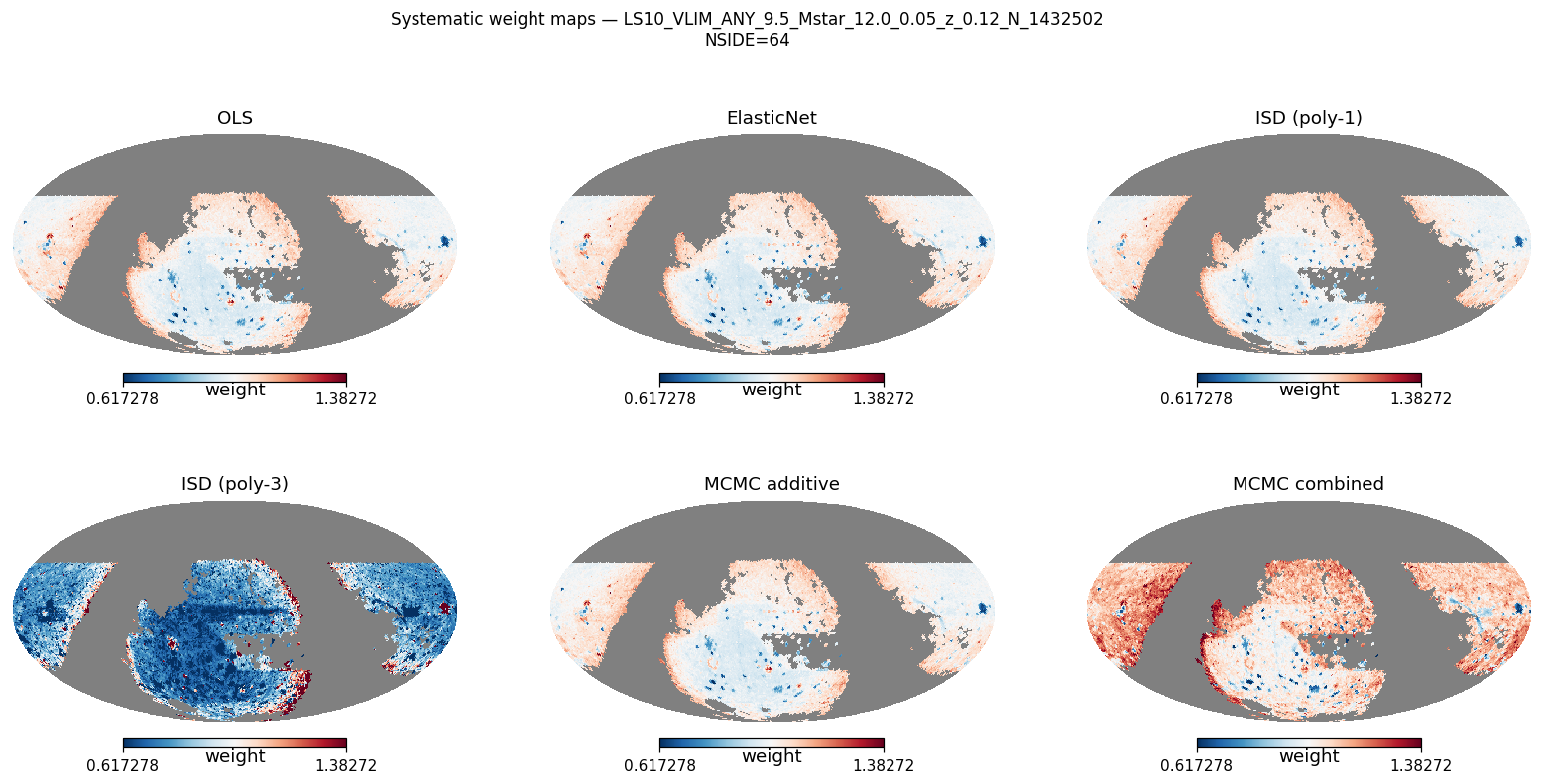
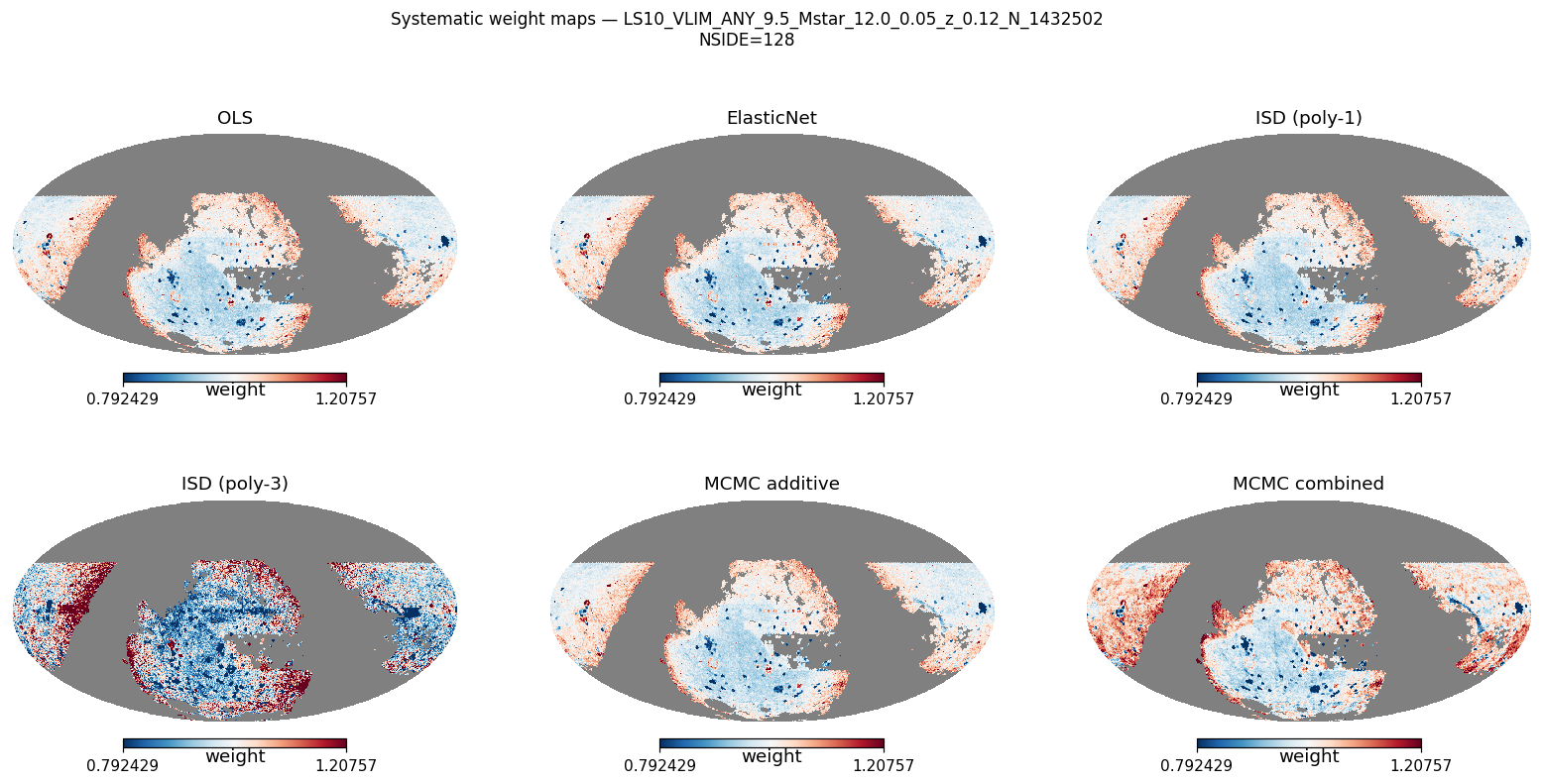
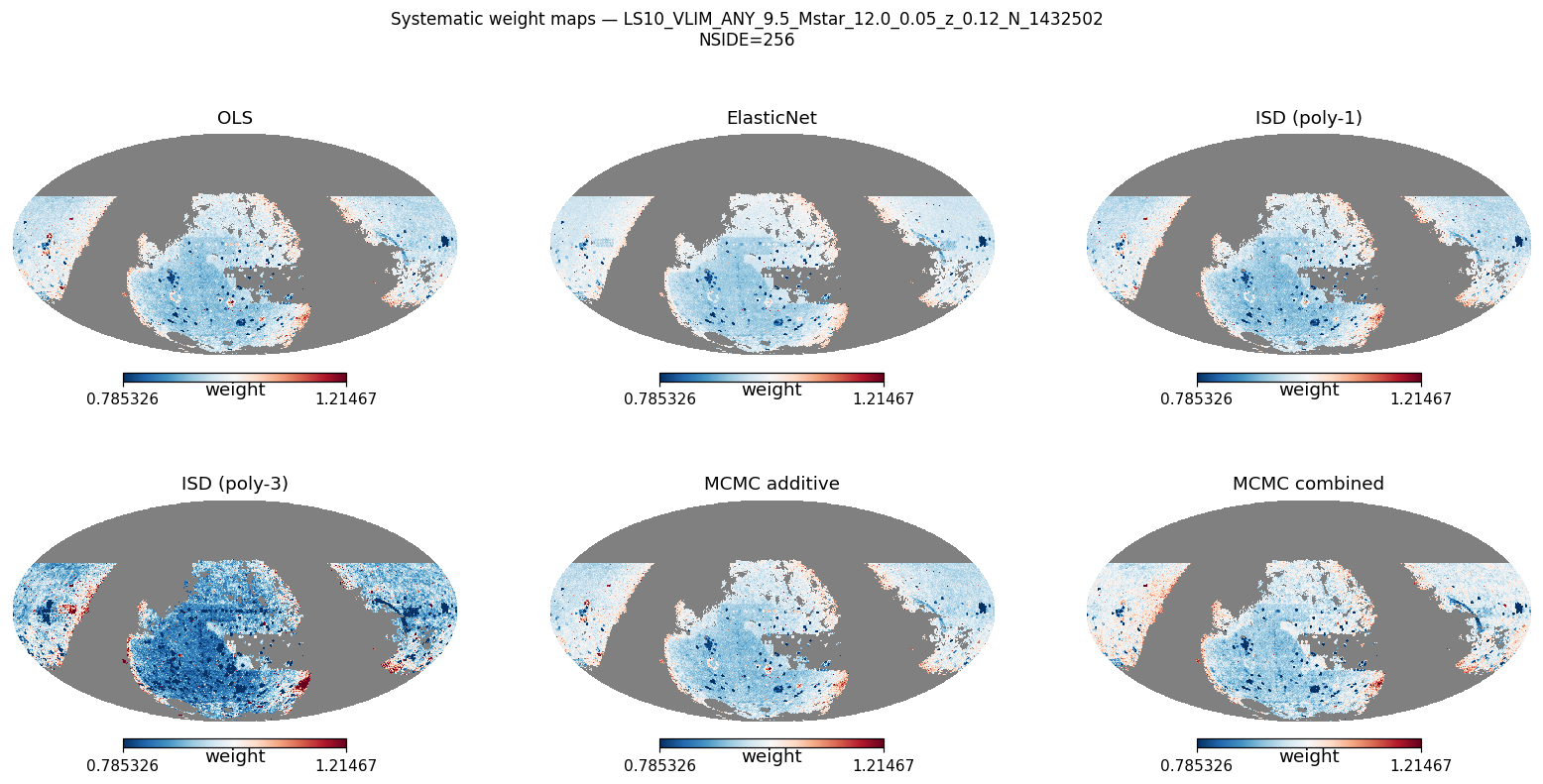
Weight distributions — log M* ≥ 9.5
Angular clustering w(θ) — observed and corrected (one line per method) — log M* ≥ 9.5
Parameter |
NSIDE 32 |
NSIDE 64 |
NSIDE 128 |
NSIDE 256 |
|---|---|---|---|---|
Ngal |
1 432 502 |
1 432 502 |
1 432 502 |
1 432 502 |
Npix (good) |
5611 |
21637 |
84627 |
331787 |
LRT λLR (dof=11) |
621.5 (Yes) |
730.6 (Yes) |
2267.7 (Yes) |
5424.7 (Yes) |
σ̂ OLS |
0.4708 |
0.5239 |
0.7458 |
1.1021 |
σ̂ ElasticNet |
0.4757 |
0.5239 |
0.7458 |
1.1023 |
σ̂ ISD-1 |
0.4708 |
0.5239 |
0.7458 |
1.1022 |
σ̂ ISD-3 ‡ |
4.0550 |
0.7911 |
0.8344 |
1.1371 |
σ̂ MCMC-add |
0.4714 |
0.5240 |
0.7458 |
1.1022 |
σ̂ MCMC-comb |
0.6059 |
0.5545 |
0.7408 |
1.0519 |
MCMC-add acc. frac. |
0.387 |
0.391 |
0.389 |
0.388 |
MCMC-comb acc. frac. |
0.288 |
0.297 |
0.299 |
0.296 |
Dominant template |
ns_fnt |
ns_fnt |
ns_fnt |
ns_med |
δw/w at 30′ |
— |
-4.8 % |
— |
— |
- ‡ ISD-3 uses a degree-3 polynomial expansion and is unreliable at all
resolutions. Do not use ISD-3 weights for any science analysis.
See also
BGS VLIM log M* ≥ 9.5, z < 0.12 — detailed systematic analysis — full template amplitude tables, weight statistics, and cosmological analysis verdict for log M* ≥ 9.5.
log M* ≥ 10.0, z < 0.18 (N = 2 759 238)
Systematic weight maps — log M* ≥ 10.0
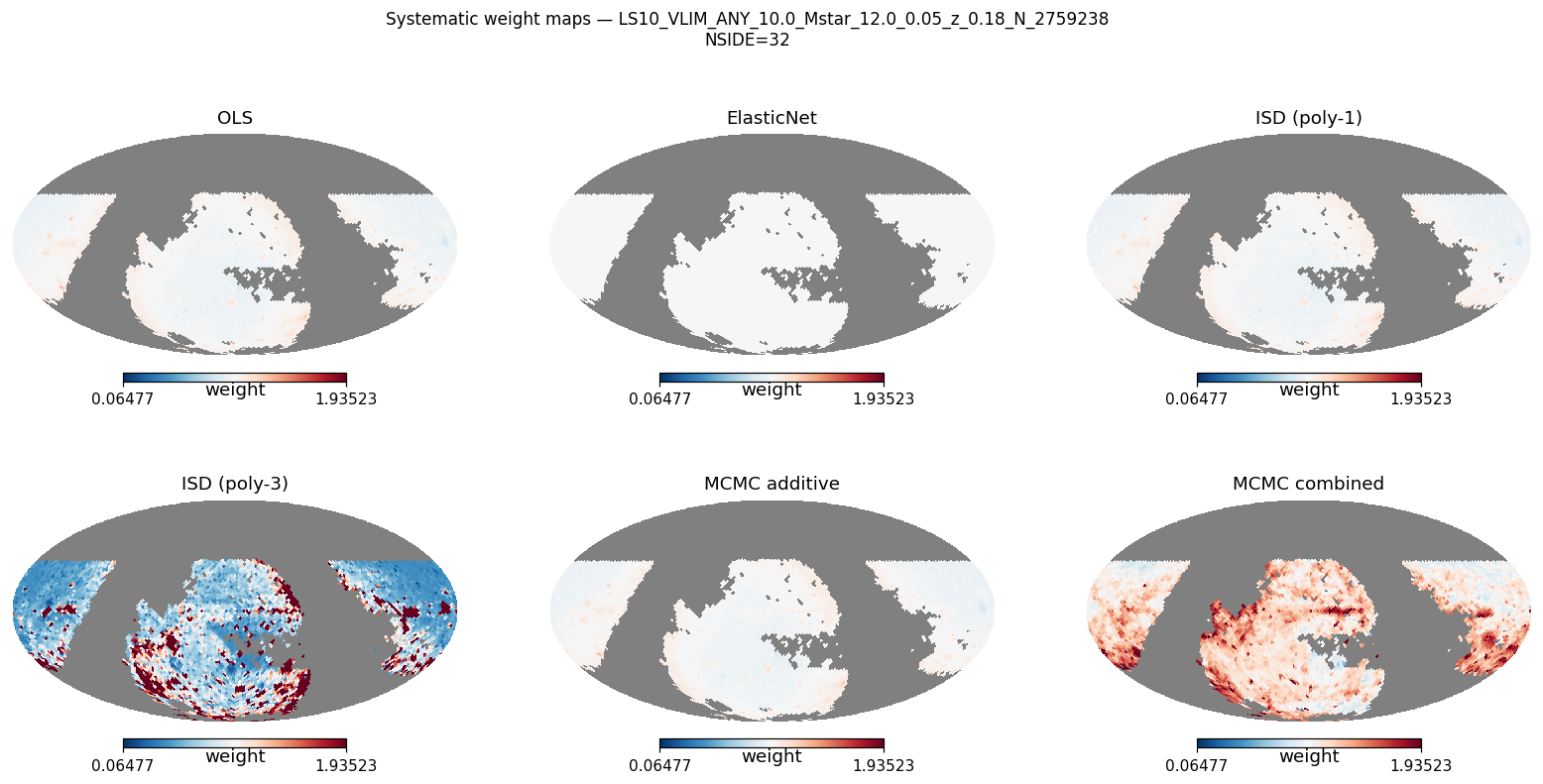
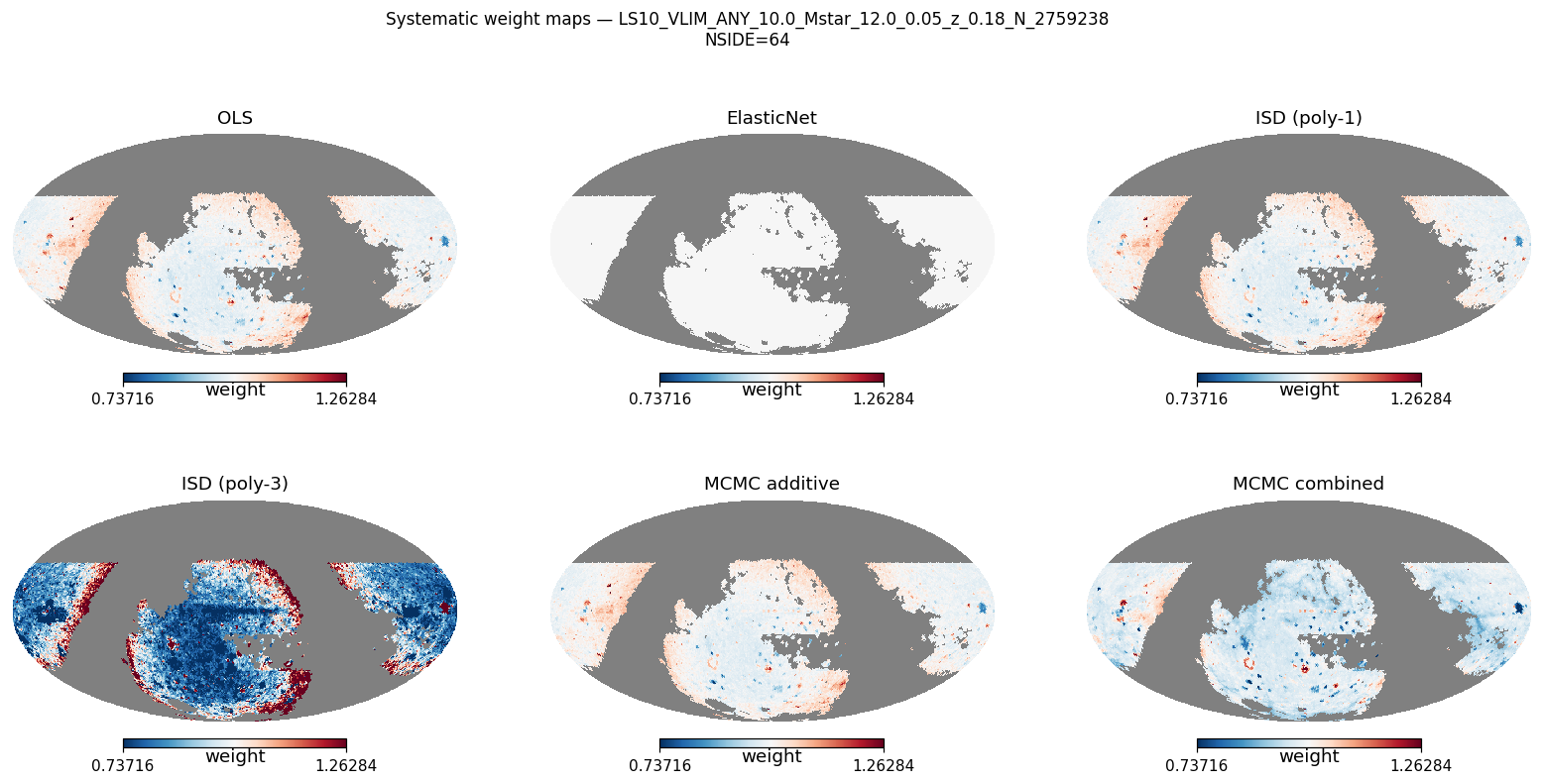
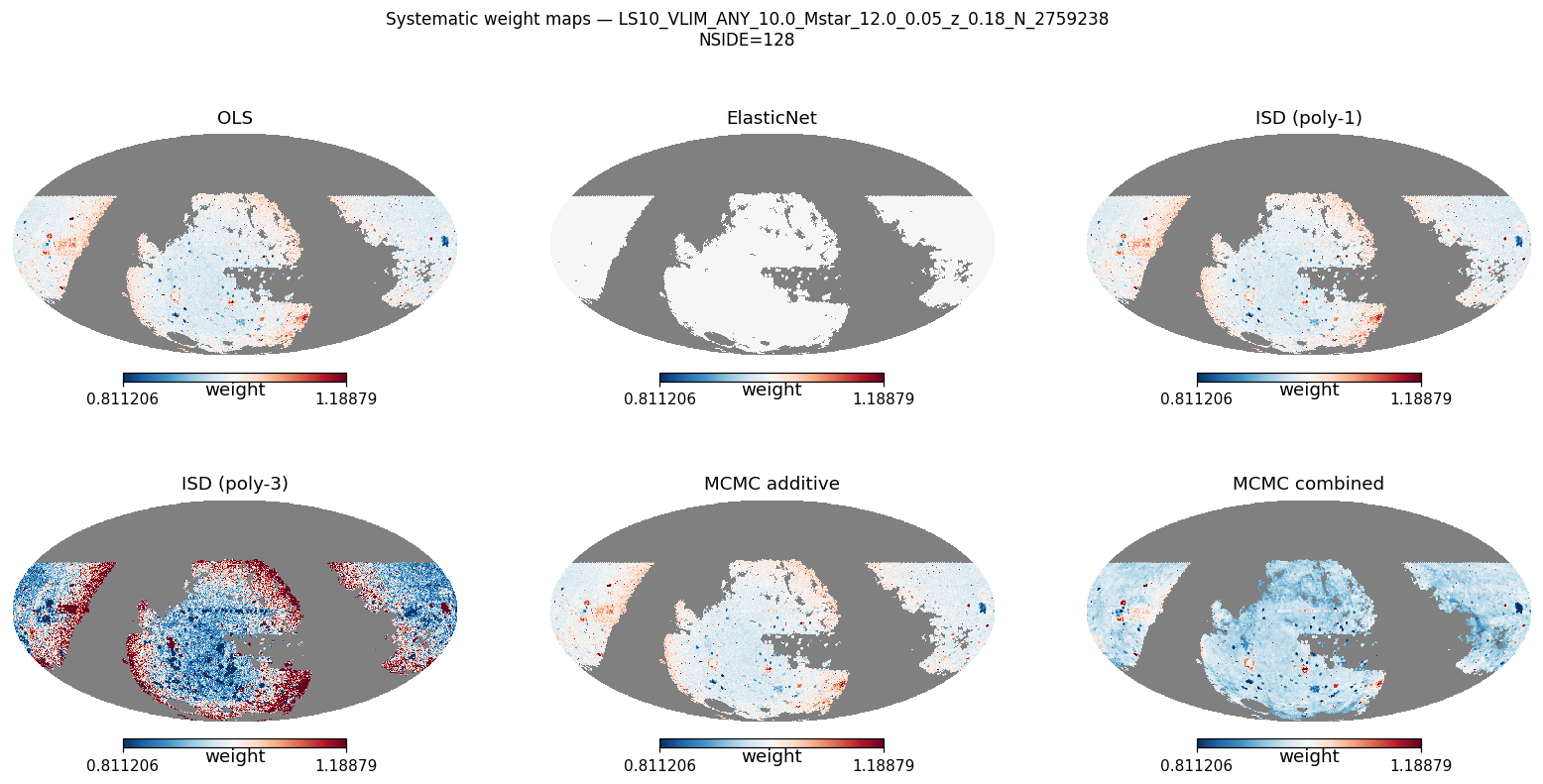
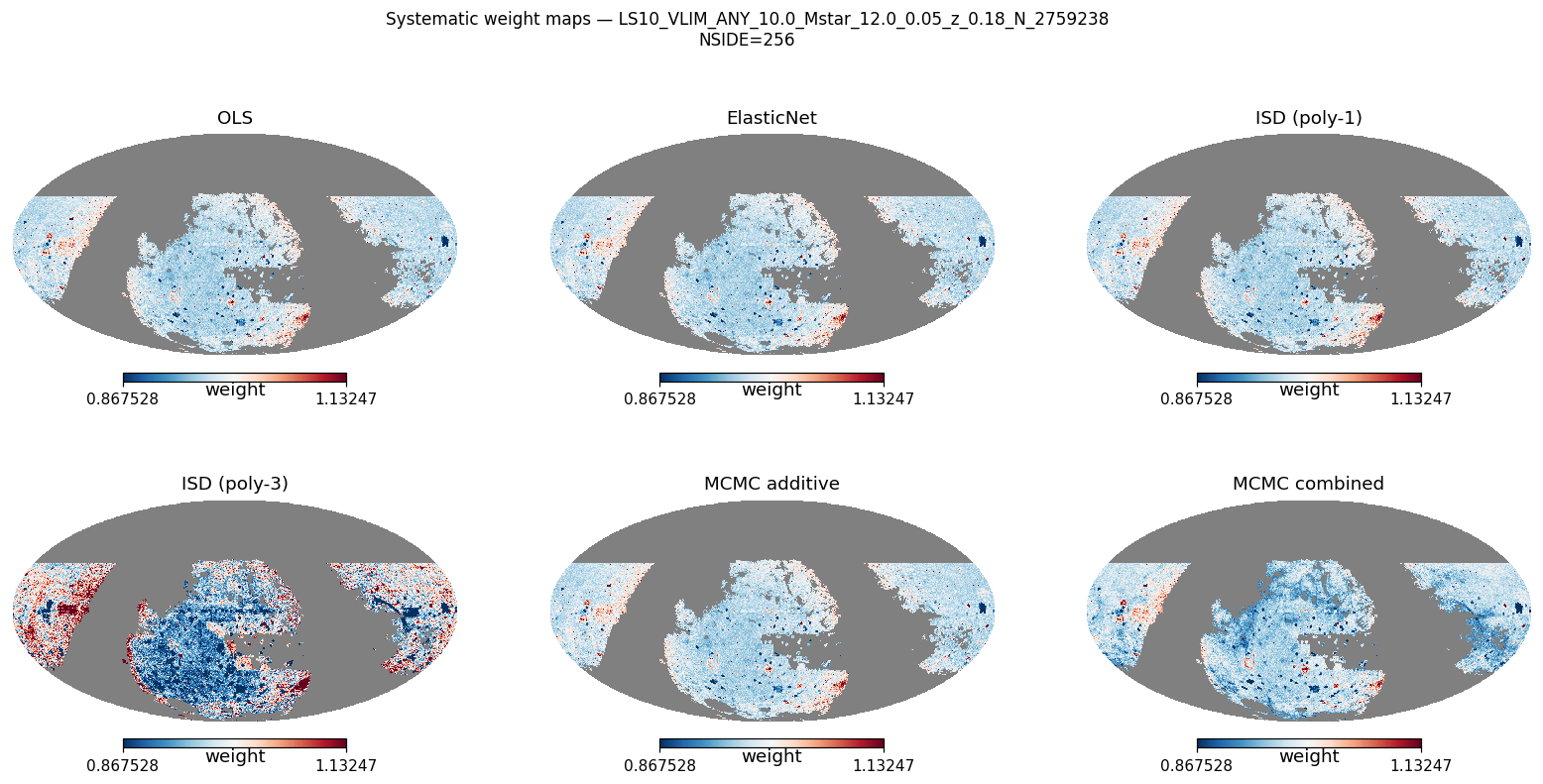
Weight distributions — log M* ≥ 10.0
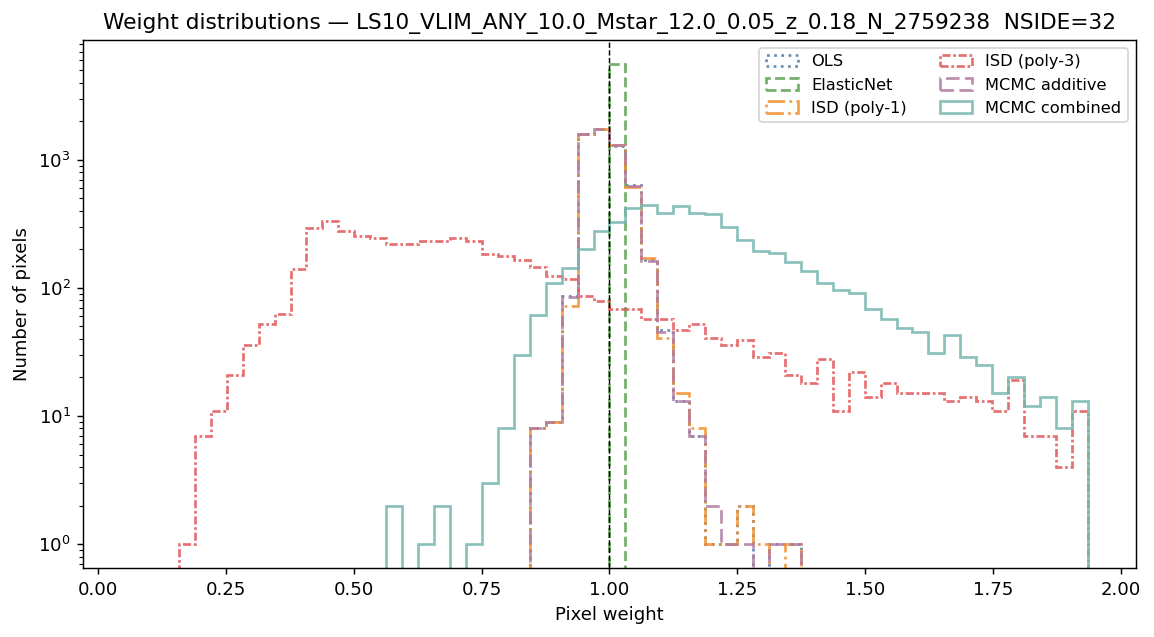
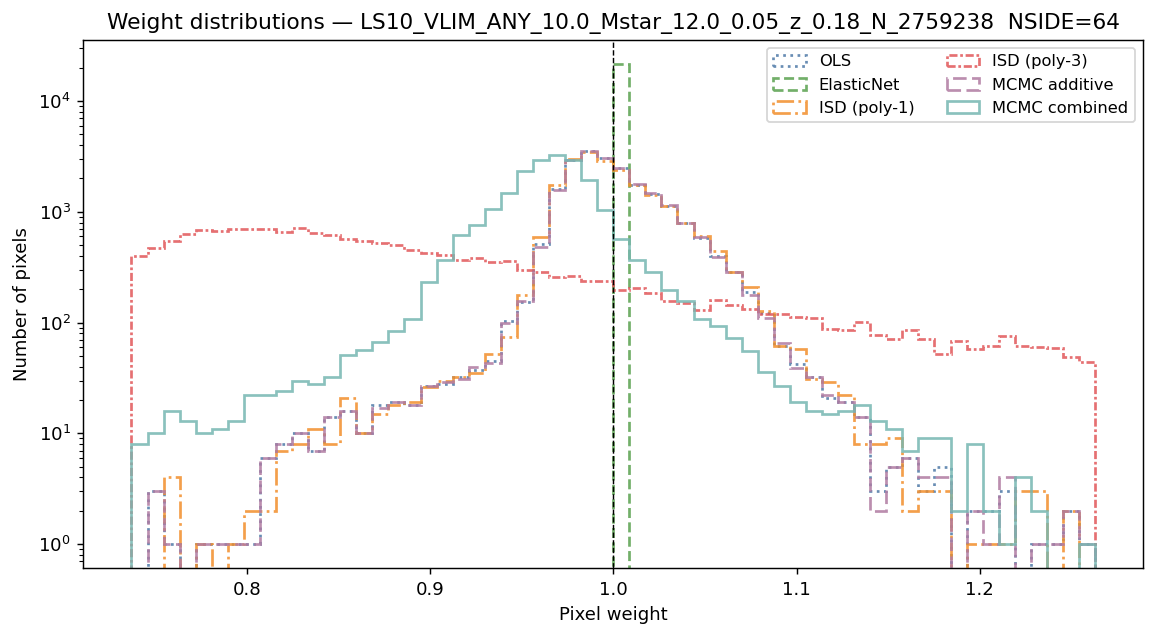
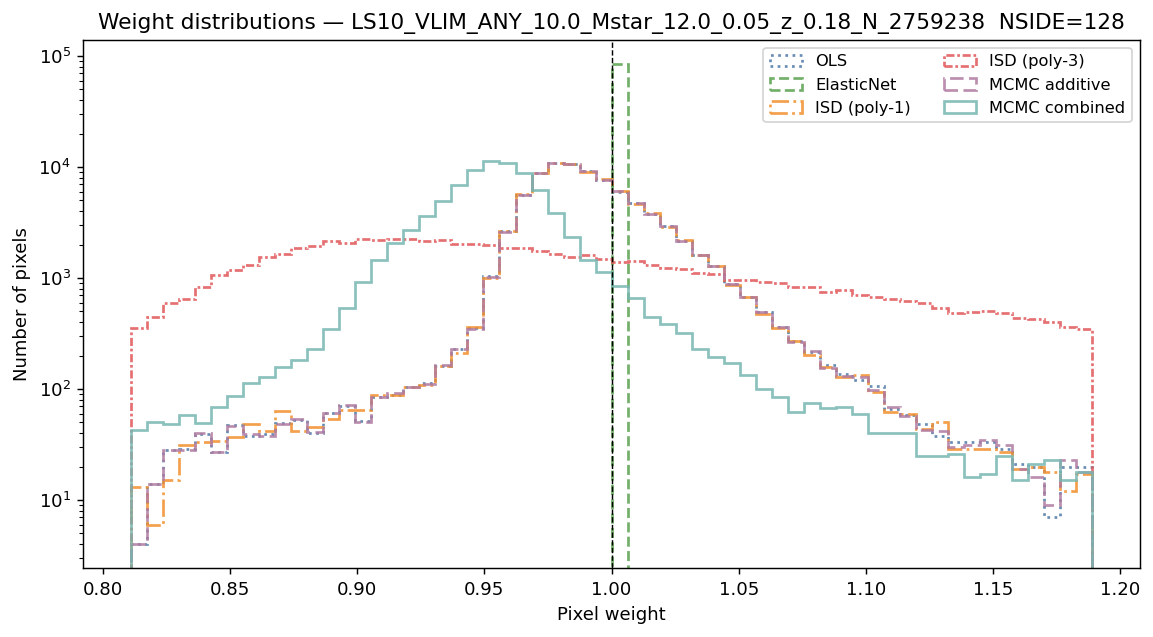
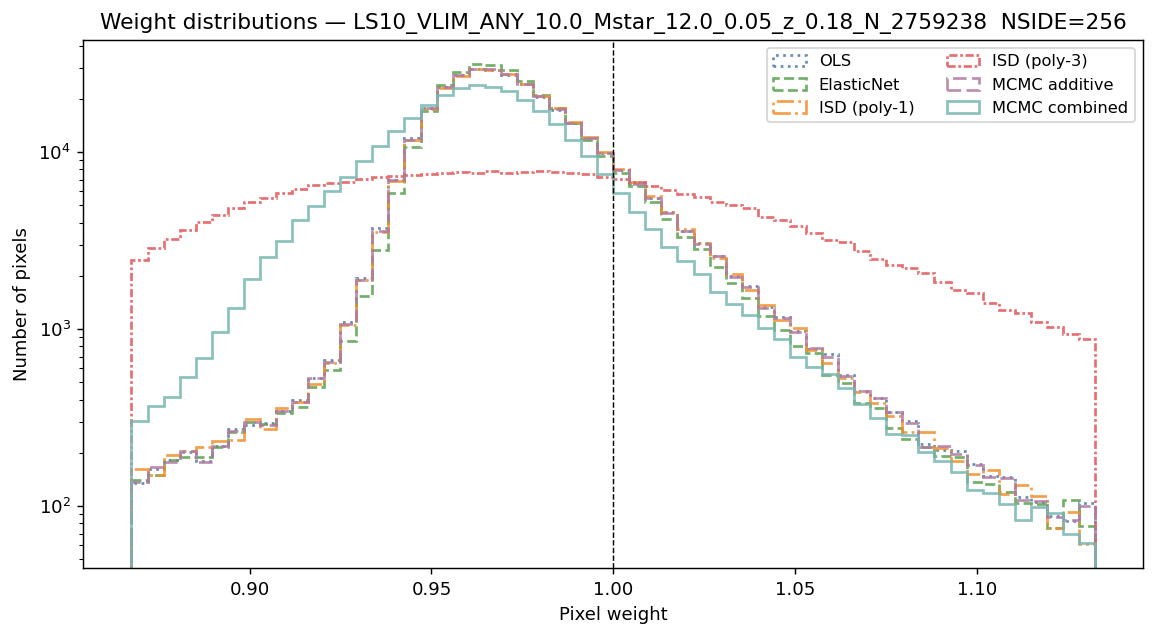
Angular clustering w(θ) — observed and corrected (one line per method) — log M* ≥ 10.0
Parameter |
NSIDE 32 |
NSIDE 64 |
NSIDE 128 |
NSIDE 256 |
|---|---|---|---|---|
Ngal |
2 759 238 |
2 759 238 |
2 759 238 |
2 759 238 |
Npix (good) |
5616 |
21667 |
84860 |
332734 |
LRT λLR (dof=11) |
668.9 (Yes) |
123.9 (Yes) |
324.8 (Yes) |
1400.4 (Yes) |
σ̂ OLS |
0.3801 |
0.3969 |
0.5606 |
0.8173 |
σ̂ ElasticNet |
0.3820 |
0.3982 |
0.5616 |
0.8173 |
σ̂ ISD-1 |
0.3801 |
0.3969 |
0.5606 |
0.8173 |
σ̂ ISD-3 ‡ |
1.0389 |
0.7254 |
0.6472 |
0.8355 |
σ̂ MCMC-add |
0.3805 |
0.3969 |
0.5607 |
0.8173 |
σ̂ MCMC-comb |
0.4224 |
0.3817 |
0.5337 |
0.7855 |
MCMC-add acc. frac. |
0.386 |
0.389 |
0.388 |
0.386 |
MCMC-comb acc. frac. |
0.281 |
0.277 |
0.288 |
0.306 |
Dominant template |
ns_fnt |
ns_fnt |
ns_fnt |
ns_med |
δw/w at 30′ |
— |
-0.4 % |
— |
— |
- ‡ ISD-3 uses a degree-3 polynomial expansion and is unreliable at all
resolutions. Do not use ISD-3 weights for any science analysis.
See also
BGS VLIM log M* ≥ 10.0, z < 0.18 — detailed systematic analysis — full template amplitude tables, weight statistics, and cosmological analysis verdict for log M* ≥ 10.0.
log M* ≥ 10.25, z < 0.22 (N = 3 308 841)
Systematic weight maps — log M* ≥ 10.25
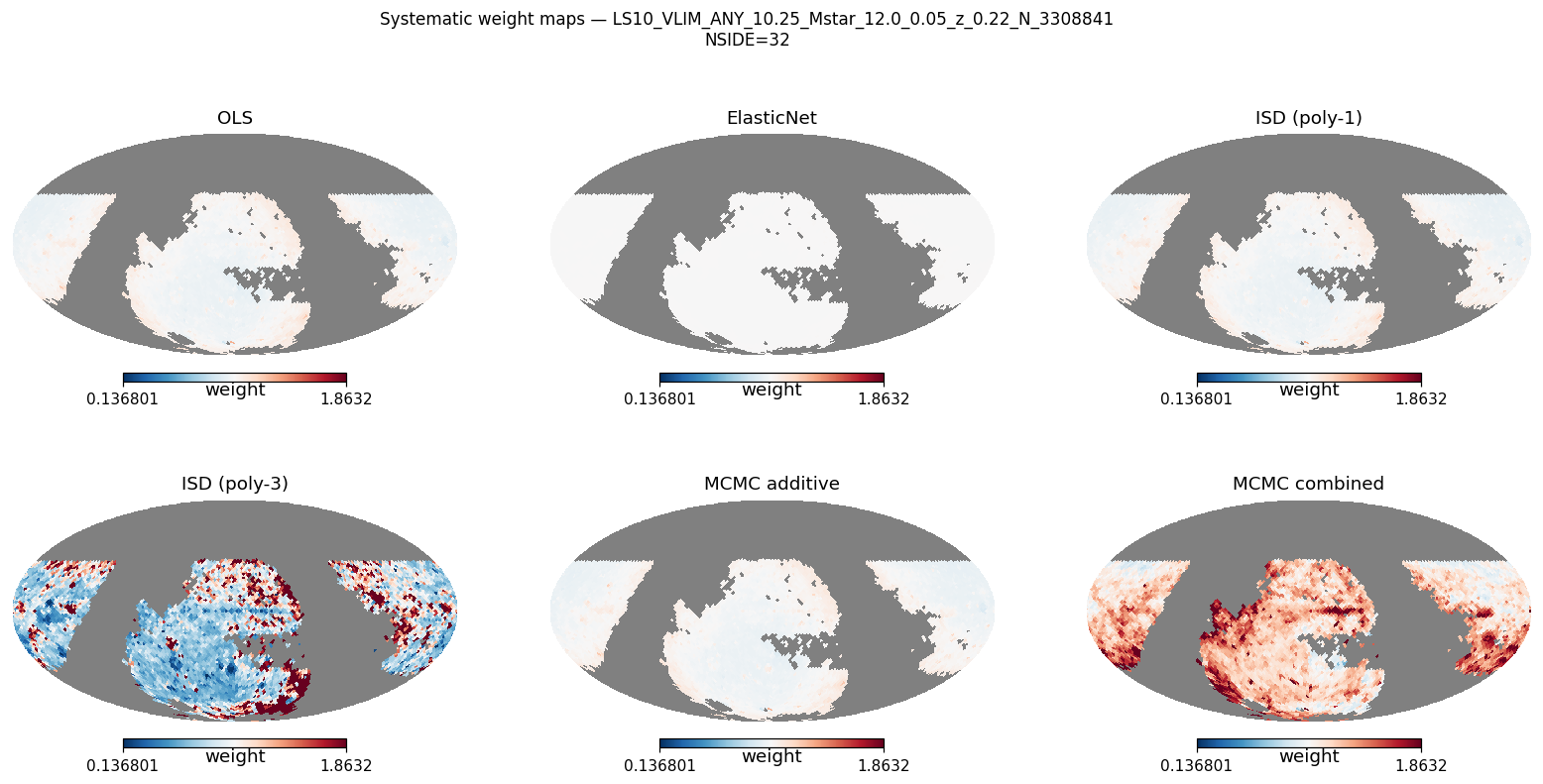
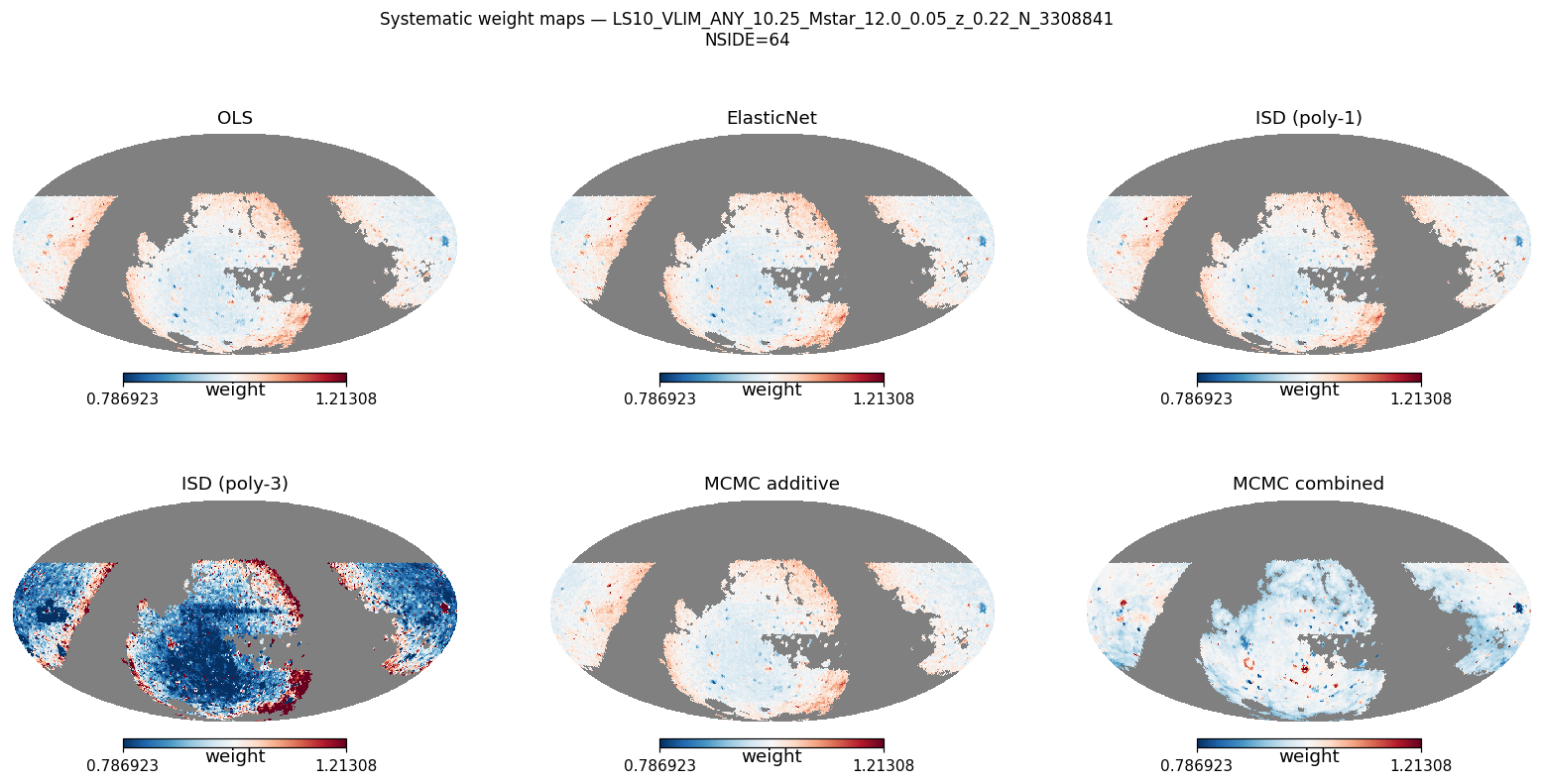
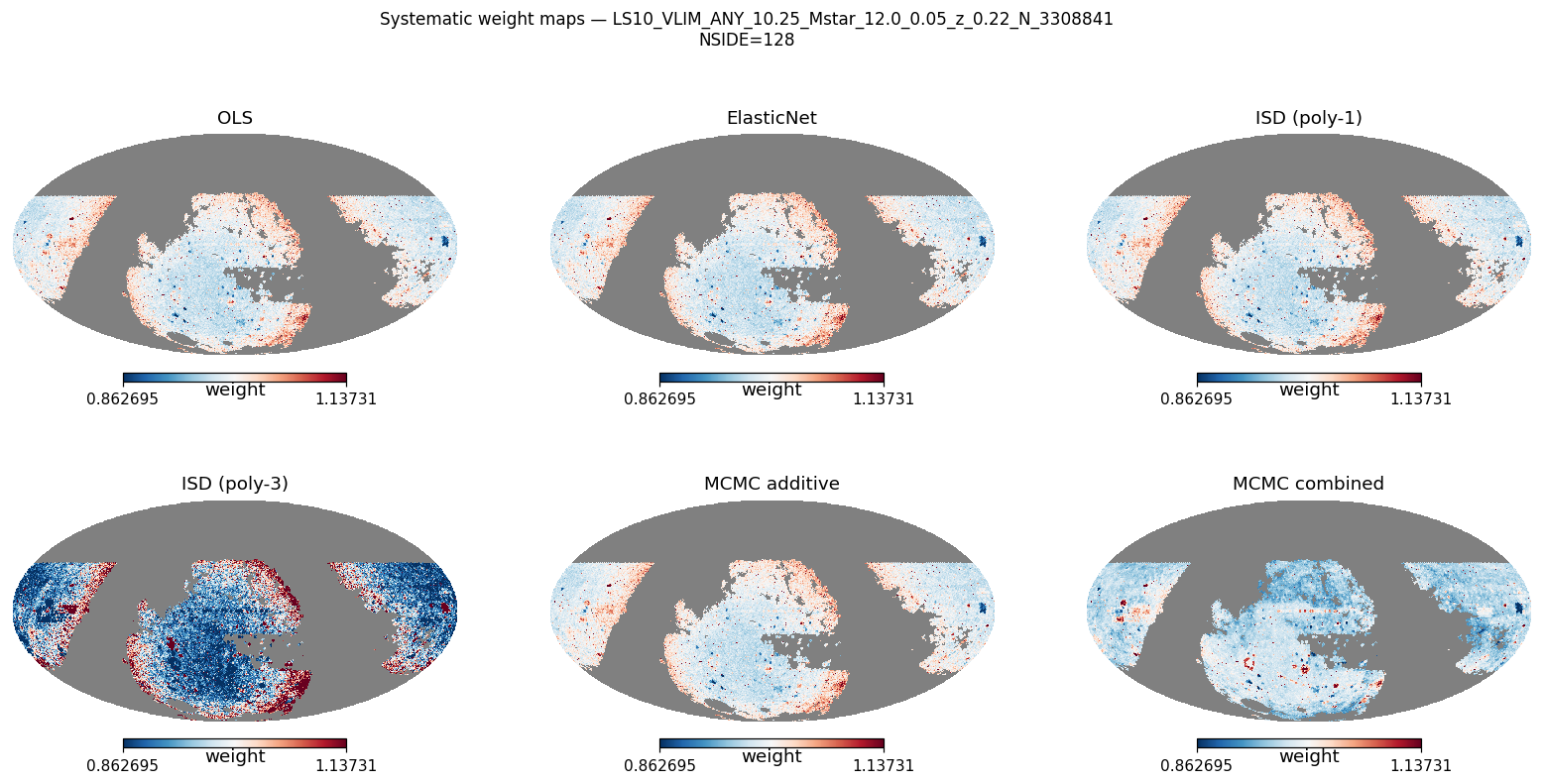
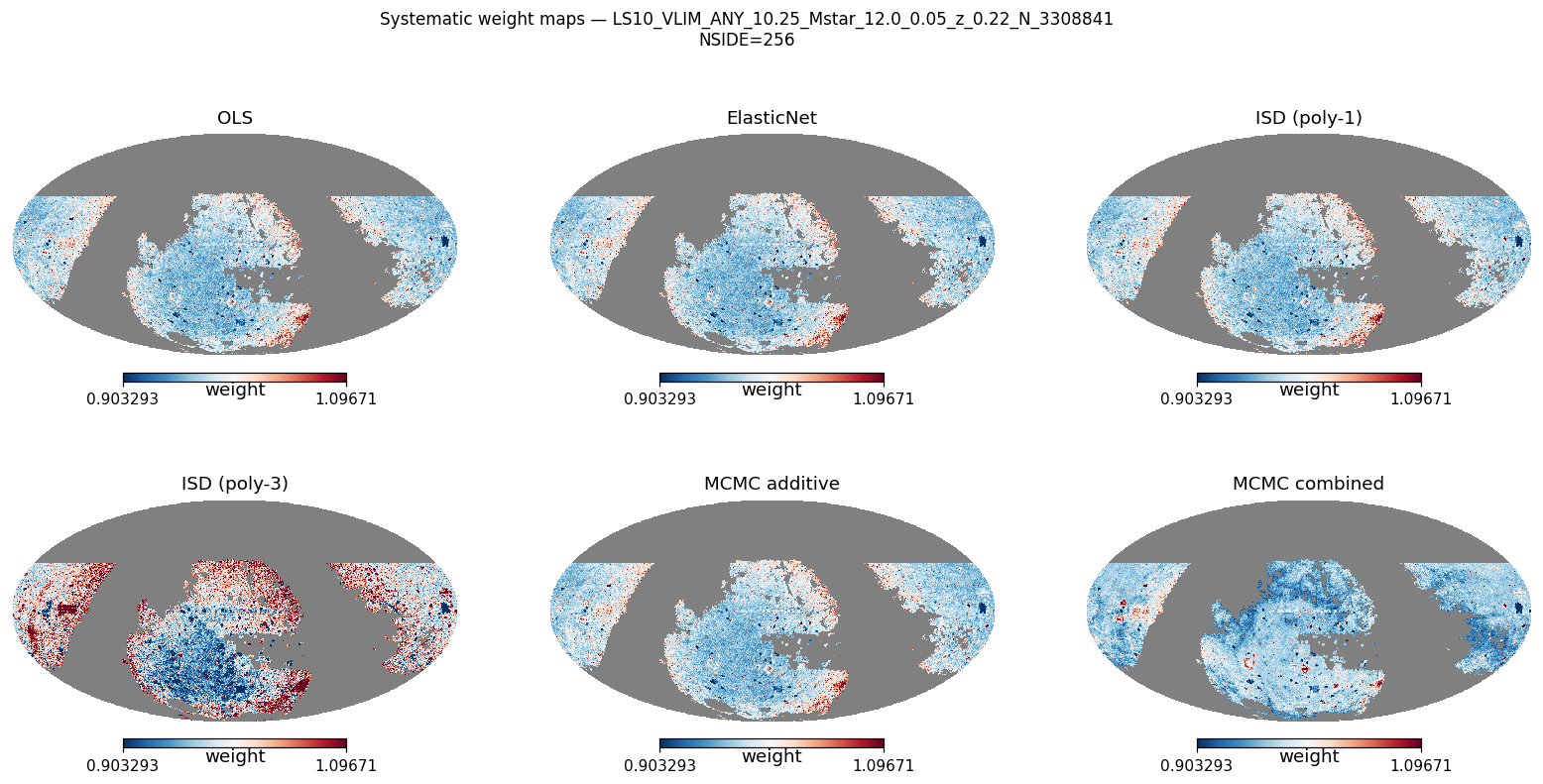
Weight distributions — log M* ≥ 10.25
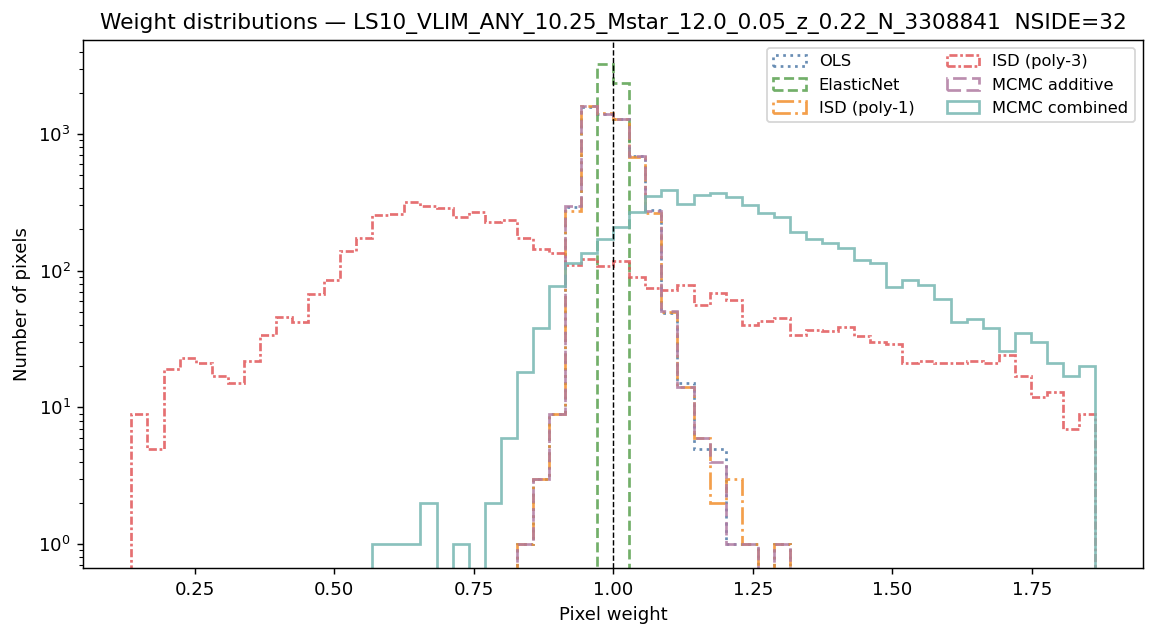
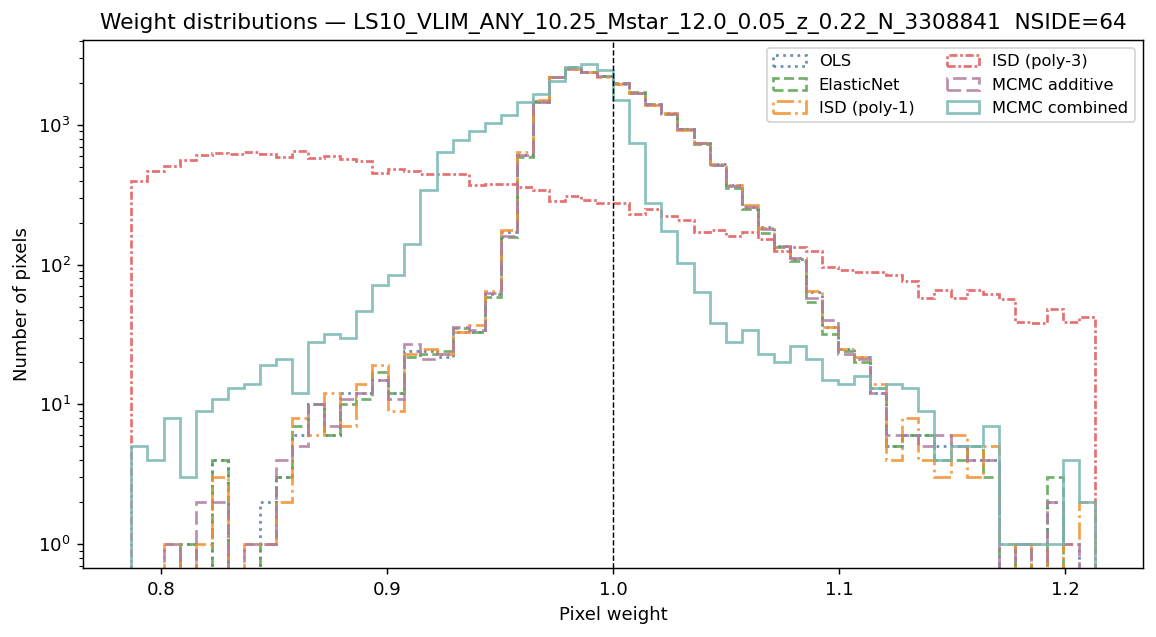
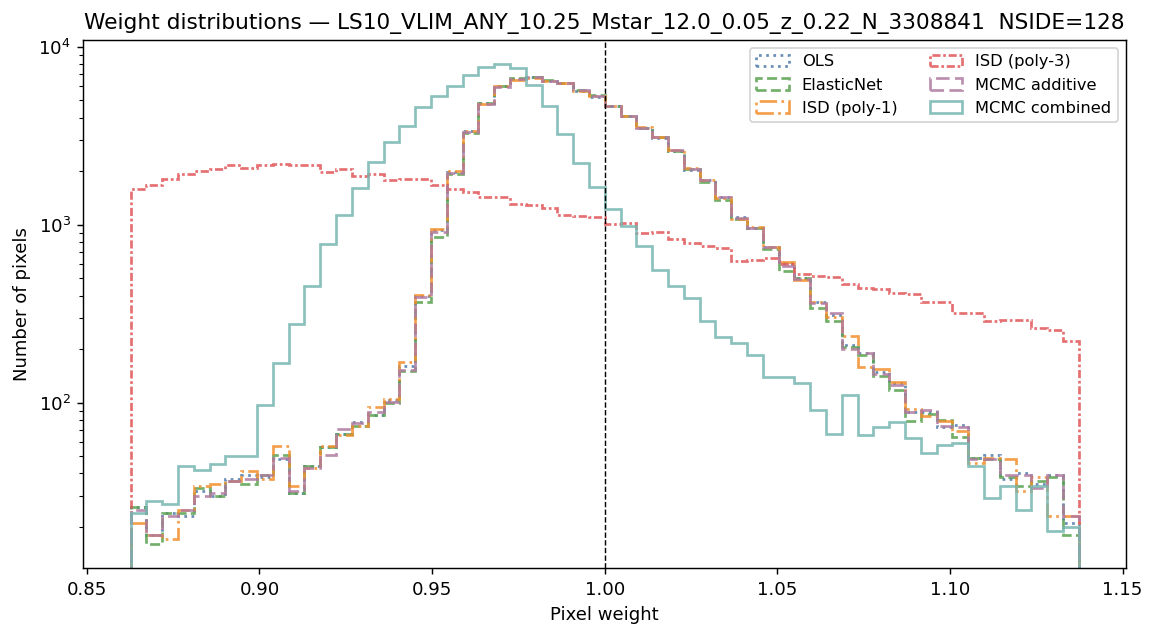
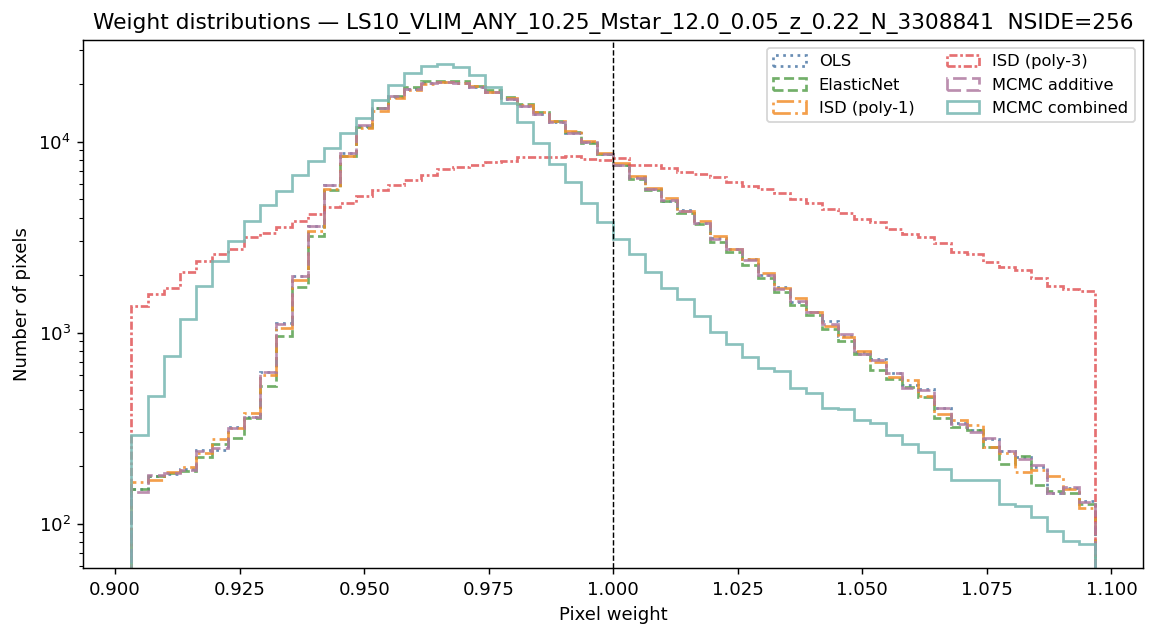
Angular clustering w(θ) — observed and corrected (one line per method) — log M* ≥ 10.25
Parameter |
NSIDE 32 |
NSIDE 64 |
NSIDE 128 |
NSIDE 256 |
|---|---|---|---|---|
Ngal |
3 308 841 |
3 308 841 |
3 308 841 |
3 308 841 |
Npix (good) |
5618 |
21669 |
84831 |
333050 |
LRT λLR (dof=11) |
808.3 (Yes) |
66.9 (Yes) |
206.8 (Yes) |
740.9 (Yes) |
σ̂ OLS |
0.3417 |
0.3434 |
0.4900 |
0.7212 |
σ̂ ElasticNet |
0.3436 |
0.3434 |
0.4900 |
0.7212 |
σ̂ ISD-1 |
0.3417 |
0.3434 |
0.4900 |
0.7212 |
σ̂ ISD-3 ‡ |
0.8803 |
0.9979 |
0.5192 |
0.7267 |
σ̂ MCMC-add |
0.3421 |
0.3435 |
0.4900 |
0.7212 |
σ̂ MCMC-comb |
0.3903 |
0.3343 |
0.4739 |
0.6964 |
MCMC-add acc. frac. |
0.387 |
0.389 |
0.388 |
0.388 |
MCMC-comb acc. frac. |
0.280 |
0.277 |
0.288 |
0.298 |
Dominant template |
ns_fnt |
ns_fnt |
ns_fnt |
ns_med |
δw/w at 30′ |
— |
n/a |
— |
— |
- ‡ ISD-3 uses a degree-3 polynomial expansion and is unreliable at all
resolutions. Do not use ISD-3 weights for any science analysis.
See also
BGS VLIM log M* ≥ 10.25, z < 0.22 — detailed systematic analysis — full template amplitude tables, weight statistics, and cosmological analysis verdict for log M* ≥ 10.25.
log M* ≥ 10.5, z < 0.26 (N = 3 263 228)
Systematic weight maps — log M* ≥ 10.5
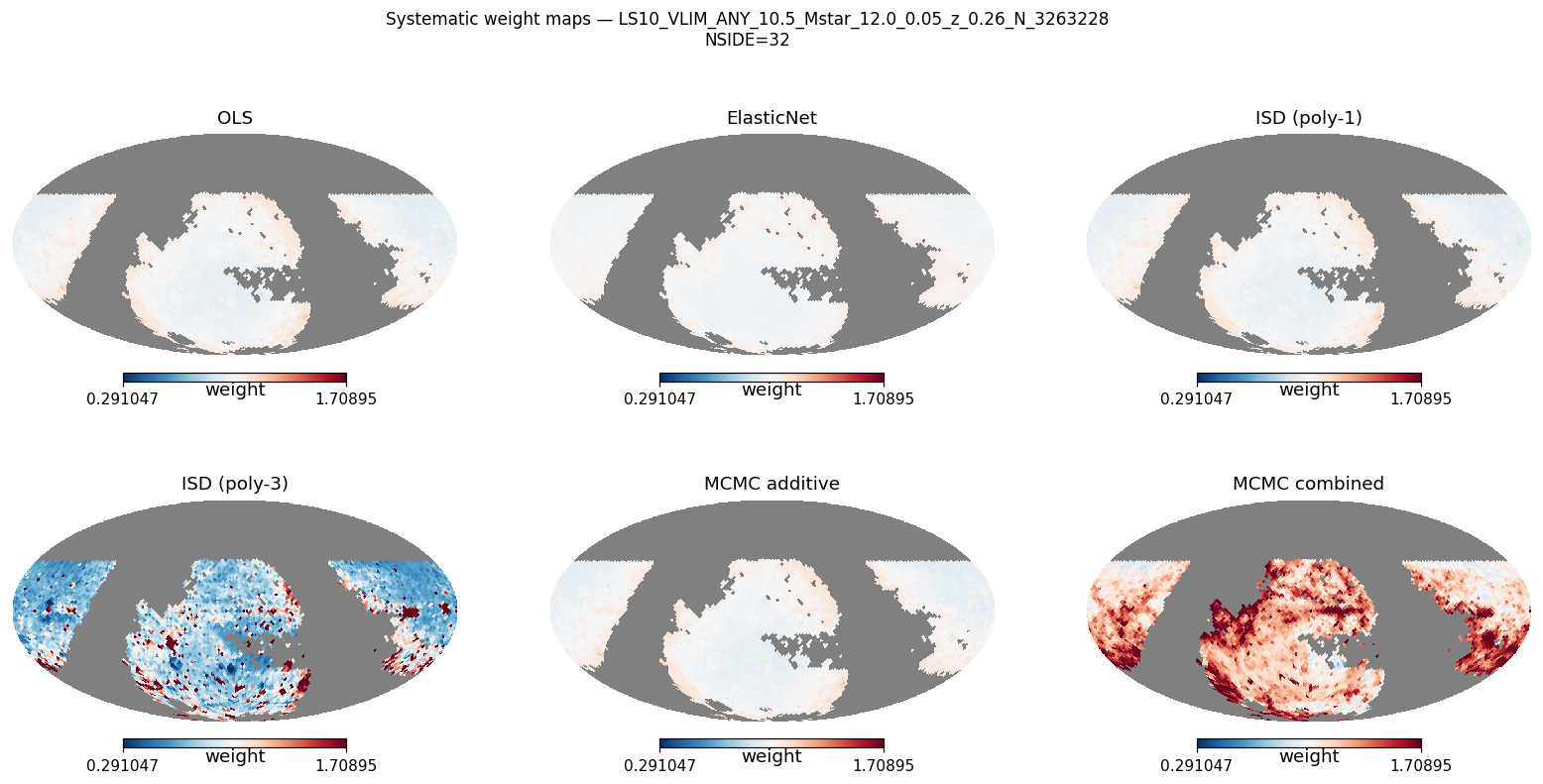
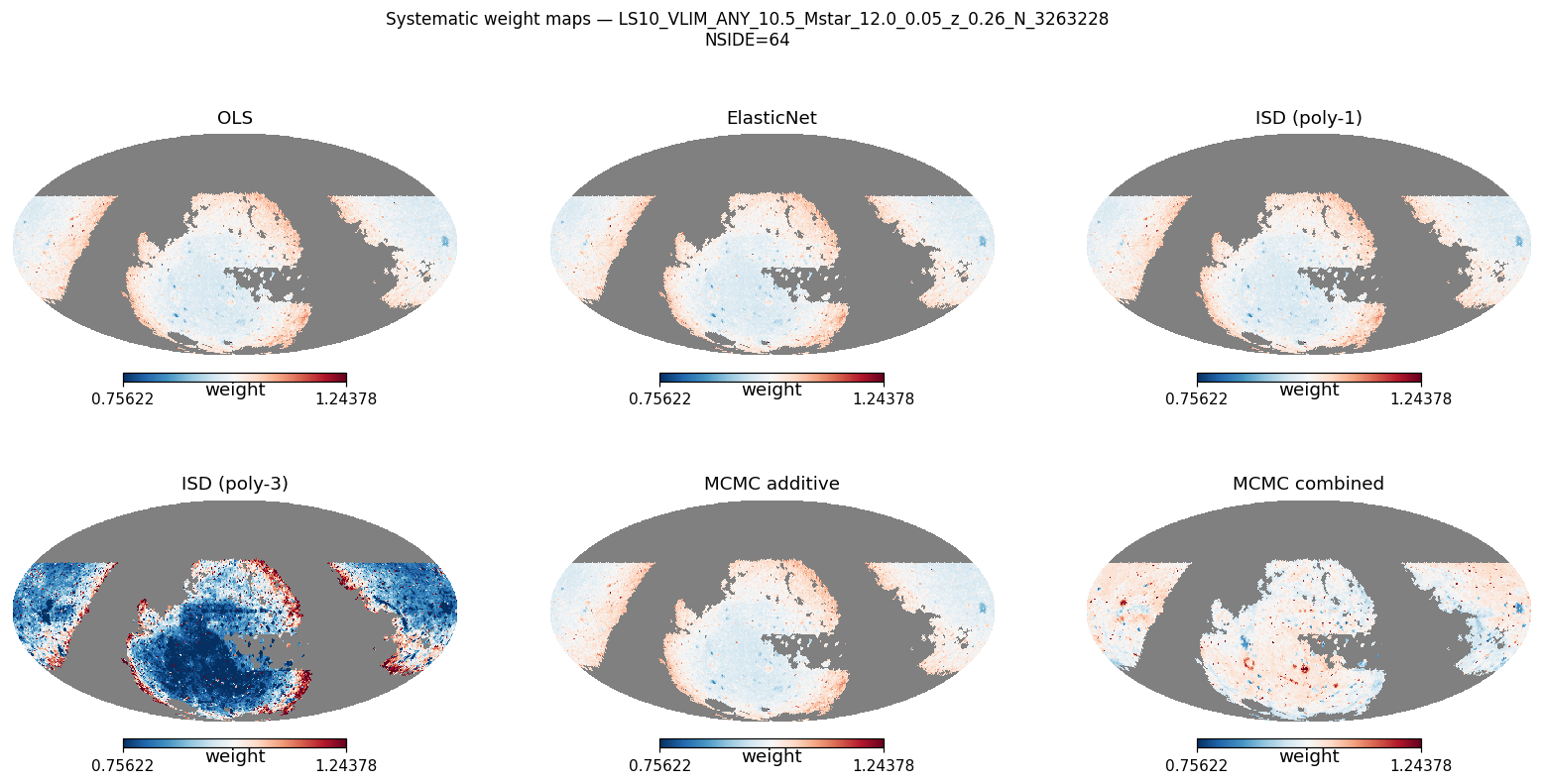
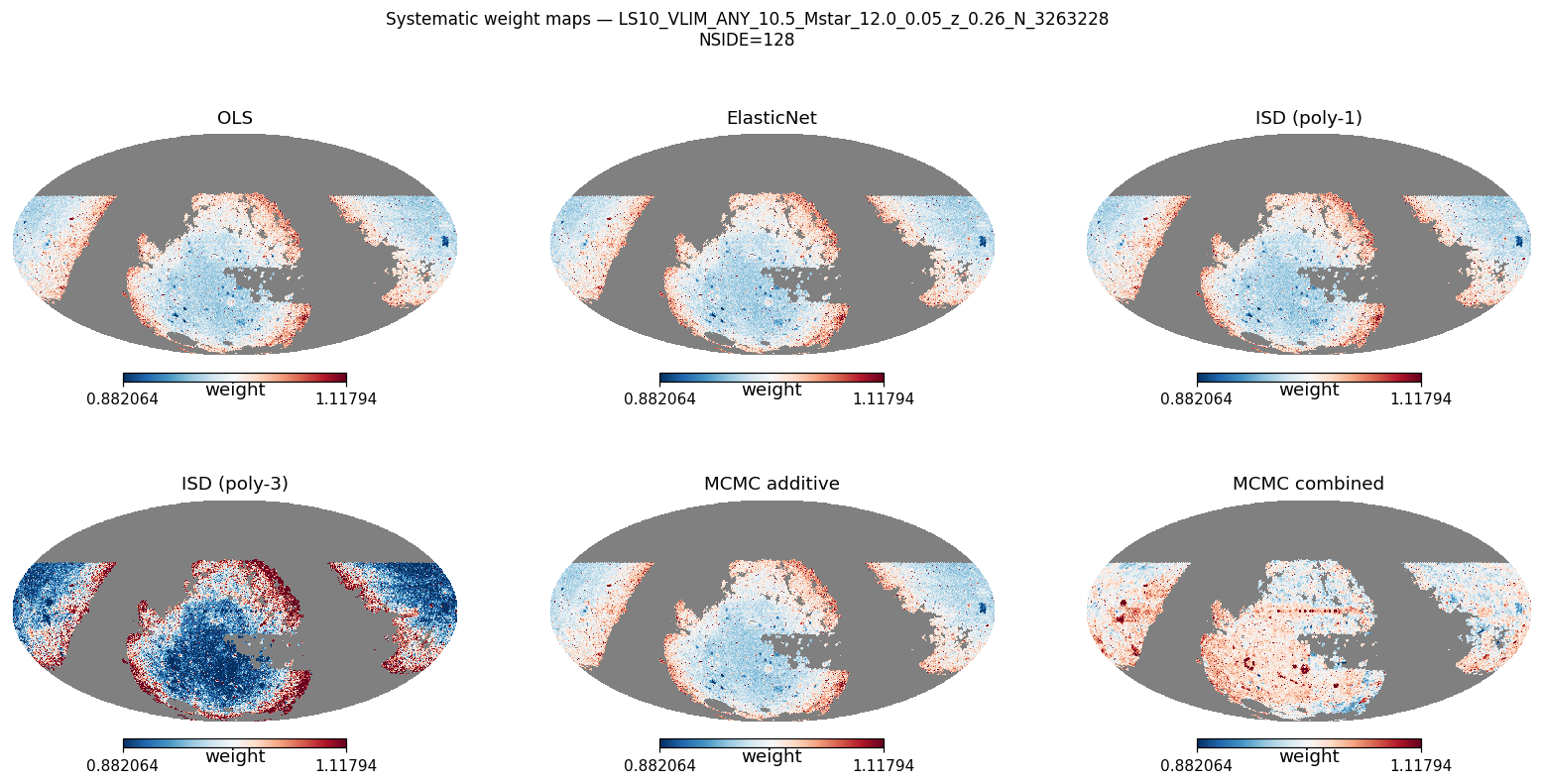
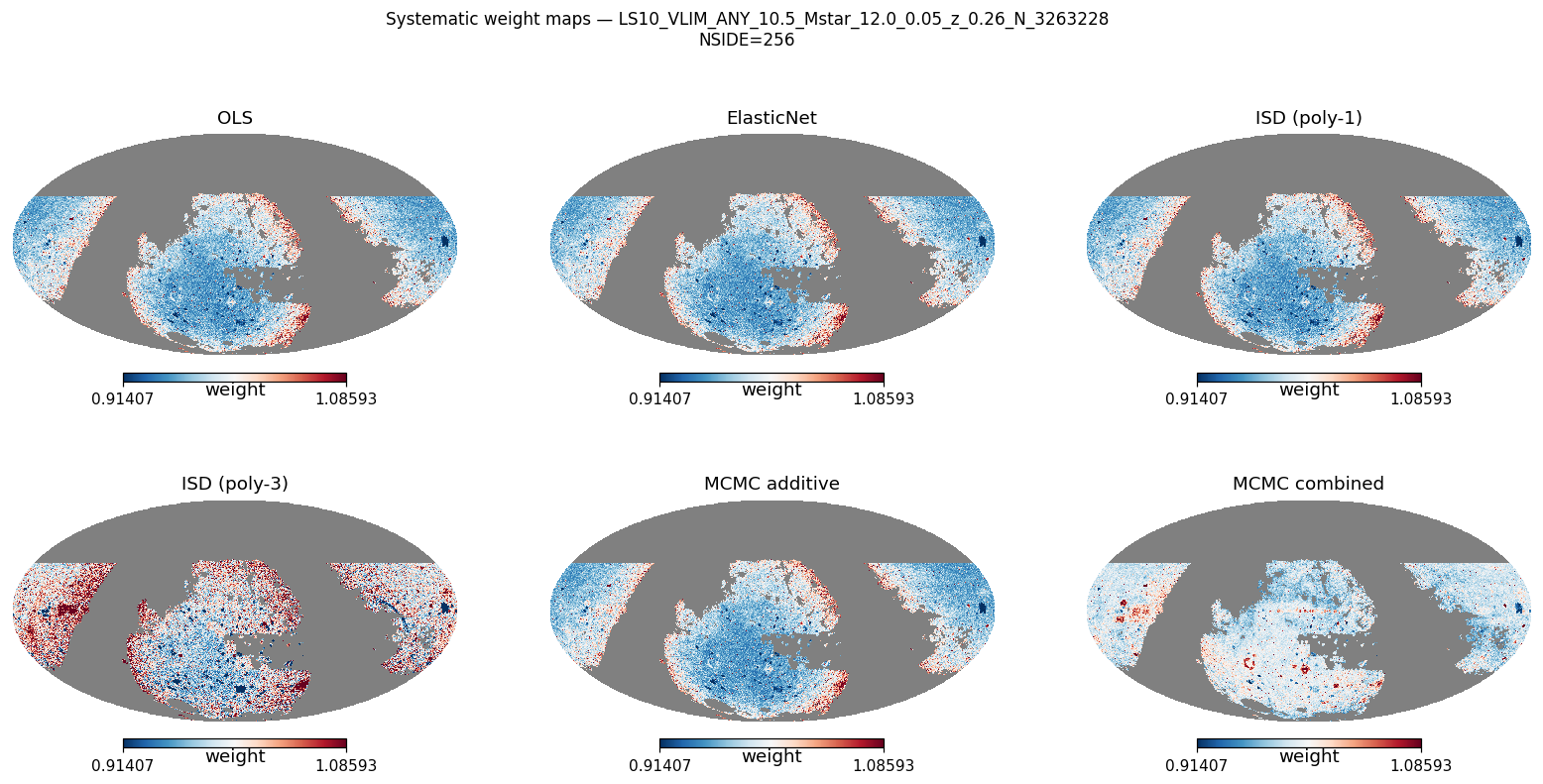
Weight distributions — log M* ≥ 10.5
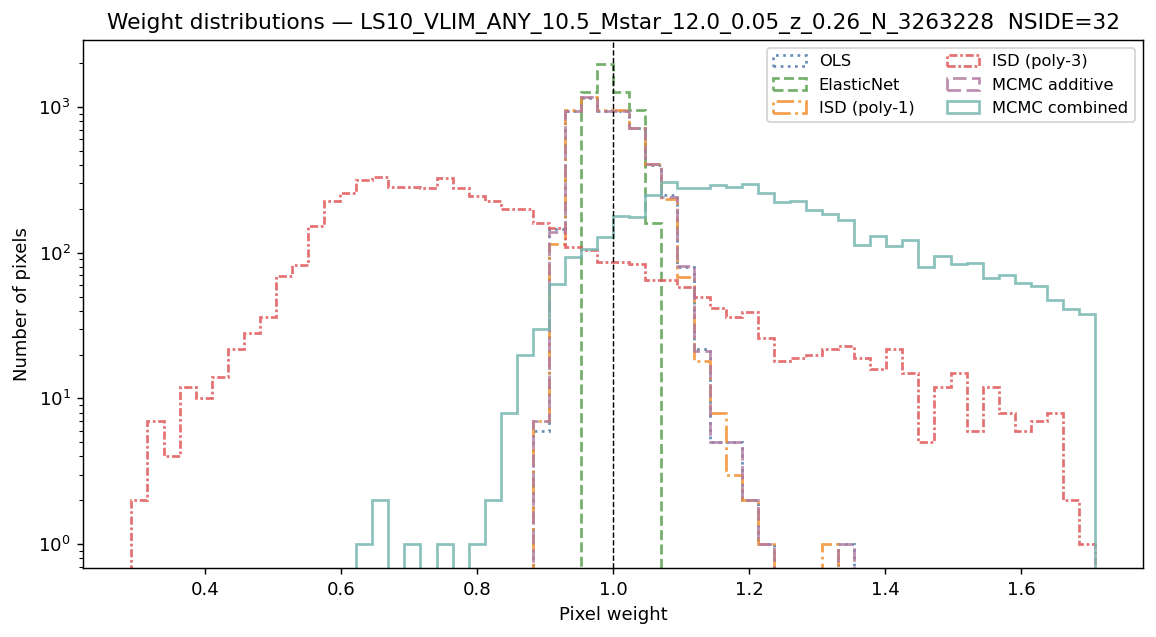
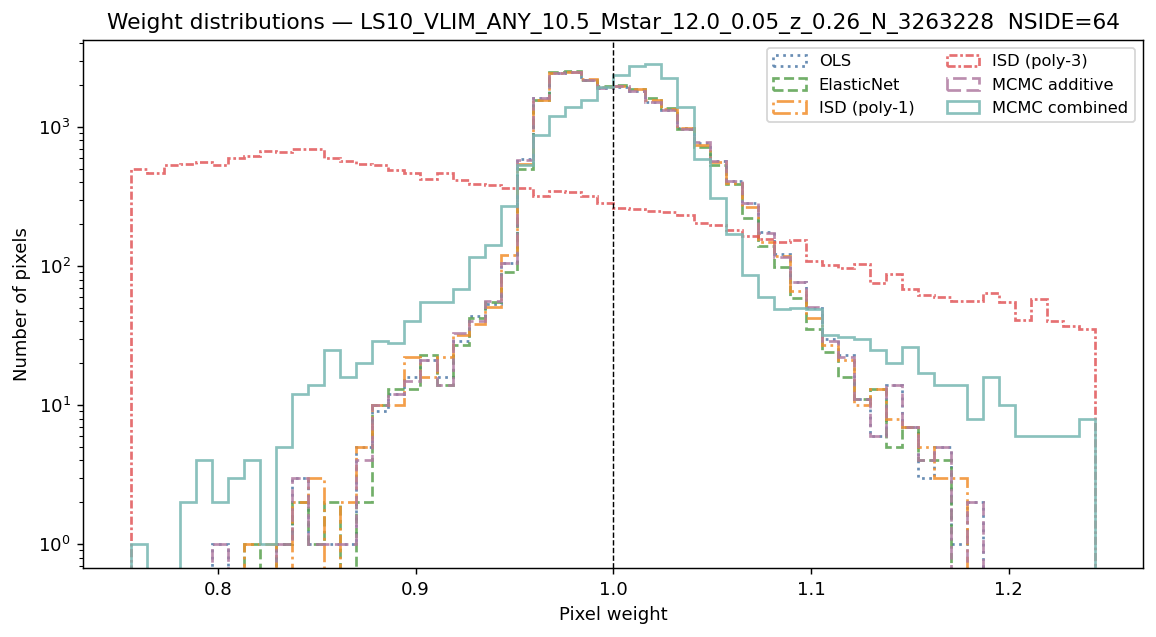
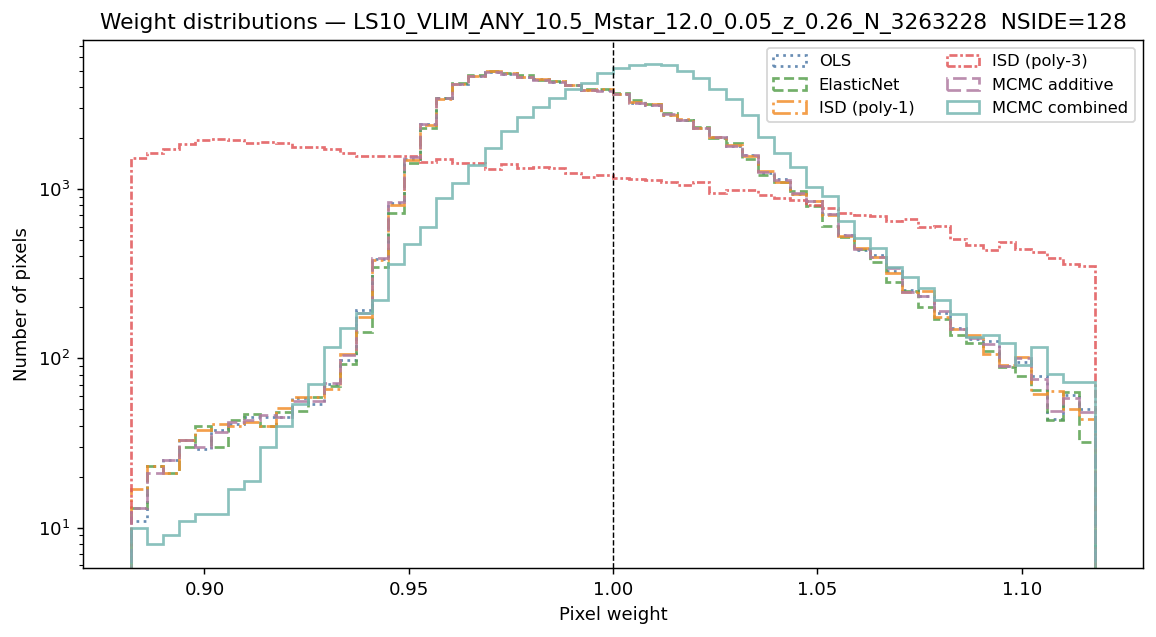
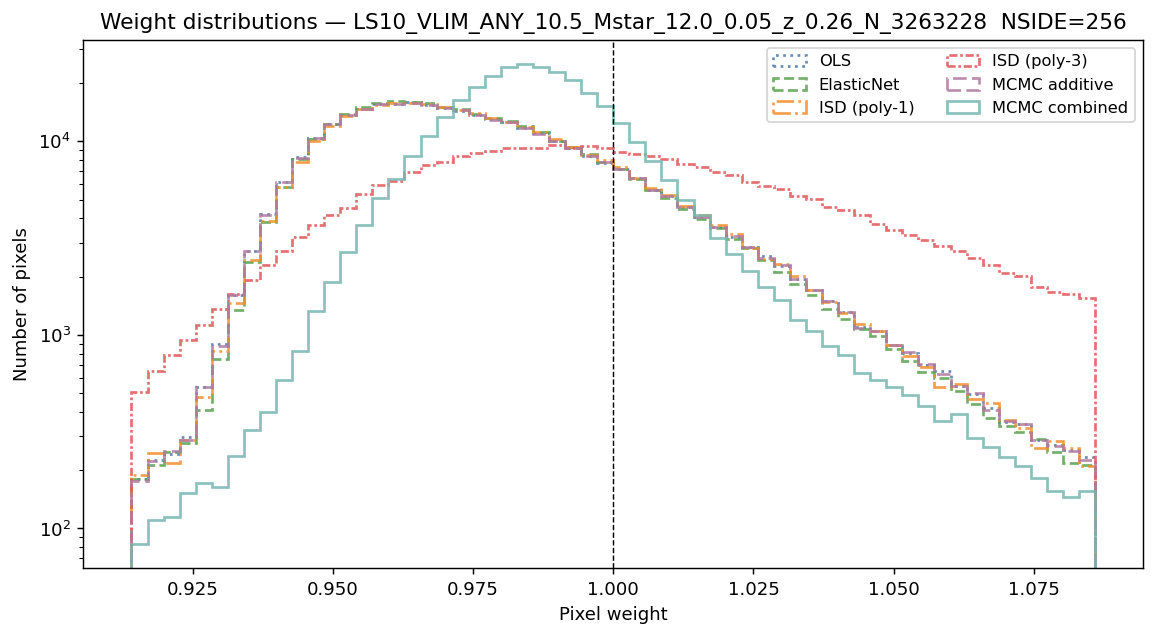
Angular clustering w(θ) — observed and corrected (one line per method) — log M* ≥ 10.5
Parameter |
NSIDE 32 |
NSIDE 64 |
NSIDE 128 |
NSIDE 256 |
|---|---|---|---|---|
Ngal |
3 263 228 |
3 263 228 |
3 263 228 |
3 263 228 |
Npix (good) |
5617 |
21675 |
84811 |
332982 |
LRT λLR (dof=11) |
952.9 (Yes) |
69.6 (Yes) |
233.9 (Yes) |
557.4 (Yes) |
σ̂ OLS |
0.3238 |
0.3089 |
0.4477 |
0.6676 |
σ̂ ElasticNet |
0.3252 |
0.3089 |
0.4477 |
0.6676 |
σ̂ ISD-1 |
0.3238 |
0.3089 |
0.4477 |
0.6677 |
σ̂ ISD-3 ‡ |
0.6415 |
1.0787 |
0.5027 |
0.6727 |
σ̂ MCMC-add |
0.3241 |
0.3089 |
0.4478 |
0.6677 |
σ̂ MCMC-comb |
0.3731 |
0.3104 |
0.4514 |
0.6593 |
MCMC-add acc. frac. |
0.388 |
0.390 |
0.389 |
0.388 |
MCMC-comb acc. frac. |
0.282 |
0.287 |
0.288 |
0.298 |
Dominant template |
ns_fnt |
ns_fnt |
ns_fnt |
ns_med |
δw/w at 30′ |
— |
n/a |
— |
— |
- ‡ ISD-3 uses a degree-3 polynomial expansion and is unreliable at all
resolutions. Do not use ISD-3 weights for any science analysis.
See also
BGS VLIM log M* ≥ 10.5, z < 0.26 — detailed systematic analysis — full template amplitude tables, weight statistics, and cosmological analysis verdict for log M* ≥ 10.5.
log M* ≥ 10.75, z < 0.31 (N = 2 802 710)
Systematic weight maps — log M* ≥ 10.75
Weight distributions — log M* ≥ 10.75
Angular clustering w(θ) — observed and corrected (one line per method) — log M* ≥ 10.75
Parameter |
NSIDE 32 |
NSIDE 64 |
NSIDE 128 |
NSIDE 256 |
|---|---|---|---|---|
Ngal |
2 802 710 |
2 802 710 |
2 802 710 |
2 802 710 |
Npix (good) |
5618 |
21662 |
84824 |
332812 |
LRT λLR (dof=11) |
1169.2 (Yes) |
89.1 (Yes) |
287.4 (Yes) |
580.6 (Yes) |
σ̂ OLS |
0.3057 |
0.2831 |
0.4190 |
0.6422 |
σ̂ ElasticNet |
0.3069 |
0.2831 |
0.4194 |
0.6423 |
σ̂ ISD-1 |
0.3057 |
0.2831 |
0.4190 |
0.6422 |
σ̂ ISD-3 ‡ |
0.6315 |
0.4658 |
0.9265 |
0.6894 |
σ̂ MCMC-add |
0.3061 |
0.2831 |
0.4191 |
0.6422 |
σ̂ MCMC-comb |
0.3982 |
0.3009 |
0.4300 |
0.6305 |
MCMC-add acc. frac. |
0.388 |
0.392 |
0.388 |
0.388 |
MCMC-comb acc. frac. |
0.295 |
0.281 |
0.293 |
0.297 |
Dominant template |
ns_fnt |
ns_fnt |
ns_fnt |
ns_med |
δw/w at 30′ |
— |
n/a |
— |
— |
- ‡ ISD-3 uses a degree-3 polynomial expansion and is unreliable at all
resolutions. Do not use ISD-3 weights for any science analysis.
See also
BGS VLIM log M* ≥ 10.75, z < 0.31 — detailed systematic analysis — full template amplitude tables, weight statistics, and cosmological analysis verdict for log M* ≥ 10.75.
log M* ≥ 11.0, z < 0.35 (N = 1 619 838)
Systematic weight maps — log M* ≥ 11.0
Weight distributions — log M* ≥ 11.0
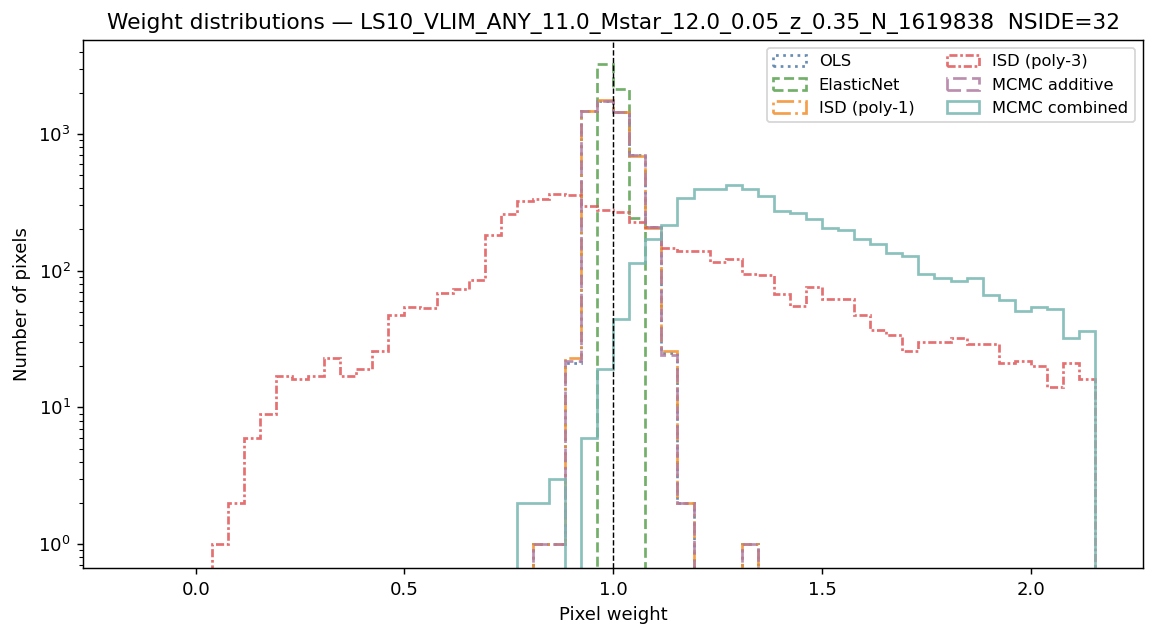
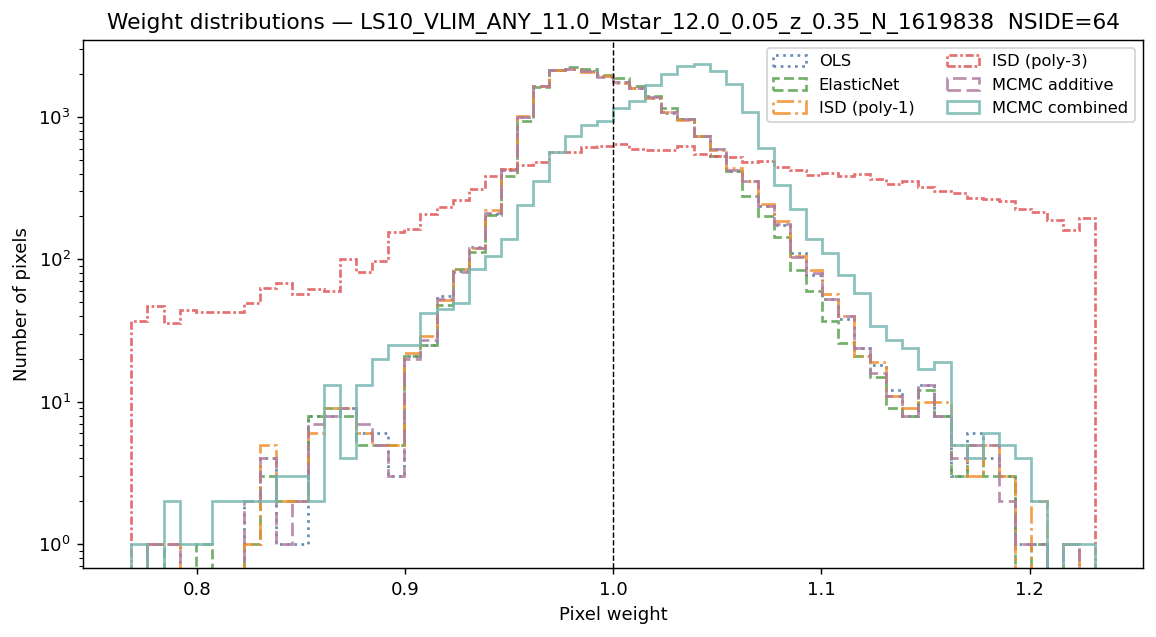
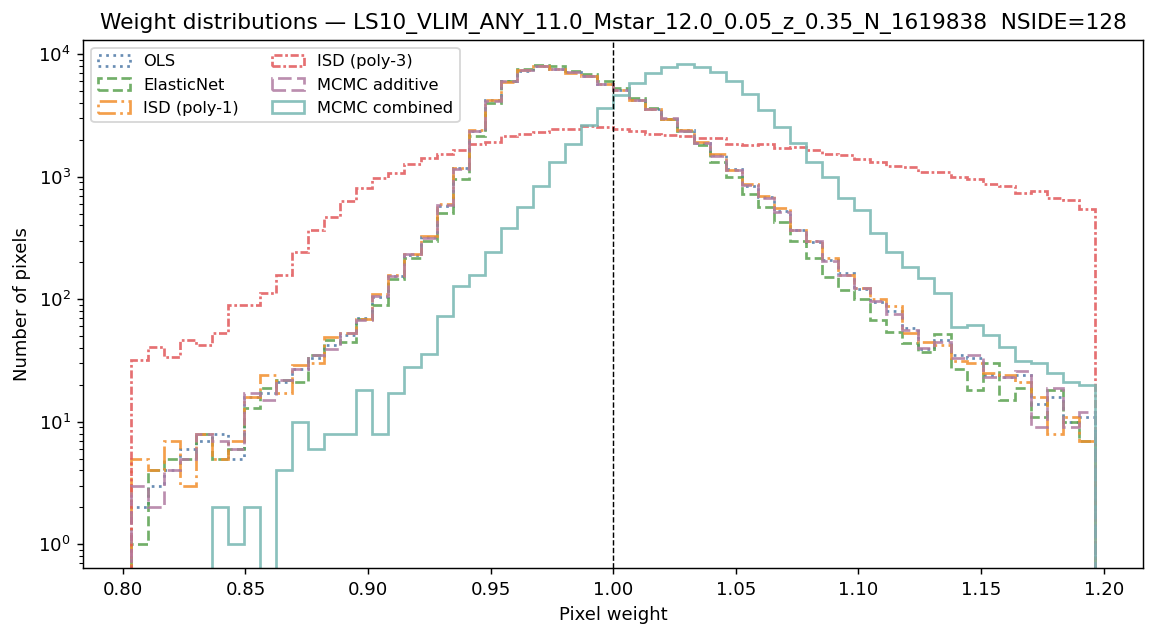
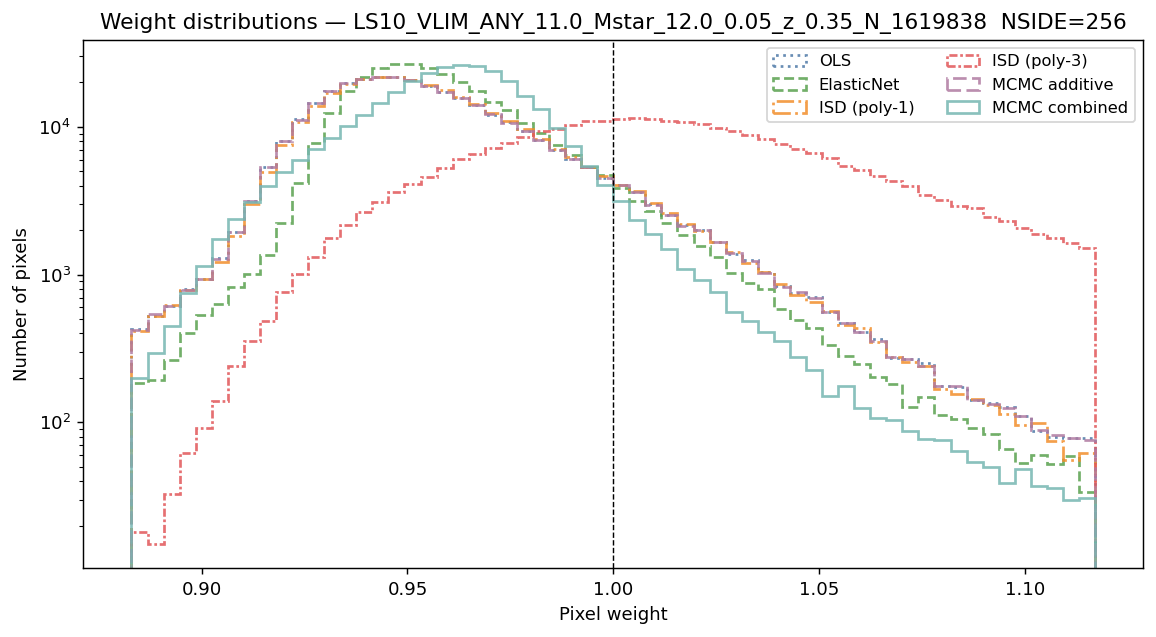
Angular clustering w(θ) — observed and corrected (one line per method) — log M* ≥ 11.0
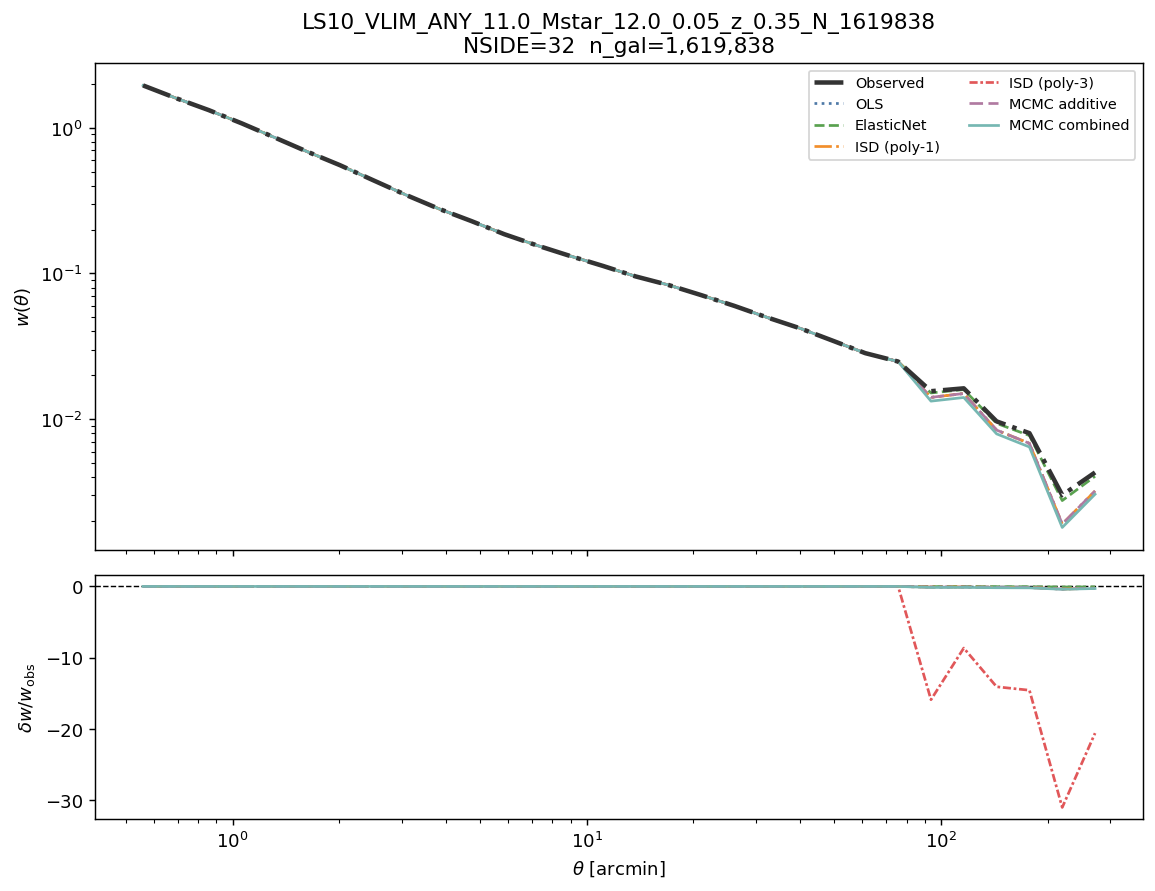
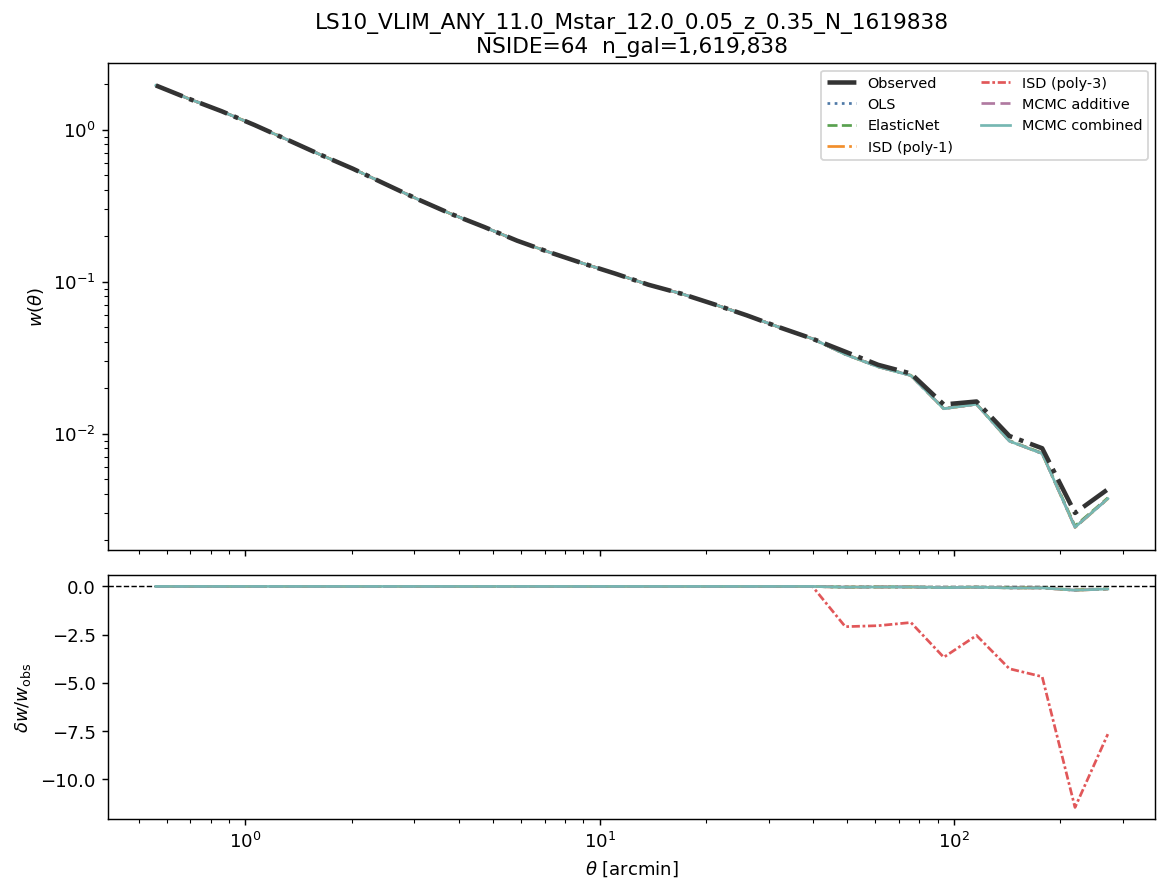
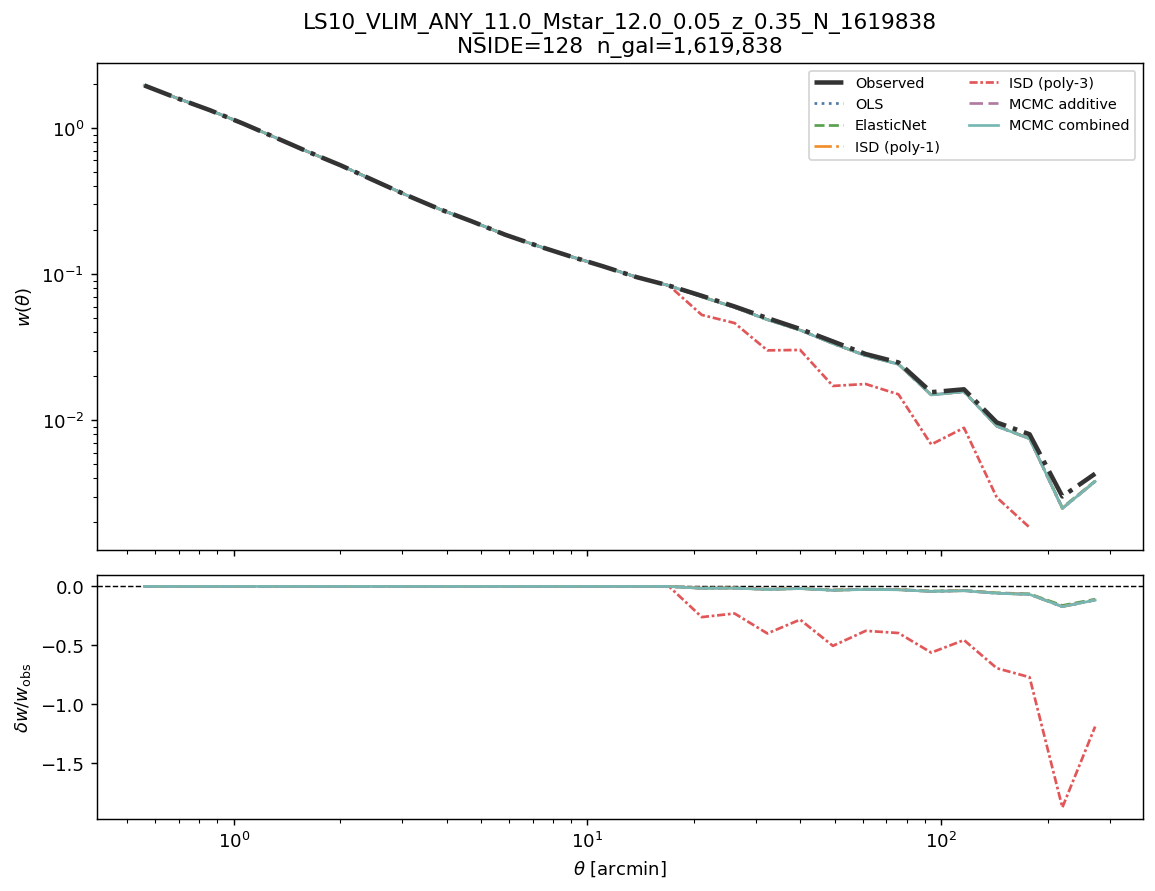
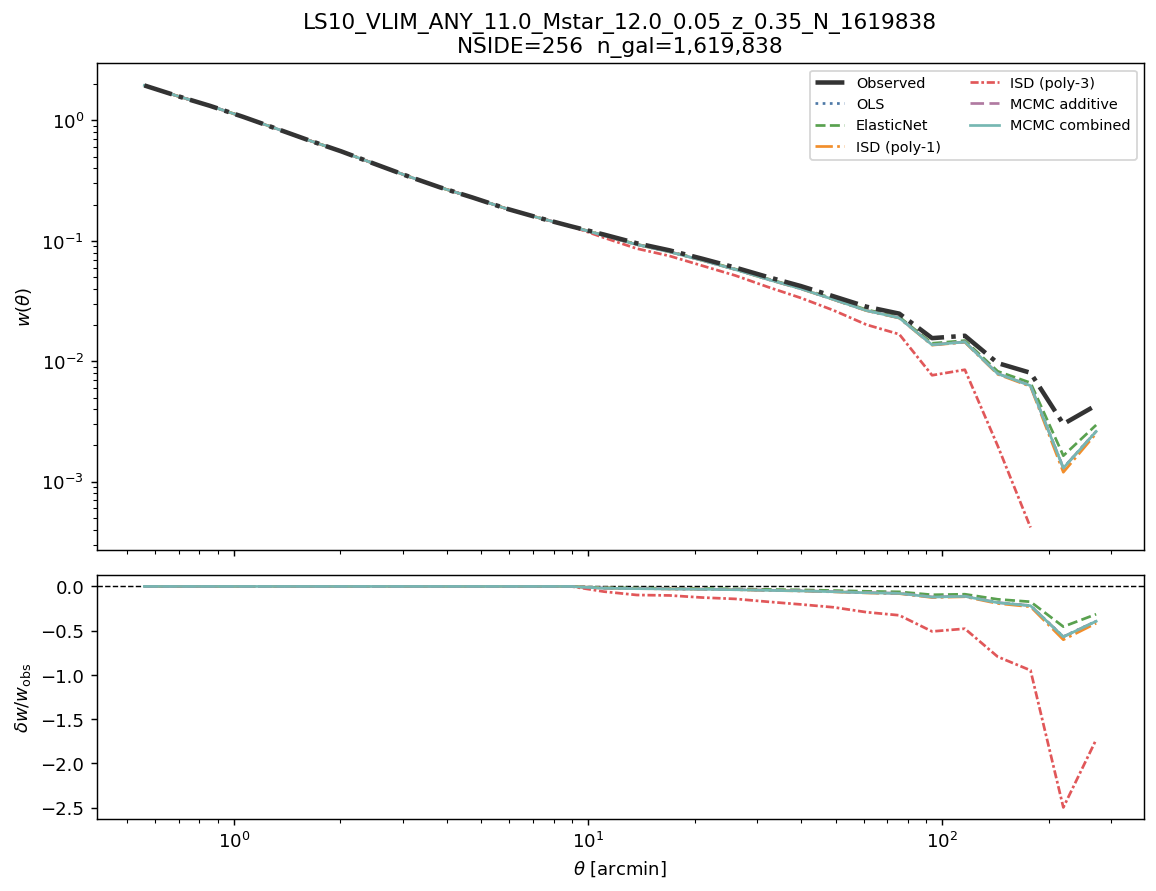
Parameter |
NSIDE 32 |
NSIDE 64 |
NSIDE 128 |
NSIDE 256 |
|---|---|---|---|---|
Ngal |
1 619 838 |
1 619 838 |
1 619 838 |
1 619 838 |
Npix (good) |
5614 |
21646 |
84719 |
332484 |
LRT λLR (dof=11) |
997.4 (Yes) |
75.1 (Yes) |
206.1 (Yes) |
682.0 (Yes) |
σ̂ OLS |
0.2971 |
0.2974 |
0.4580 |
0.7557 |
σ̂ ElasticNet |
0.2985 |
0.2974 |
0.4580 |
0.7558 |
σ̂ ISD-1 |
0.2971 |
0.2974 |
0.4580 |
0.7558 |
σ̂ ISD-3 ‡ |
0.7040 |
0.4975 |
0.4899 |
0.7786 |
σ̂ MCMC-add |
0.2974 |
0.2975 |
0.4580 |
0.7558 |
σ̂ MCMC-comb |
0.3927 |
0.3052 |
0.4716 |
0.7256 |
MCMC-add acc. frac. |
0.389 |
0.390 |
0.389 |
0.388 |
MCMC-comb acc. frac. |
0.292 |
0.289 |
0.291 |
0.288 |
Dominant template |
ns_fnt |
ns_fnt |
ns_fnt |
ns_med |
δw/w at 30′ |
— |
-0.1 % |
— |
— |
- ‡ ISD-3 uses a degree-3 polynomial expansion and is unreliable at all
resolutions. Do not use ISD-3 weights for any science analysis.
See also
BGS VLIM log M* ≥ 11.0, z < 0.35 — detailed systematic analysis — full template amplitude tables, weight statistics, and cosmological analysis verdict for log M* ≥ 11.0.
log M* ≥ 11.25, z < 0.35 (N = 541 855)
Systematic weight maps — log M* ≥ 11.25
Weight distributions — log M* ≥ 11.25
Angular clustering w(θ) — observed and corrected (one line per method) — log M* ≥ 11.25
Parameter |
NSIDE 32 |
NSIDE 64 |
NSIDE 128 |
NSIDE 256 |
|---|---|---|---|---|
Ngal |
541 855 |
541 855 |
541 855 |
541 855 |
Npix (good) |
5609 |
21555 |
84131 |
325324 |
LRT λLR (dof=11) |
613.5 (Yes) |
123.4 (Yes) |
140.8 (Yes) |
597.3 (Yes) |
σ̂ OLS |
0.3308 |
0.3842 |
0.6405 |
1.2602 |
σ̂ ElasticNet |
0.3319 |
0.3846 |
0.6406 |
1.2603 |
σ̂ ISD-1 |
0.3308 |
0.3842 |
0.6405 |
1.2602 |
σ̂ ISD-3 ‡ |
0.7031 |
0.6196 |
0.6454 |
1.3131 |
σ̂ MCMC-add |
0.3313 |
0.3843 |
0.6406 |
1.2602 |
σ̂ MCMC-comb |
0.4062 |
0.3930 |
0.6329 |
1.2117 |
MCMC-add acc. frac. |
0.386 |
0.389 |
0.387 |
0.390 |
MCMC-comb acc. frac. |
0.293 |
0.288 |
0.287 |
0.301 |
Dominant template |
ns_fnt |
ns_fnt |
ns_med |
ns_fnt |
δw/w at 30′ |
— |
+2.2 % |
— |
— |
- ‡ ISD-3 uses a degree-3 polynomial expansion and is unreliable at all
resolutions. Do not use ISD-3 weights for any science analysis.
See also
BGS VLIM log M* ≥ 11.25, z < 0.35 — detailed systematic analysis — full template amplitude tables, weight statistics, and cosmological analysis verdict for log M* ≥ 11.25.
log M* ≥ 11.5, z < 0.35 (N = 120 882)
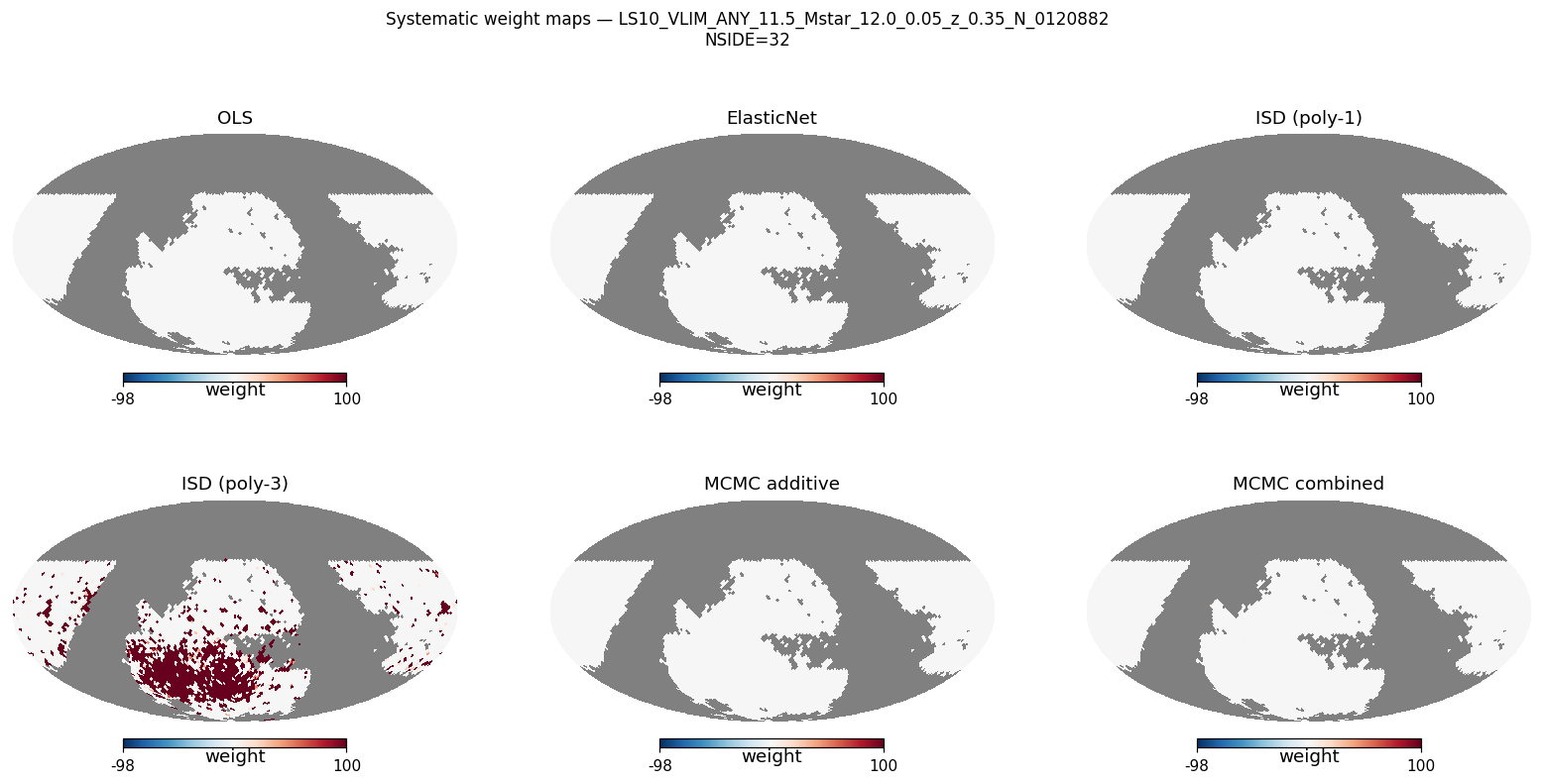
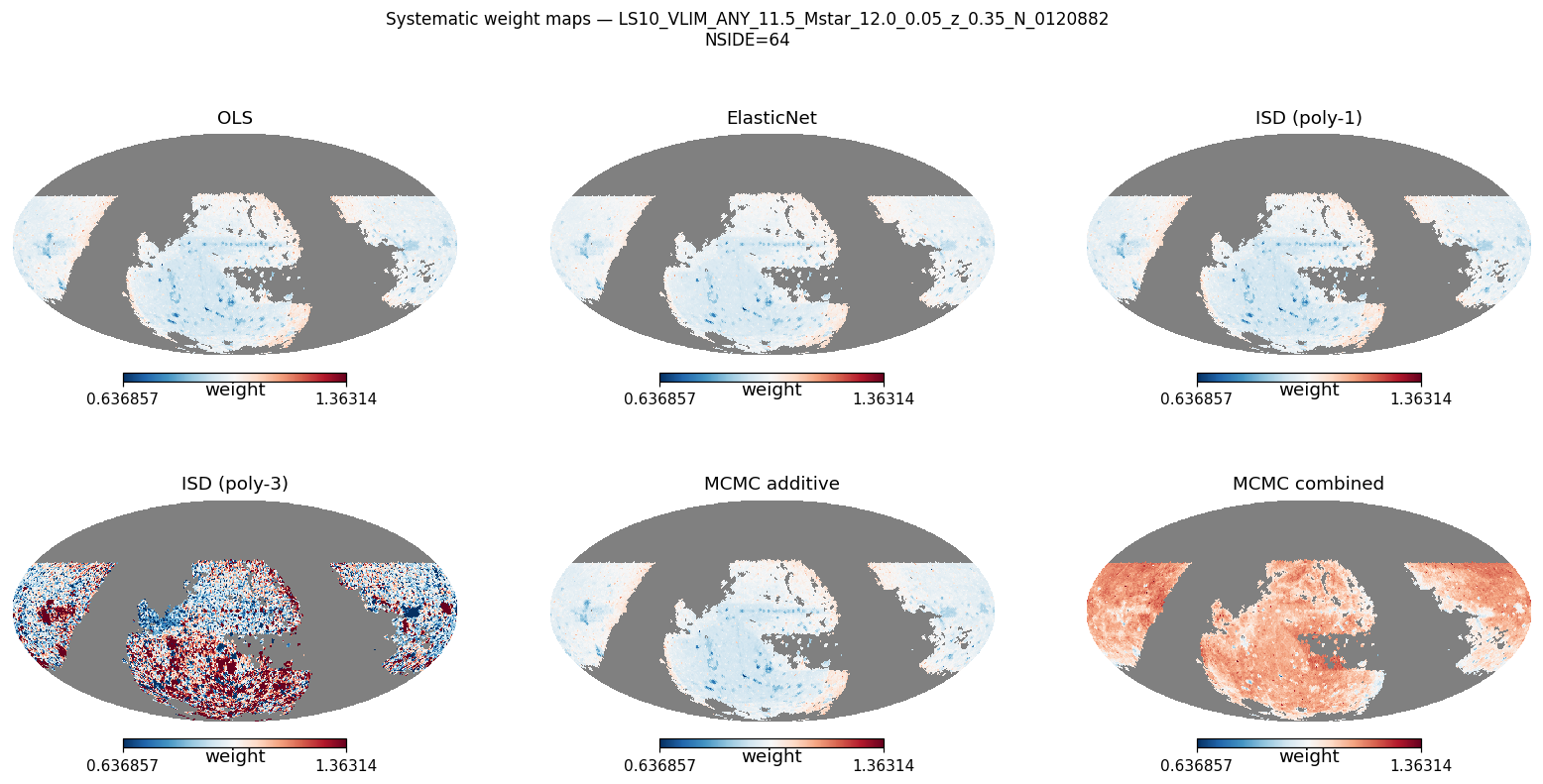
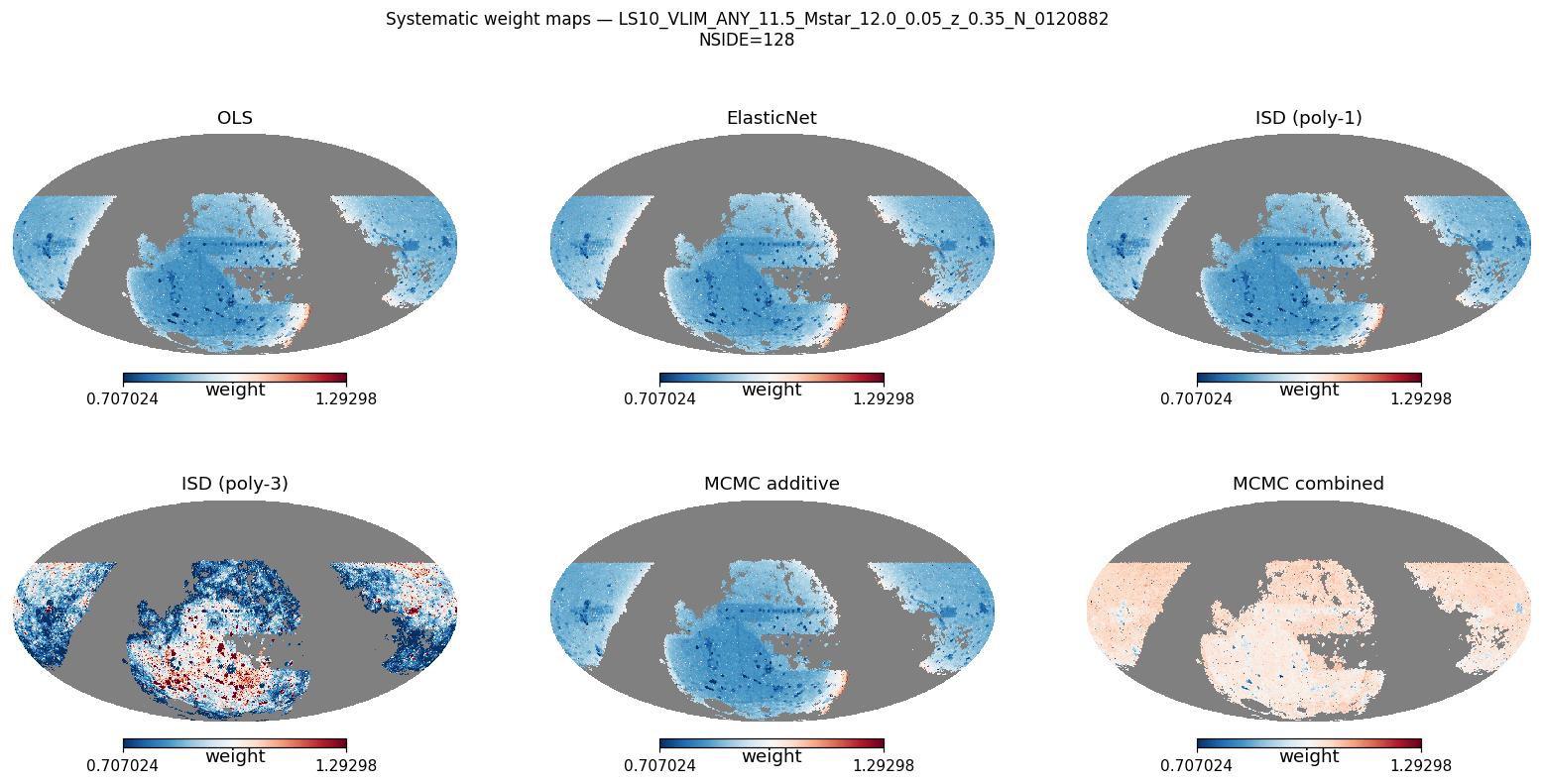
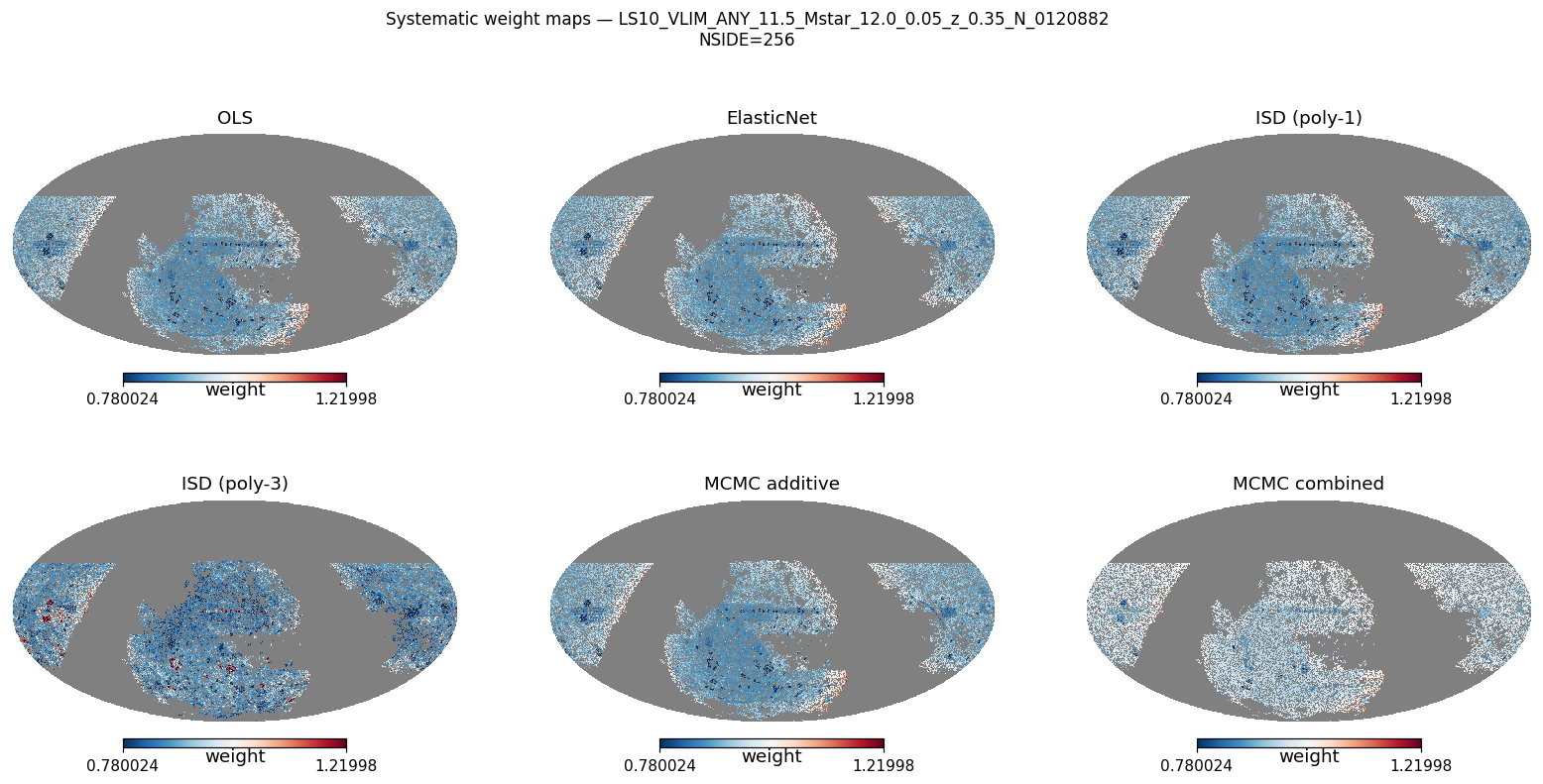
Systematic weight maps — log M* ≥ 11.5
Weight distributions — log M* ≥ 11.5
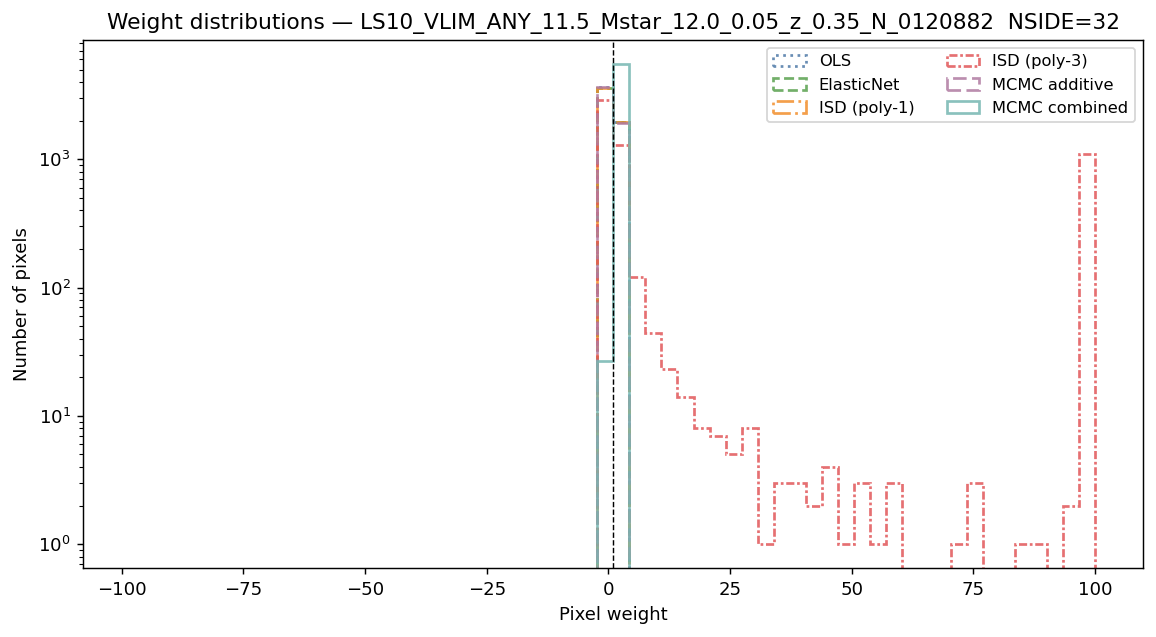
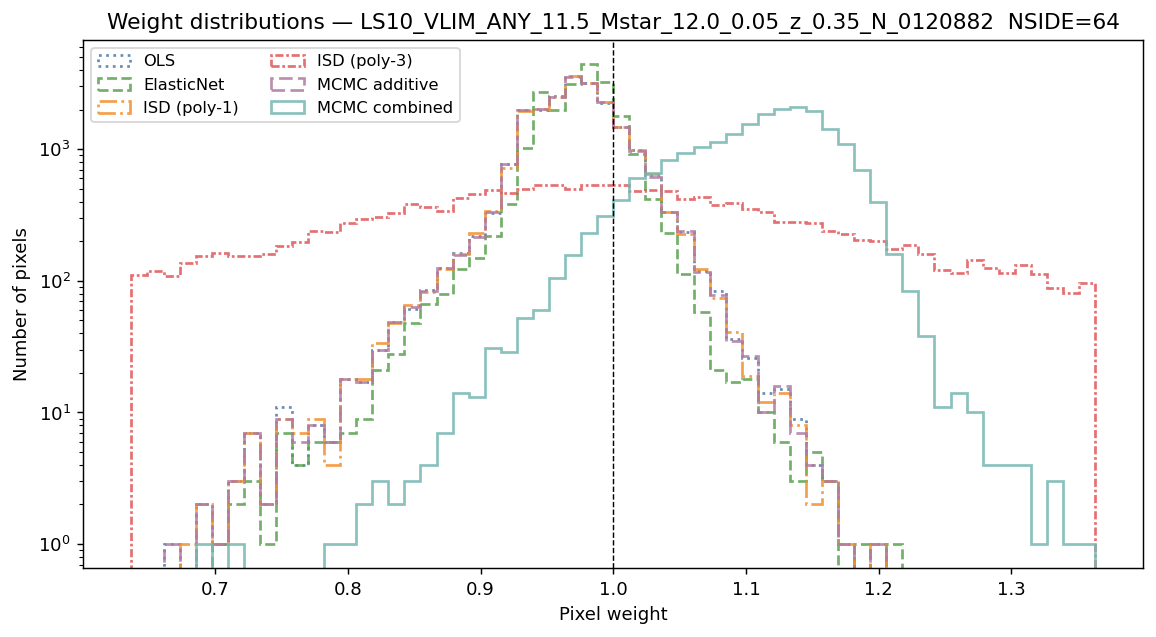
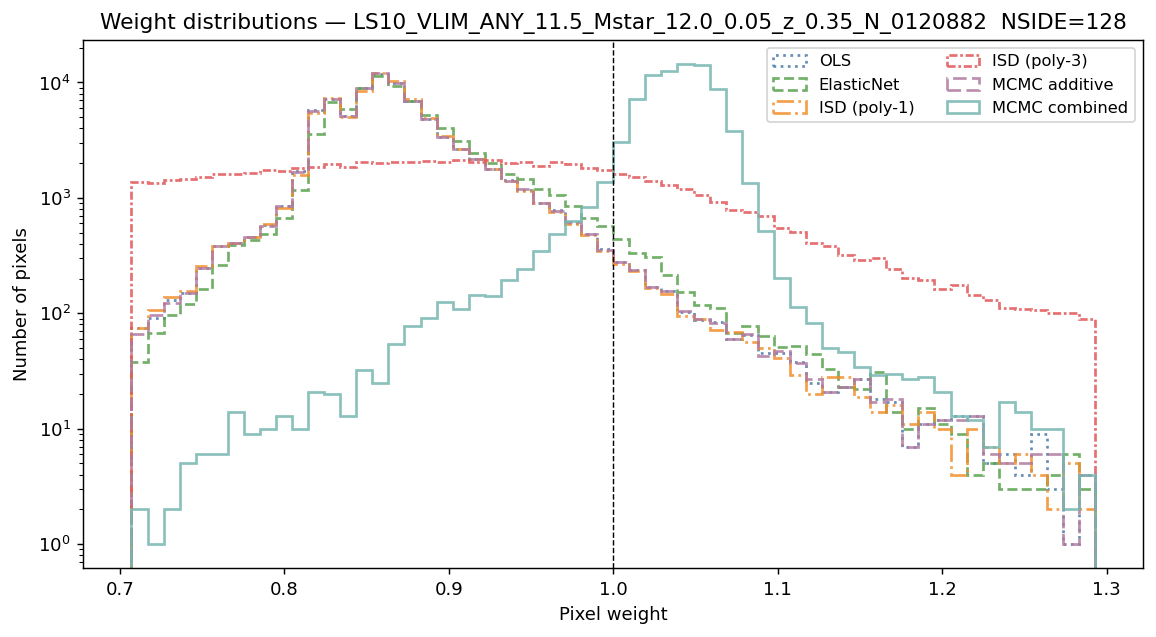
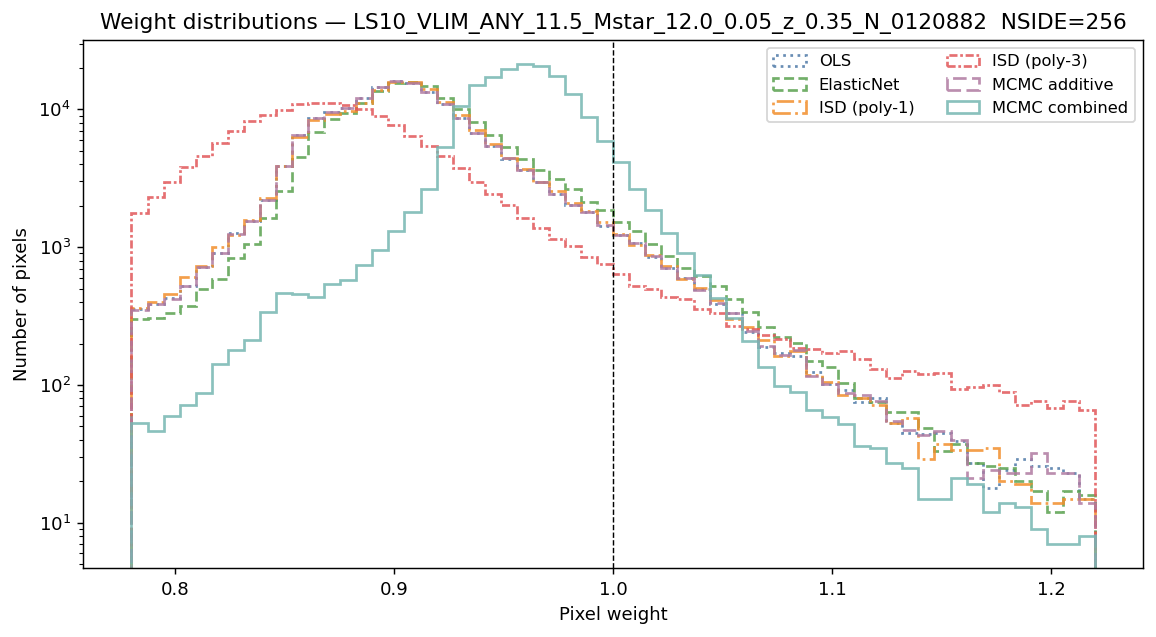
Angular clustering w(θ) — observed and corrected (one line per method) — log M* ≥ 11.5
Parameter |
NSIDE 32 |
NSIDE 64 |
NSIDE 128 |
NSIDE 256 |
|---|---|---|---|---|
Ngal |
120 882 |
120 882 |
120 882 |
120 882 |
Npix (good) |
5571 |
21344 |
83244 |
180102 |
LRT λLR (dof=11) |
352.1 (Yes) |
151.5 (Yes) |
196.7 (Yes) |
575.1 (Yes) |
σ̂ OLS |
0.4451 |
0.6438 |
1.3802 |
2.1098 |
σ̂ ElasticNet |
0.4453 |
0.6440 |
1.3803 |
2.1098 |
σ̂ ISD-1 |
0.4451 |
0.6438 |
1.3802 |
2.1098 |
σ̂ ISD-3 ‡ |
2.1206 |
1.0507 |
1.4249 |
2.1189 |
σ̂ MCMC-add |
0.4455 |
0.6441 |
1.3803 |
2.1098 |
σ̂ MCMC-comb |
0.5862 |
0.7104 |
1.4304 |
2.0211 |
MCMC-add acc. frac. |
0.387 |
0.388 |
0.388 |
0.387 |
MCMC-comb acc. frac. |
0.281 |
0.287 |
0.297 |
0.283 |
Dominant template |
ns_fnt |
ns_med |
ns_fnt |
ns_fnt |
δw/w at 30′ |
— |
+0.7 % |
— |
— |
- ‡ ISD-3 uses a degree-3 polynomial expansion and is unreliable at all
resolutions. Do not use ISD-3 weights for any science analysis.
See also
BGS VLIM log M* ≥ 11.5, z < 0.35 — detailed systematic analysis — full template amplitude tables, weight statistics, and cosmological analysis verdict for log M* ≥ 11.5.
MAP parameters — 11-template analysis (NSIDE 64)
The table below lists MAP estimates from the NSIDE = 64 run (11 templates). Column abbreviations:
Abbreviation |
Full template name |
|---|---|
EBV |
LS10:EBV |
GD_G |
LS10:GALDEPTH_G |
GD_R |
LS10:GALDEPTH_R |
GD_Z |
LS10:GALDEPTH_Z |
NOBS_R |
LS10:NOBS_R |
PSF_R |
LS10:PSFSIZE_R |
ns_fnt |
GAIA:nstar_faint |
ns_med |
GAIA:nstar_medium |
bp_fl |
GAIA:phot_bp_mean_flux |
g_fl |
GAIA:phot_g_mean_flux |
rp_fl |
GAIA:phot_rp_mean_flux |
The dominant systematic in all samples is GAIA:nstar_faint (stellar density).
Additive MAP parameters \(\hat{a}_i\) (MCMC-add, NSIDE 64)
Sample (log M* ≥, z <) |
EBV |
GD_G |
GD_R |
GD_Z |
NOBS_R |
PSF_R |
ns_fnt |
ns_med |
bp_fl |
g_fl |
rp_fl |
|---|---|---|---|---|---|---|---|---|---|---|---|
9.0, 0.08 |
+0.4449 |
-0.3143 |
-0.0246 |
+0.0372 |
-0.0339 |
-0.0211 |
-0.0266 |
+0.0826 |
+0.0002 |
-0.0040 |
-0.0086 |
9.5, 0.12 |
+0.5516 |
-0.3989 |
-0.0201 |
+0.0142 |
-0.0119 |
-0.0158 |
-0.0233 |
+0.0724 |
+0.0017 |
-0.0113 |
+0.0116 |
10.0, 0.18 |
+0.3631 |
-0.2667 |
-0.0029 |
+0.0037 |
-0.0165 |
+0.0036 |
-0.0138 |
+0.0296 |
+0.0066 |
-0.0158 |
-0.0059 |
10.25, 0.22 |
+0.3181 |
-0.2279 |
-0.0050 |
+0.0116 |
-0.0253 |
-0.0021 |
-0.0087 |
+0.0188 |
+0.0042 |
-0.0112 |
-0.0098 |
10.5, 0.26 |
+0.3550 |
-0.2488 |
-0.0138 |
+0.0288 |
-0.0394 |
-0.0101 |
-0.0061 |
+0.0143 |
+0.0025 |
-0.0069 |
-0.0043 |
10.75, 0.31 |
+0.3222 |
-0.2216 |
-0.0149 |
+0.0290 |
-0.0415 |
-0.0122 |
+0.0017 |
+0.0076 |
+0.0045 |
-0.0023 |
-0.0047 |
11.0, 0.35 |
+0.3608 |
-0.2525 |
-0.0174 |
+0.0316 |
-0.0427 |
-0.0060 |
+0.0067 |
+0.0046 |
+0.0055 |
+0.0011 |
-0.0067 |
11.25, 0.35 |
+0.2755 |
-0.1944 |
-0.0334 |
+0.0530 |
-0.0511 |
-0.0029 |
+0.0132 |
+0.0034 |
+0.0054 |
+0.0044 |
-0.0079 |
11.5, 0.35 |
+0.0901 |
-0.1024 |
-0.0288 |
+0.0501 |
-0.0527 |
+0.0031 |
+0.0193 |
+0.0065 |
+0.0083 |
+0.0073 |
-0.0098 |
Multiplicative MAP parameters \(\hat{b}_i\) (MCMC-comb, NSIDE 64)
Sample (log M* ≥, z <) |
EBV |
GD_G |
GD_R |
GD_Z |
NOBS_R |
PSF_R |
ns_fnt |
ns_med |
bp_fl |
g_fl |
rp_fl |
|---|---|---|---|---|---|---|---|---|---|---|---|
9.0, 0.08 |
+1.1908 |
-0.6523 |
-0.0060 |
+0.0280 |
-0.0428 |
+0.0069 |
-0.0181 |
+0.1162 |
+0.0850 |
-0.0147 |
+0.0194 |
9.5, 0.12 |
+0.9926 |
-0.6066 |
-0.0135 |
+0.0111 |
-0.0257 |
-0.0075 |
-0.0153 |
+0.0965 |
+0.0415 |
-0.0176 |
+0.0417 |
10.0, 0.18 |
+0.1685 |
-0.1994 |
-0.0108 |
-0.0167 |
+0.0121 |
+0.0301 |
-0.0256 |
+0.0540 |
+0.0002 |
-0.0089 |
+0.0098 |
10.25, 0.22 |
-0.0279 |
-0.0258 |
+0.0163 |
-0.0162 |
-0.0133 |
+0.0322 |
-0.0187 |
+0.0358 |
-0.0066 |
-0.0026 |
-0.0009 |
10.5, 0.26 |
+0.1317 |
-0.0659 |
+0.0100 |
+0.0120 |
-0.0546 |
+0.0254 |
-0.0166 |
+0.0227 |
-0.0045 |
+0.0119 |
+0.0044 |
10.75, 0.31 |
+0.6170 |
-0.3227 |
-0.0108 |
+0.0250 |
-0.0498 |
+0.0117 |
-0.0050 |
+0.0109 |
-0.0076 |
+0.0166 |
+0.0129 |
11.0, 0.35 |
+0.3700 |
-0.2100 |
-0.0251 |
+0.0332 |
-0.0359 |
+0.0297 |
+0.0049 |
+0.0139 |
-0.0026 |
+0.0101 |
+0.0044 |
11.25, 0.35 |
+0.3944 |
-0.2422 |
-0.0343 |
+0.0288 |
-0.0168 |
+0.0513 |
+0.0137 |
+0.0098 |
-0.0063 |
+0.0054 |
-0.0016 |
11.5, 0.35 |
+0.6752 |
-0.3323 |
-0.0356 |
+0.0188 |
+0.0143 |
+0.0415 |
+0.0077 |
+0.0134 |
+0.0047 |
+0.0119 |
-0.0027 |
Key pattern: GAIA:nstar_faint (ns_fnt) carries the largest amplitude
in nearly every sample. The anti-correlated GAIA:nstar_medium (ns_med)
reflects stellar colour selection at moderate magnitudes. LS10:GALDEPTH_R
captures imaging-depth variations in the \(r\) band.
Outcome
The systematic decontamination analysis of LS10 BGS VLIM (\(r < 19.5\)) yields a clear conclusion:
Systematics are present and detectable. The LRT rejects the additive null for all nine samples at all four NSIDEs (dof = 11, \(\chi^2_{11,\,0.95} \approx 19.7\)). The dominant source is GAIA stellar density (nstar_faint).
Sub-degree clustering is safe after correction. At \(\theta < 30'\), the fractional correction is \(\delta w/w < 2\%\) for log M* ≥ 10.0.
Large-angle clustering requires the correction. At \(\theta > 2°\), stellar contamination contributes 10–40 % to \(w(\theta)\).
Use NSIDE 64 weights for all science. NSIDE 32 overfits the multiplicative model (too few pixels). NSIDE 128/256 add noise without improving the fit.
Recommended weight:
WEIGHT_COMB(NSIDE 64) for all science.