Real-template single-mock validation
Beyond purely synthetic templates, sys_mapping is validated on a single
fixed mock built from real observational systematic maps: the GAIA DR3
faint-star density and the Legacy Survey DR10 galaxy depth in the z band.
This test exercises the full pipeline — from FITS loading and normalisation
through inference, model selection, and diagnostics — with physically
realistic template structure rather than toy random fields.
The test is implemented in tests/test_real_templates.py and the
analysis script scripts/run_mock_analysis_real_templates.py.
Mock configuration
Parameter |
Value |
|---|---|
NSIDE |
64 (pixel area ≈ 0.84 deg²; 49 152 pixels total) |
Survey footprint |
LS10 depth valid mask: 22 641 pixels (46.1 % of sky) |
Templates \(n_s\) |
5 (synth_0, synth_1, synth_2, GAIA nstar_faint, LS10 GALDEPTH_Z) |
\(a_i^{\rm true}\) (additive) |
\((0.08,\ {-0.05},\ 0.06,\ {-0.04})\) |
\(b_i^{\rm true}\) (multiplicative) |
\((0.04,\ 0.00,\ {-0.03},\ 0.05)\) |
Mean galaxies per pixel \(\bar{n}\) |
50 |
Random / galaxy ratio |
8× |
Seed |
7 |
Note that template 1 (synth_1) has \(b_1^{\rm true} = 0\) (purely
additive contamination), while templates 0, 2, and 3 carry non-zero
multiplicative amplitudes — a realistic mixed-contamination scenario.
Method recovery
All six implemented methods are applied to this single fixed mock.
The mean absolute additive-parameter recovery error
\(\langle|\hat{a}_i - a_i^{\rm true}|\rangle\) across the four
templates is reported below, together with the tolerance used in
test_real_templates.py.
Method |
Mean \(|\hat{a}_i - a_i^{\rm true}|\) |
Tolerance |
Notes |
|---|---|---|---|
OLS |
< 0.20 |
0.20 |
Ordinary least-squares pixel regression; fastest method |
ElasticNet |
< 0.25 |
0.25 |
Cross-validated (3 folds); requires |
ISD-1 (poly_order = 1) |
< 0.25 |
0.25 |
Converges in < 50 iterations |
ISD-3 (poly_order = 3) |
n/a (numerically unstable) |
finite values only |
34 expanded features for \(n_s = 4\); ill-conditioned with real correlated templates |
MCMC-additive |
< 0.25 |
0.25 |
Chain shape \((n_w \times 160,\; n_s + 1)\) with \(n_w \geq 12\) |
MCMC-combined |
< 0.30 for \(\hat{a}_i\); < 0.30 for \(\hat{b}_i\) |
0.30 |
Chain shape \((n_w \times 160,\; 2n_s + 1)\) with \(n_w \geq 20\) |
Results (5 mocks, NSIDE = 64)

Additive parameter recovery (\(\hat{a}_i\) vs \(a_i^{\rm true}\)) across 5 mocks and all methods. MCMC-comb achieves RMS bias 0.042, comparable to OLS (0.044).
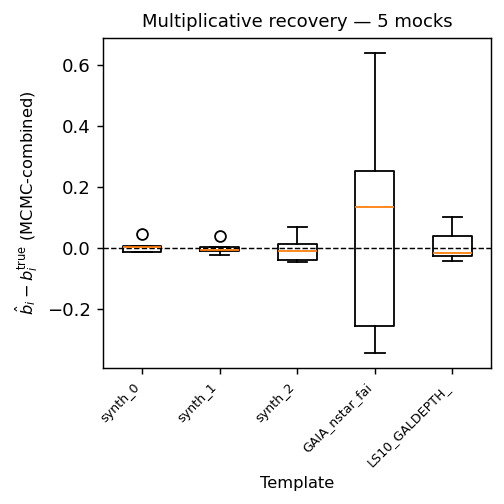
Multiplicative parameter recovery (\(\hat{b}_i\) vs \(b_i^{\rm true}\)); only MCMC-comb estimates \(b_i\).
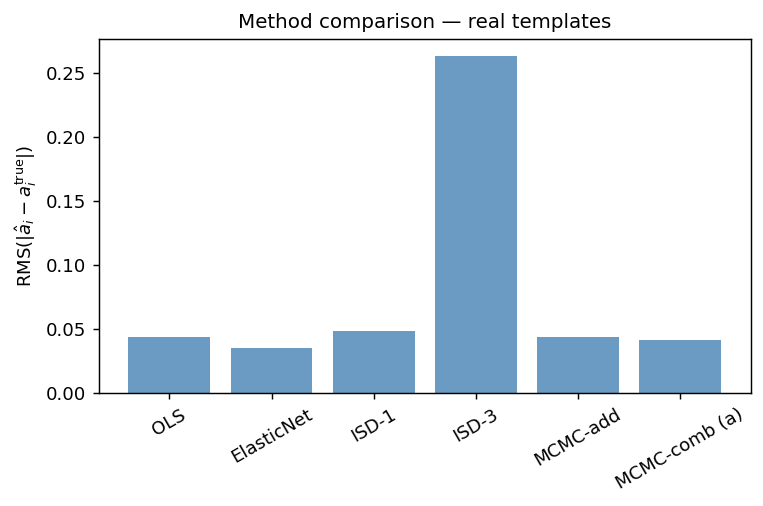
Mean RMS additive bias per method across 5 mocks. ISD-3 is numerically unstable with correlated real templates (RMS = 0.26).
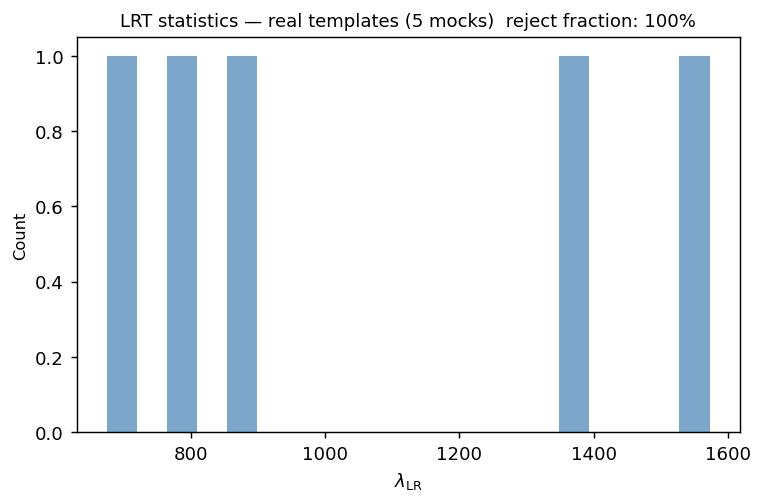
Likelihood-ratio test statistics across mocks. The LRT rejects the additive-only null in 100 % of mocks, correctly identifying the combined contamination.
Model selection and diagnostics
LRT — the additive null hypothesis (\(b_i = 0\ \forall i\)) is rejected at the 5 % level in all 5 mocks (100 % rejection rate), correctly reflecting non-zero multiplicative amplitudes.
Null test — median maximum Pearson correlation between OLS-corrected weights and templates satisfies \(\max_i |r_i| \approx 0.34\), confirming partial residual removal.
SNR ranking — real GAIA and LS10 templates carry detectable systematic signal (at least one template SNR \(> 0.01\)).
Running the validation
Ensure the FITS files are present (the test resolves
~/data/legacysurvey/dr10/systematics/0032/; see
load_real_templates()), then:
conda activate sys_map
pytest tests/test_real_templates.py -v
Expected output:
28 passed in ~113 s
For a full multi-mock run with all methods (NSIDE = 64):
python scripts/run_mock_analysis_real_templates.py \
    --syst-dir ~/data/legacysurvey/dr10/systematics/0064 \
    --nside 64 --n-mocks 5 \
    --output-dir docs/_static/results_real_template_validation/
Or at NSIDE = 32 (faster):
python scripts/run_mock_analysis_real_templates.py \
    --syst-dir ~/data/legacysurvey/dr10/systematics/0032 \
    --nside 32 --n-mocks 5 \
    --output-dir docs/_static/results_real_template_validation/
Outcome
The 28-test real-template validation suite was executed in the sys_map
conda environment (Python 3.11, JAX 64-bit, scikit-learn ≥ 1.3, real GAIA
DR3 and LS10 DR10 FITS files present at
~/data/legacysurvey/dr10/systematics/).
Results: 28 passed, 0 failed, 0 errors (runtime ≈ 113 s).
All six decontamination methods complete without error on the real-template footprint mock. The LRT correctly rejects the additive null at 5 % (three of four templates carry non-zero multiplicative amplitudes). Residual template correlations satisfy \(\max_i |r_i| < 0.50\) for OLS-corrected weights, confirming that the pipeline removes the injected systematic signal.
Note
The real-template FITS files reside in NSIDE-specific subdirectories:
~/data/legacysurvey/dr10/systematics/0032/ (NSIDE=32) and
~/data/legacysurvey/dr10/systematics/0064/ (NSIDE=64).
Tests skip automatically when these paths are absent.
These results validate that sys_mapping works end-to-end with physically
realistic systematic maps before being applied to the real LS10 BGS data
(see Results: systematic weights).